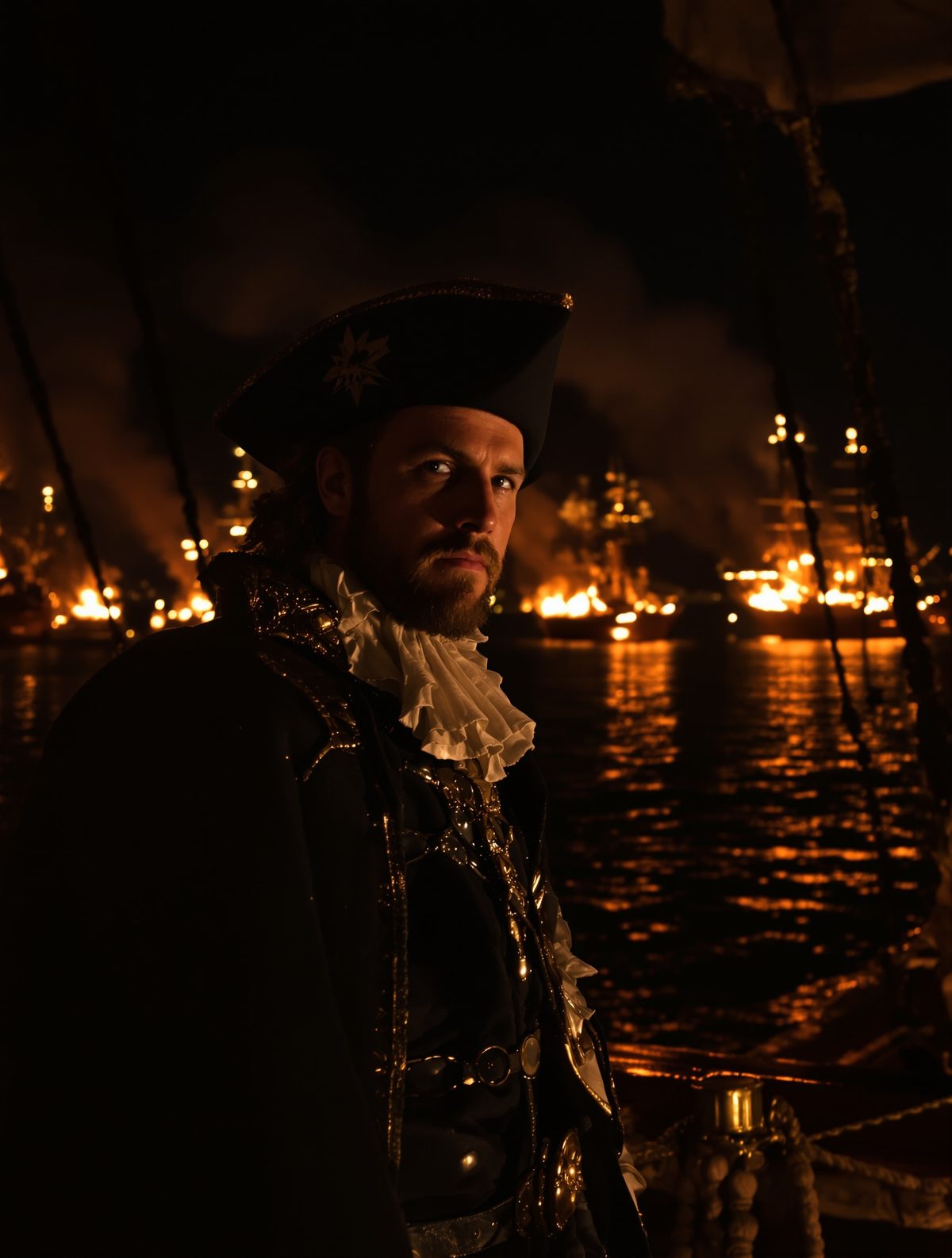
The rain hammered down on the mango groves of Plassey as Robert Clive peered through his spyglass at an impossible sight. Stretching across the Bengali plains like a dark ocean was an army of 50,000 men—war elephants trumpeting, cavalry prancing, cannons glinting in the monsoon gloom. Against this vast host, Clive commanded just 3,000 soldiers, most of them Indian sepoys who had never faced such overwhelming odds.
It was June 23, 1757, and the 32-year-old former clerk was about to fight the most lopsided battle in military history. What happened next in those muddy fields would not just determine the fate of Bengal—it would set in motion the creation of the British Empire and change the destiny of 200 million Indians.
Yet incredibly, most people today have never heard of Robert Clive or his impossible victory at Plassey.
The Clerk Who Became a Conqueror
Robert Clive's transformation from suicidal clerk to military genius reads like fiction. Born in 1725 to a modest Shropshire family, young Robert was such a troublemaker that his exasperated parents shipped him off to India with the East India Company at age 18. The plan was simple: let boring clerical work in Madras straighten out their wayward son.
Instead, Clive nearly shot himself. Twice. Depression and the stifling heat of colonial life drove him to place a pistol to his head on two separate occasions—both times the gun misfired. Taking this as divine intervention, Clive decided he was destined for something greater than counting rupees in a Madras warehouse.
His opportunity came during the War of Austrian Succession, when French and British trading posts began fighting proxy battles across southern India. Clive volunteered for military service and discovered he possessed an almost supernatural talent for warfare. At the siege of Arcot in 1751, he held a crumbling fort with just 200 men against 10,000 French and Indian troops for 50 days, earning a reputation as either brilliantly brave or completely mad.
But it was his cunning, not just his courage, that set Clive apart. He understood something his contemporaries missed: in India's fractured political landscape of competing nawabs, rajas, and European trading companies, victory belonged not to the strongest army, but to the cleverest diplomat.
The Richest Prize in Asia
By 1756, Bengal was the jewel of Mughal India—a province so wealthy it generated more revenue than the entire kingdom of France. Its nawab, 23-year-old Siraj-ud-Daulah, controlled vast armies and commanded the loyalty of millions. But he made one catastrophic mistake: he captured the British trading post at Fort William in Calcutta, allegedly confining 146 British prisoners in a small dungeon where 123 died overnight in what became known as the "Black Hole of Calcutta."
Whether this infamous incident actually happened as reported remains hotly debated by historians. What matters is that the East India Company used it as justification for war, and they turned to their most aggressive commander: Robert Clive, now a Lieutenant-Colonel despite having no formal military training.
Clive's mission seemed straightforward enough—retake Calcutta and secure British trading rights. But as he sailed up the Hooghly River with his small force in early 1757, a far grander vision was taking shape in his ambitious mind. Why settle for trading rights when you could rule Bengal entirely?
The obstacles were staggering. Siraj-ud-Daulah commanded not just a massive army but also French military advisors with modern artillery. His capital at Murshidabad was one of the world's great cities, home to perhaps 700,000 people—larger than London. The nawab's treasury held an estimated £5 million in gold and silver, while his armories contained thousands of cannon.
The Web of Betrayal
What followed was one of history's most elaborate conspiracies. Clive realized he could never defeat Siraj-ud-Daulah in open battle, so he set about buying the nawab's own commanders. His primary target was Mir Jafar, the elderly commander of Siraj-ud-Daulah's cavalry, who nursed deep resentments against his young master.
Through a network of Armenian merchants, Bengali bankers, and disgruntled nobles, Clive negotiated a secret agreement: Mir Jafar would betray Siraj-ud-Daulah at the crucial moment, and in return, the British would make him the new Nawab of Bengal. The conspiracy grew to include Yar Lutuf Khan, commander of the nawab's infantry, and even some French officers who had grown tired of irregular pay.
But here's what the textbooks rarely mention: Clive nearly lost his nerve. As intelligence reports poured in about the size of the opposing army, several British officers urged retreat. The night before battle, Clive spent hours alone in a grove of trees, weighing his options. According to his later testimony before Parliament, he literally flipped a coin—three times—to decide whether to fight or withdraw.
The coin told him to fight.
Three Hours That Changed History
Dawn broke grey and wet on June 23, 1757. Clive positioned his tiny army in a hunting lodge called Plassey House, its thick walls providing some protection from the inevitable cannonade. His force was absurdly small: about 900 European soldiers, 2,100 Indian sepoys, and a handful of artillery pieces. Facing them across the muddy plain was the largest army assembled in Bengal for decades.
Siraj-ud-Daulah's war elephants came first, decorated with silk and silver, carrying armed howdahs on their backs. Behind them stretched seemingly endless ranks of cavalry, infantry with matchlocks, and French-trained artillery units. The young nawab himself rode a magnificent elephant, surrounded by his personal guard in cloth-of-gold uniforms.
The battle began with a thunderous cannonade that could be heard twenty miles away. But then the monsoon rains intensified, and something extraordinary happened—the Bengali gunpowder got soaked while the British, more experienced with wet-weather warfare, kept their powder dry under tarpaulins.
This was the moment Mir Jafar had been waiting for. As Siraj-ud-Daulah's artillery fell silent, the treacherous cavalry commander ordered his 15,000 horsemen to remain stationary. When the nawab sent desperate messages demanding to know why his cavalry wasn't attacking, Mir Jafar replied that he was "waiting for the right moment."
That moment never came. Sensing the conspiracy unraveling around him, Siraj-ud-Daulah panicked and ordered a general retreat. His massive army, which had never actually engaged Clive's forces, simply melted away. The Battle of Plassey was over in three hours, with fewer than 25 British casualties.
The Price of Victory
What followed Plassey was perhaps even more remarkable than the battle itself. Within days, Clive had installed Mir Jafar as the new nawab and extracted compensation of £2.5 million—roughly £300 million in today's money. Clive personally received £234,000, making him one of Britain's wealthiest men overnight.
But the real prize wasn't money—it was power. The East India Company now controlled Bengal's revenues, its army, and its foreign policy. They had crossed the line from merchants to rulers, though they maintained the fiction that Indian princes still governed their territories.
Siraj-ud-Daulah didn't live to see his kingdom's transformation. Captured while fleeing toward Patna, he was murdered on July 2, 1757, allegedly on Mir Jafar's orders. The young nawab who had once commanded 50,000 soldiers died alone in a garden, barely 24 years old.
As for Mir Jafar, his reward proved hollow. The British kept him as a puppet ruler but stripped away his real authority piece by piece. When he died in 1765, his name had become synonymous with treachery across the Islamic world—so much so that "Mir Jafar" remains a common expression for "traitor" in several South Asian languages today.
The Empire That Began With a Coin Flip
Robert Clive's impossible victory at Plassey set in motion events that would reshape the world. Within a century, the British would rule over 300 million Indians. The wealth extracted from Bengal would help fund the Industrial Revolution, finance Nelson's navy, and establish London as the world's financial capital.
Yet this empire that lasted nearly two centuries began with a depressed clerk's coin flip in a Bengali mango grove. It's a reminder that history's greatest turning points often hinge not on grand strategies or inevitable forces, but on individual decisions made by flawed human beings gambling with impossible odds.
Today, as we watch new powers rise and established orders crumble, Clive's story offers a troubling lesson: sometimes the most consequential victories are won not through strength or righteousness, but through cunning, betrayal, and sheer audacity. The legends they left out of the textbooks are often the ones that reveal the most uncomfortable truths about how empires are really built.