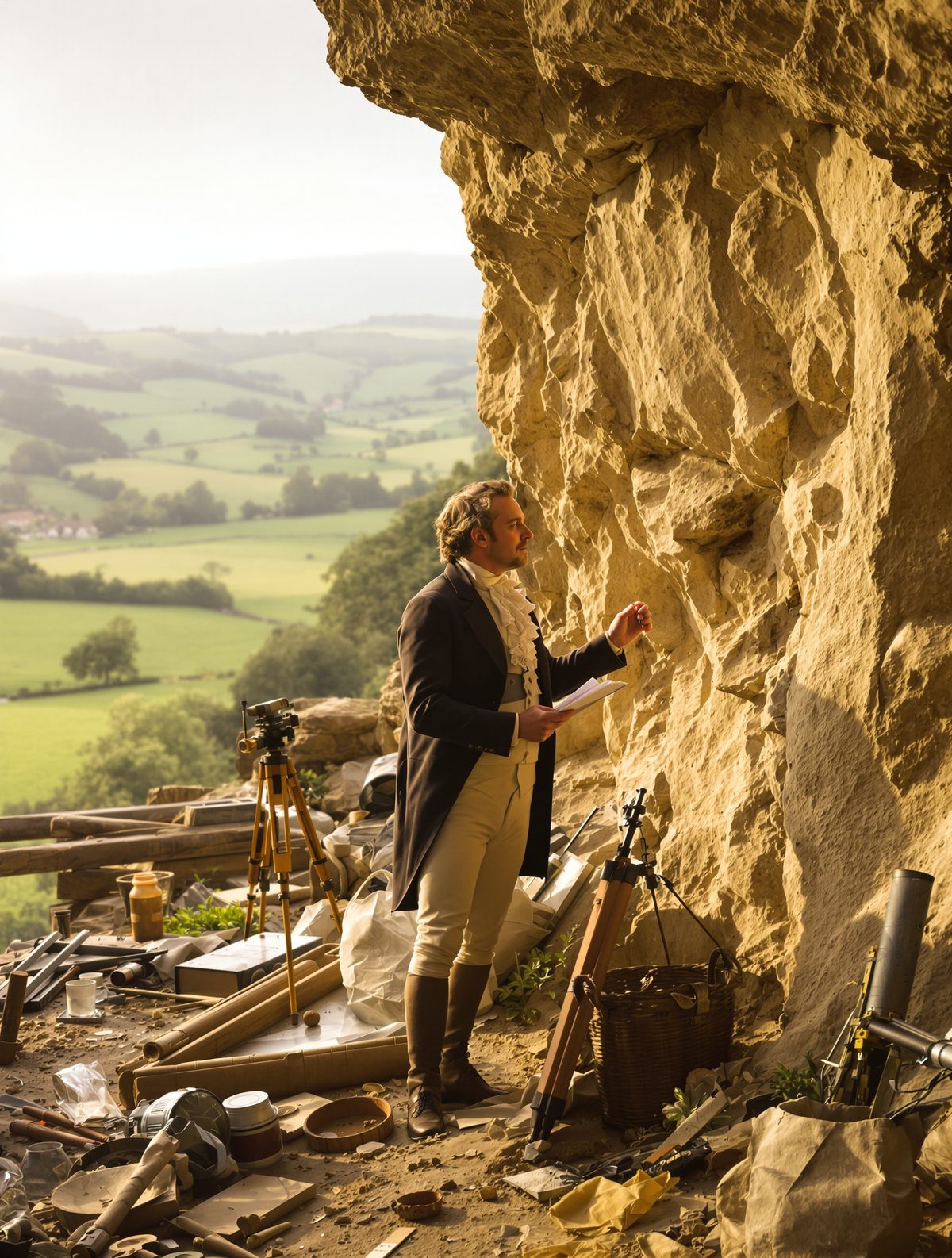
Picture this: a muddy canal digger crouches in a ditch somewhere in the English countryside, rain dripping from his hat brim as he examines a handful of earth. To most people, it's just dirt. But William Smith sees something extraordinary—a story written in stone that stretches back hundreds of millions of years. The year is 1799, and this blacksmith's son from a tiny Oxfordshire village is about to revolutionize our understanding of the world beneath our feet.
What Smith discovered in those muddy trenches would become one of the most important scientific breakthroughs of the Georgian era. Yet unlike the gentleman scientists of his day—men with university educations and wealthy patrons—Smith was a working-class surveyor whose laboratory was the rough, dangerous world of Britain's expanding canal network.
The Blacksmith's Son Who Read the Earth
William Smith was born in 1769 in Churchill, a village so small it barely warranted a dot on most maps. His father died when William was just eight, leaving the family in modest circumstances. But young Smith had an unusual hobby that would change everything: he collected what locals called "poundstones"—fossils that littered the Oxfordshire countryside.
While other boys played with marbles, Smith studied the strange spiral shells and ancient sea creatures embedded in the local limestone. His uncle, who raised him after his father's death, was wise enough to apprentice the curious boy to Edward Webb, a local surveyor. It was a decision that would literally reshape our understanding of Earth's history.
By his early twenties, Smith had mastered the art of surveying, but it was the canal boom of the 1790s that would provide him with an unprecedented opportunity. Britain was gripped by "canalmania"—a frenzy of waterway construction that promised to revolutionize transport and trade. The Somerset Coal Canal Company hired Smith in 1793 to survey routes and oversee construction. What they got was much more than they bargained for.
Eureka in a Coal Mine
The breakthrough came in 1796, deep in the Mearns Pit colliery near High Littleton. Smith was examining the layers of rock exposed by the mine workings when he noticed something that would have escaped most observers. The rock layers—what geologists call strata—weren't randomly arranged. They appeared in the same sequence everywhere he looked, like pages in a book written by time itself.
Even more remarkable, each layer contained its own distinctive collection of fossils. Smith realized he could identify any rock layer simply by examining the fossils it contained—a principle he would later call the "succession of strata identified by organized fossils." In less technical terms, he had discovered that fossils were nature's timestamps, allowing him to date rocks with unprecedented accuracy.
This was revolutionary thinking. In 1796, most educated people still believed the Earth was only about 6,000 years old, created in six days as described in Genesis. Smith's observations suggested something far more dramatic—that the Earth was unimaginably ancient, and that life had changed dramatically over vast periods of time. He was developing ideas that would later influence Charles Darwin, though Smith himself wasn't particularly concerned with the theological implications of his discoveries.
Walking Every Mile of England
Armed with his earth-shaking insight, Smith embarked on what must rank as one of the most ambitious solo research projects in scientific history. For fifteen years, from 1794 to 1815, he walked virtually every mile of England and Wales, often covering 10,000 miles per year on foot and horseback.
Smith's fieldwork was grueling and dangerous. He clambered down mine shafts, scrambled up cliff faces, and waded through marshlands, all while making meticulous notes about the rocks beneath his feet. He examined quarries, road cuts, and canal excavations, building up a three-dimensional picture of Britain's geological structure that no one had ever attempted before.
His notebooks from this period reveal an almost obsessive attention to detail. Near Bath, he noted: "Fuller's Earth Rock, lies under the upper beds of stone, and appears at Combe Down... contains Ostrea and other shells." Each observation was another piece of evidence for his grand theory that England's geology followed predictable, mappable patterns.
The work was lonely and often thankless. Smith frequently slept in hedgerows or cheap inns, funding his research from his modest surveyor's income. His contemporaries thought him eccentric at best, obsessed at worst. But Smith pressed on, driven by an almost mystical certainty that he was uncovering something profound about the nature of the Earth itself.
The Map That Changed Everything
On August 1st, 1815, after two decades of painstaking work, Smith finally published his masterpiece: "A Delineation of the Strata of England and Wales, with part of Scotland." Measuring eight feet by six feet and hand-colored with watercolors, it was the first geological map of an entire country ever produced.
The map was breathtakingly beautiful and scientifically revolutionary in equal measure. Different rock formations were shown in distinct colors—the red Devonian sandstones of the southwest, the grey Jurassic limestones of the Cotswolds, the dark Carboniferous rocks of the industrial north. For the first time, anyone could see the hidden architecture of Britain laid bare.
Smith priced his maps at five guineas each—roughly £500 in today's money—hoping to recoup some of his massive investment. But the map was too radical, too expensive, and too far ahead of its time. Only a few hundred copies sold, leaving Smith nearly bankrupt. In 1819, he was briefly imprisoned for debt, a humiliating end to years of pioneering work.
Yet the map's scientific impact was immediate and profound. Geologists across Europe recognized that Smith had created something unprecedented—a new way of understanding the Earth that combined rigorous observation with bold theoretical insight. The London Geological Society, which had initially ignored Smith's work, began to realize what they had overlooked.
Recognition at Last
Smith's vindication came slowly but surely. In 1831, sixteen years after his map's publication, the Geological Society of London awarded him their first Wollaston Medal, finally recognizing him as the "Father of English Geology." The society's president, Reverend Adam Sedgwick, praised Smith's work in terms that must have seemed like sweet justice: "He has made a map which will be imperishable."
The irony wasn't lost on contemporary observers. Here was a working-class surveyor who had been honored by the same scientific establishment that had initially dismissed him. Smith had succeeded where university-trained geologists had failed, proving that careful observation could trump formal education.
By the 1830s, Smith's methods were being used across the globe. His principle of biological succession became fundamental to geological science, enabling the discovery of coal deposits, oil reserves, and mineral wealth that would fuel the Industrial Revolution and beyond.
A Legacy Written in Stone
William Smith died in 1839, just as the Victorian era was dawning. He lived long enough to see his methods transform geology from a gentleman's hobby into a rigorous science. More importantly, he had fundamentally changed humanity's relationship with time itself.
Before Smith, history was measured in thousands of years. After his map, we began to think in terms of millions and hundreds of millions of years. The Earth Smith revealed wasn't the stable, unchanging creation described in scripture, but a dynamic, evolving planet with an almost incomprehensibly deep history.
Today, every geological survey, every oil exploration, every search for mineral resources builds on principles that Smith established in those muddy canal trenches. GPS satellites and computer modeling have replaced his walking boots and hand-drawn maps, but the fundamental insight remains the same: the Earth tells its own story, if only we know how to read it.
Perhaps most remarkably, Smith achieved all this without any formal scientific training, university degree, or wealthy patron. He proves that revolutionary discoveries can come from the most unexpected places—that sometimes the most profound insights belong not to those who study the world from ivory towers, but to those who get their hands dirty in its depths. In our age of increasing specialization, William Smith reminds us that curiosity, persistence, and careful observation can still change the world.