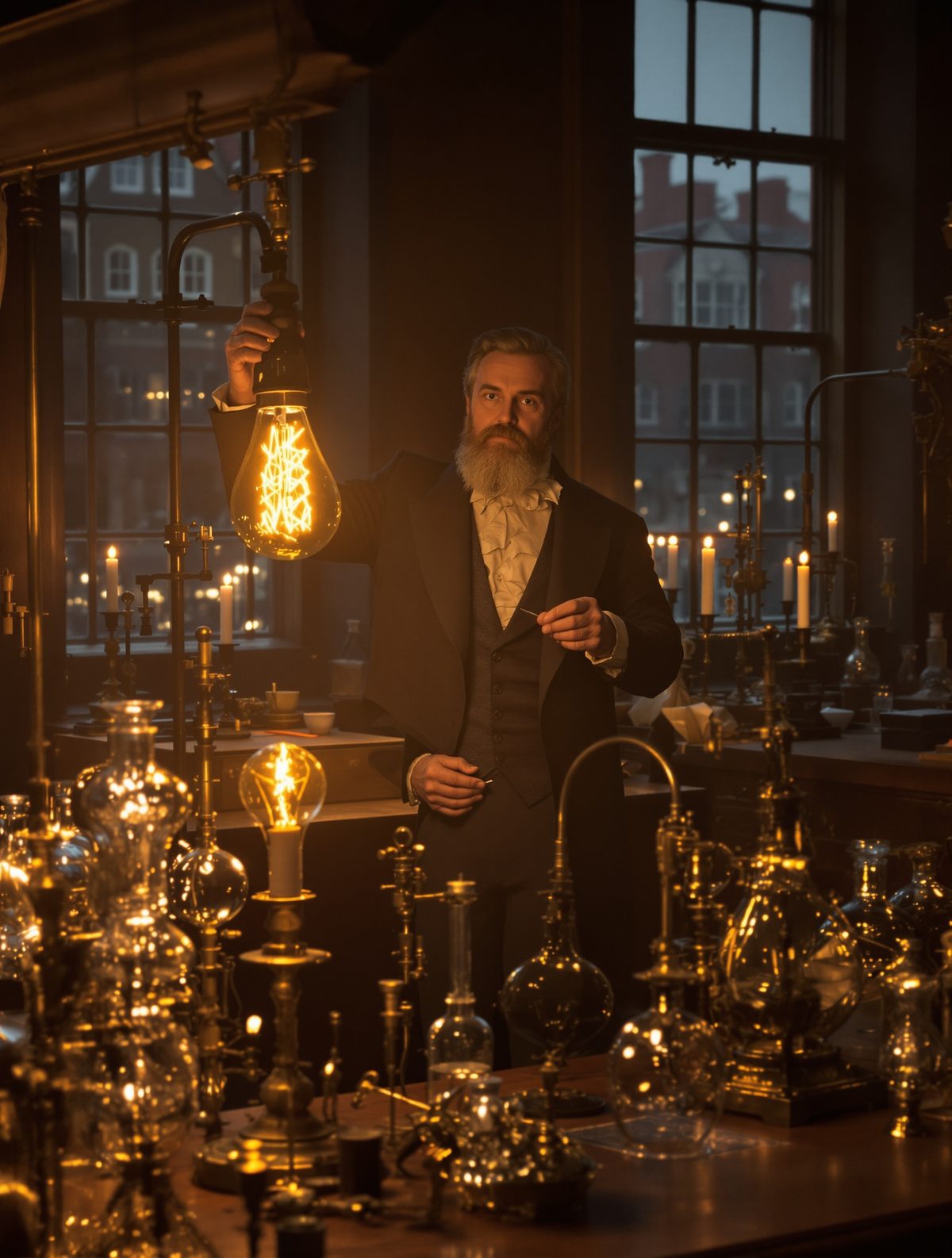
The gas lamps flickered weakly in the February darkness of Newcastle as Joseph Swan made his way to his modest laboratory on Mosley Street. It was 1879, and the bitter Tyneside wind cut through the industrial city like a blade. Inside his cluttered workshop, surrounded by glass tubes, coils of wire, and the acrid smell of experimental chemicals, Swan was about to change the world. He didn't know it yet, but in a few hours, he would beat Thomas Edison in the race that would define the modern age.
As Swan's fingers moved carefully across his latest creation—a delicate carbon filament sealed inside a glass bulb—history held its breath. This wasn't just another failed experiment. This was the night that Britain quietly won the race to light the world, ten months before Edison's celebrated demonstration would make headlines across America.
The Forgotten Pioneer of Mosley Street
Joseph Wilson Swan was an unlikely revolutionary. Born in Sunderland in 1828, he began his career as a chemist's apprentice before setting up his own practice in Newcastle. While Edison was building his reputation as the "Wizard of Menlo Park" with a team of assistants and unlimited funding, Swan worked largely alone, driven by curiosity rather than commercial ambition.
Swan had been tinkering with electric lighting since the 1860s—nearly two decades before that fateful February night. His early experiments used strips of carbonized paper as filaments, enclosed in glass bulbs from which he painstakingly removed the air. The challenge wasn't just making the filament glow; it was making it glow consistently without burning out in seconds.
What most people don't realize is that Swan had actually demonstrated a working incandescent lamp as early as 1878 at a meeting of the Newcastle Chemical Society. But those early bulbs were unreliable, lasting only a few hours at best. The scientific community was politely interested but hardly electrified. Swan knew he needed something more spectacular, something that would prove electric light could be practical for everyday use.
The Night That Changed Everything
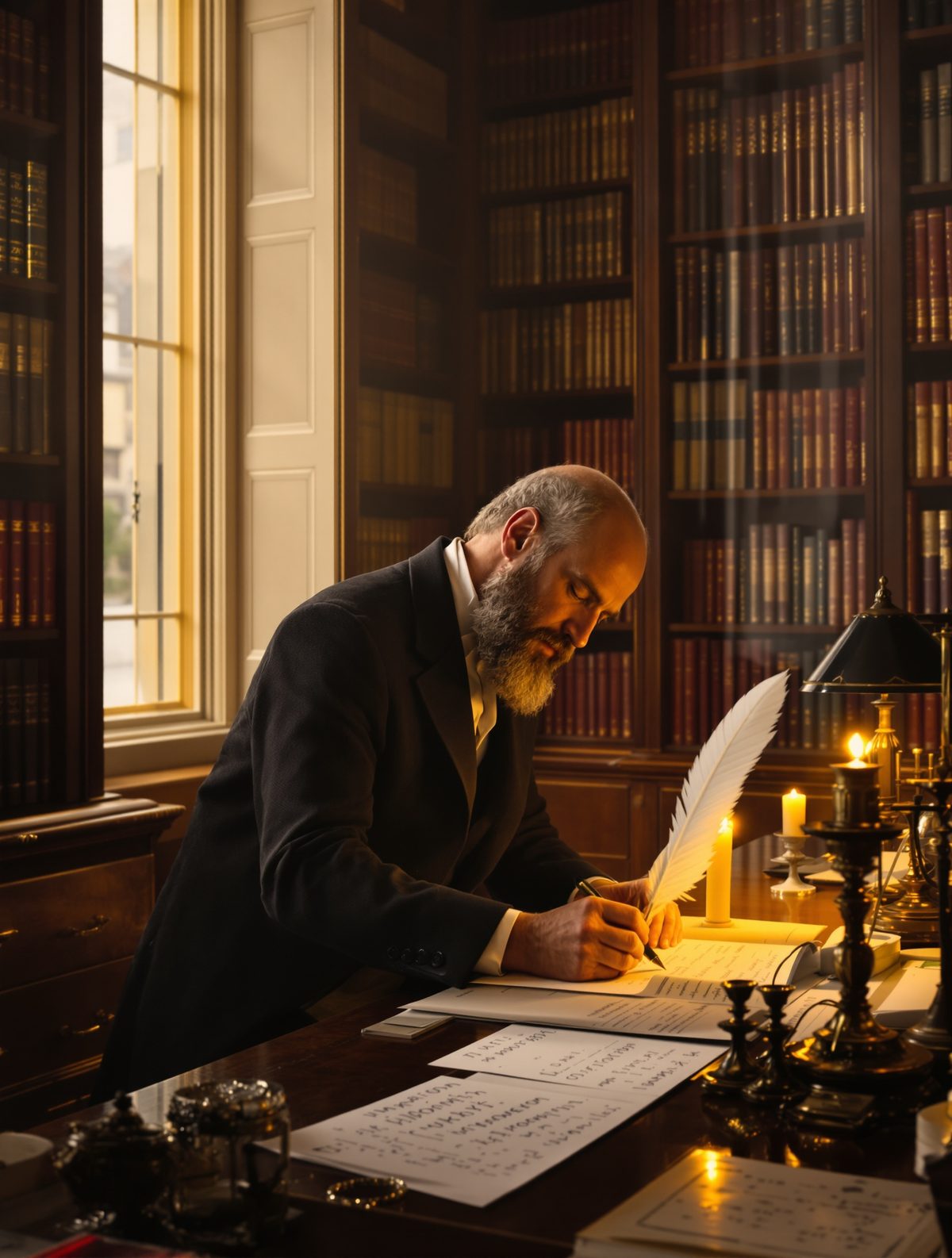
February 3rd, 1879. The date should be as famous as July 4th, 1776, but it's been relegated to footnotes in history books. Swan had spent weeks perfecting his latest filament—a thread of cotton carefully carbonized in his laboratory oven until it became a delicate strand of pure carbon, thinner than a human hair but stronger than steel wire.
As evening fell over Newcastle, Swan sealed his new filament into a glass bulb. Using his improved vacuum pump, he extracted nearly all the air, creating the near-perfect vacuum that would allow his filament to glow without burning. The electrical connections were checked and double-checked. Everything had to be perfect.
At precisely 8 PM, Swan closed the circuit. The filament began to glow with a warm, steady light that filled his laboratory with an almost magical radiance. But this time was different. The light didn't flicker and die within minutes or hours. It burned steadily through the night, casting its golden glow on Swan's notes and equipment for an incredible thirteen continuous hours.
By 9 AM the following morning, when Swan finally switched off his lamp, he had achieved what no one else in the world had managed: a practical, long-lasting electric light bulb. The industrial revolution had just taken its next giant leap forward, and it happened not in the workshops of America's most famous inventor, but in a modest laboratory in the heart of England's industrial northeast.
While Edison Struggled Across the Atlantic
Here's what makes Swan's achievement even more remarkable: while his light burned steadily through that February night in Newcastle, Thomas Edison was still struggling with fundamental problems in his Menlo Park laboratory. Edison's early experiments with platinum filaments had proven frustratingly unsuccessful—platinum was expensive and had an annoying tendency to melt at high temperatures.
Edison wouldn't achieve his own breakthrough until October 21st, 1879—more than eight months after Swan's success. Even then, Edison's first successful bulb burned for only 13.5 hours, barely outlasting Swan's February demonstration. The great irony is that Edison's eventual success came from using carbonized cotton thread—essentially the same solution Swan had pioneered months earlier.
But Edison had something Swan lacked: a genius for publicity and business. While Swan quietly continued his experiments, Edison orchestrated a media sensation. On December 31st, 1879, Edison staged a spectacular public demonstration at Menlo Park, with dozens of electric lights illuminating the grounds and hundreds of visitors marveling at the electric wonderland. Newspapers across America and Europe proclaimed Edison the inventor of the light bulb, and the myth was born.
The Battle for Britain's Streets
Swan wasn't content to let Edison claim all the glory. By 1880, he had formed the Swan Electric Light Company and was installing electric lighting throughout Britain. The Savoy Theatre in London became the first public building in the world to be entirely lit by electricity, using Swan's incandescent bulbs. The opening night on October 10th, 1881, was a sensation—1,200 Swan electric lamps bathed the theater in brilliant white light, shocking audiences accustomed to dim gas lighting.
Even more impressive was Swan's installation at Cragside, the Northumberland home of industrialist William Armstrong. In 1878—a full year before Edison's famous demonstration—Swan had already installed electric lighting powered by a hydroelectric generator, making Cragside the world's first house to be lit by hydroelectric power. Visitors described walking through rooms that seemed to glow with captured sunlight, controlled by mysterious switches on the walls.
The speed of Swan's success was breathtaking. By 1881, his company was manufacturing 100,000 light bulbs per year. Streets across Newcastle, Liverpool, and London began to glow with electric light, while Edison was still fighting patent battles and struggling to establish his first commercial installations in New York.
The Gentleman's Agreement That History Forgot
The story takes a fascinating turn in 1883, when the two inventors found themselves locked in a bitter patent dispute. Both men claimed to be the true inventor of the incandescent light bulb, and both had legitimate grounds for their claims. The legal battle could have raged for years, enriching only the lawyers while stifling the growth of electric lighting.
Instead, something remarkable happened. Rather than fight each other to exhaustion, Swan and Edison decided to join forces. In 1883, they formed Edison & Swan United Electric Light Company—known as "Ediswan"—combining their patents and expertise. It was a gentleman's agreement between two brilliant inventors who realized they could achieve more together than apart.
But here's the detail that most history books miss: the merger was actually Swan's idea, proposed during a cordial meeting in London. Swan, ever the gentleman scientist, was more interested in advancing electric lighting than in claiming personal glory. Edison, the shrewd businessman, recognized a good deal when he saw one. Together, they would dominate the early electric lighting industry across Europe.
The Light That Still Shines
Why does Swan's story matter today, in an age when we take electric light for granted? Because it reminds us that innovation rarely follows the neat narratives we see in textbooks. History is messy, collaborative, and often surprisingly unfair. The most important breakthroughs don't always come from the most famous names or the best-funded laboratories.
Swan's thirteen-hour vigil in Newcastle represents something profoundly human: the quiet persistence of a curious mind, working alone in a modest workshop, driven by the simple desire to solve a problem. While Edison was building his reputation and organizing his team of assistants, Swan was hunched over his workbench, patiently carbonizing cotton threads and testing vacuum pumps, inching closer to illumination one experiment at a time.
Today, as we debate who "really" invented the smartphone, the internet, or artificial intelligence, Swan's story offers a gentle reminder that innovation is rarely the product of a single genius having a sudden inspiration. It's usually the result of countless people building on each other's work, sharing ideas, and gradually pushing the boundaries of what's possible.
The next time you flip a light switch, spare a thought for that February night in 1879, when a Newcastle chemist worked through the darkness to bring light to the world. Joseph Swan may not have won the fame, but he won something more valuable: he solved one of humanity's oldest problems and lit the path to the modern age. The bulb that glowed for thirteen hours in a modest laboratory on Mosley Street was more than just a successful experiment—it was the first flicker of the electric century that was about to begin.