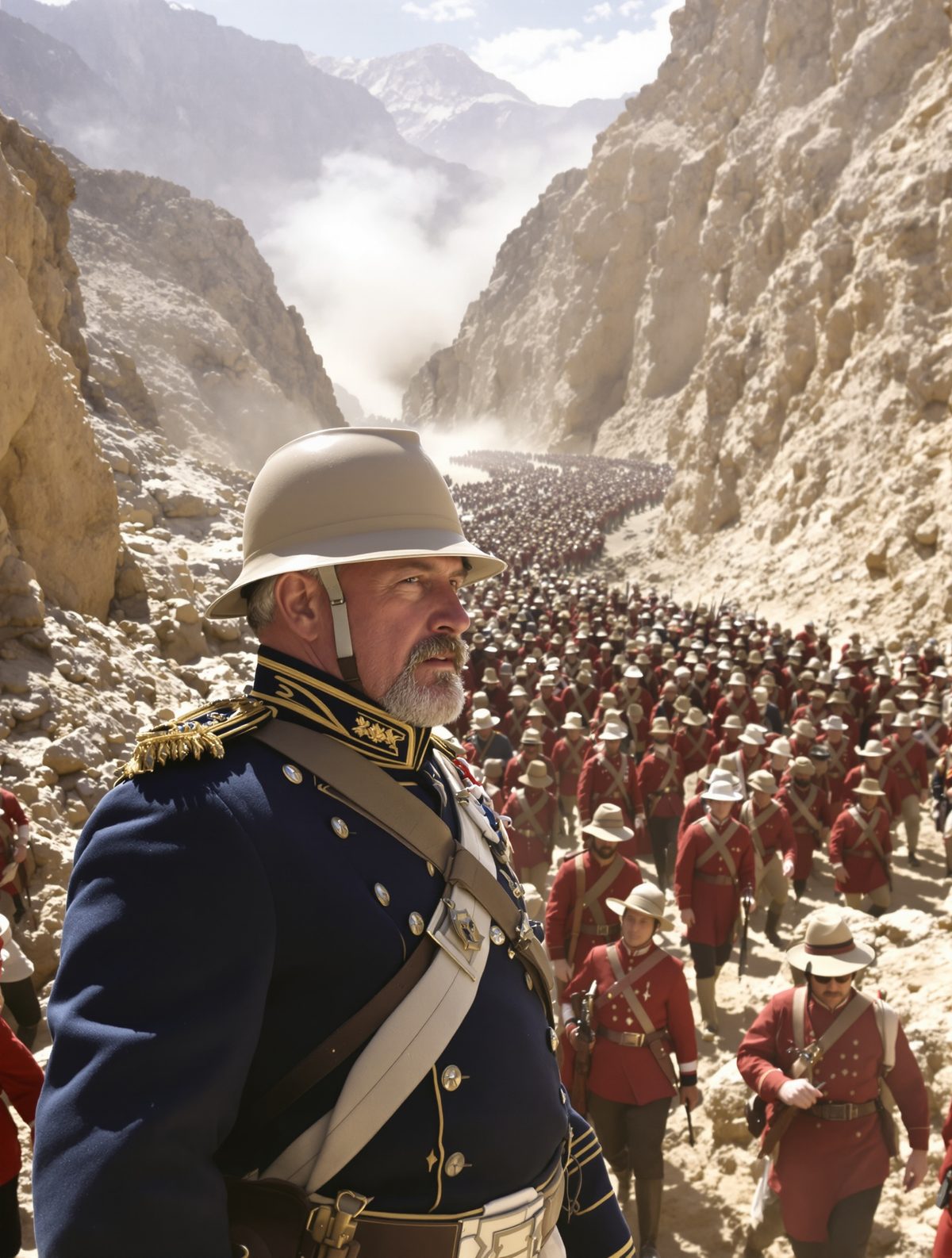
The morning sun blazed mercilessly over the Strait of Gibraltar on August 1st, 1704, as Admiral George Rooke's war-weary fleet limped toward what appeared to be certain disaster. His mission to capture Barcelona had failed spectacularly. His political enemies in London were sharpening their knives. And now, staring up at the 1,400-foot limestone monolith that the Spanish called "Jabal Tariq"—the Mountain of Tariq—Rooke was about to attempt something that would either save his career or end it in thunderous ruin.
What happened next would reshape the balance of power in Europe for centuries to come. In just six brutal hours, a ragtag force of 1,800 marines would crack open the most strategically vital fortress in the Mediterranean—and Britain would never give it back.
The Gambler's Last Throw
Admiral Sir George Rooke was not a man accustomed to failure. At 54, he had already distinguished himself in battles against the French and Dutch, earning a reputation for aggressive tactics and unshakeable nerve. But the summer of 1704 had been a parade of humiliations. His grand plan to seize Barcelona for Archduke Charles—the Habsburg claimant to the Spanish throne—had crumbled when Spanish resistance proved fiercer than expected.
Now, sailing back toward England with nothing to show for months of campaigning, Rooke faced the prospect of court-martial and disgrace. That's when his eyes fell upon Gibraltar's massive bulk, crowned by the imposing fortress known as the Castle of the Moors. Here was the guardian of the gateway between Atlantic and Mediterranean—a prize so magnificent that capturing it might transform disaster into triumph.
The idea seemed preposterous. Gibraltar had been in Spanish hands for nearly 250 years. Its fortress walls rose like natural extensions of the living rock itself. Spanish engineers had spent decades perfecting its defenses, mounting cannon that could blast any approaching fleet to splinters. Yet Rooke's intelligence suggested something tantalizing: the garrison was surprisingly small, perhaps fewer than 150 soldiers plus local militia.
On July 31st, Rooke made his fateful decision. He would stake everything on a single, audacious assault.
The Iron Fist of Admiral Byng
While Rooke commanded the overall expedition, the actual assault fell to his subordinate, Admiral Sir George Byng—a man whose very name would become synonymous with naval warfare. Byng surveyed Gibraltar's defenses with the calculating eye of a master tactician. The fortress might look impregnable, but he spotted a crucial weakness: its cannon were positioned primarily to defend against attack from the west, not the south where his fleet now anchored.
At dawn on August 4th, Byng unleashed hell. Fifteen thousand cannon balls screamed across the water in the opening barrage—a thunderous symphony of destruction that shattered windows across the strait in Moroccan Ceuta, twelve miles away. The bombardment was so intense that Spanish witnesses later described the Rock as being "wrapped in flame and smoke like a volcano."
But Byng's masterstroke wasn't just the naval bombardment. As his ships pounded the fortress walls, 1,800 marines under Captain Edward Whitaker splashed ashore at the narrow isthmus connecting Gibraltar to the Spanish mainland. Here lay the key to victory: the Devil's Tower, an isolated fortification guarding the landward approaches. If they could take it, they could storm the town itself.
Marines Against the Inferno
What followed was a scene from Dante's Inferno. Captain Whitaker's marines charged across the narrow neck of land under a withering hail of Spanish musket fire. The summer heat was so brutal that men collapsed from heatstroke even as enemy bullets whistled around them. Yet within hours, they had seized the Devil's Tower and turned its own guns against the Spanish defenders.
The Spanish garrison, commanded by Captain Diego de Salinas, fought with desperate courage. But they faced an impossible situation. With Byng's fleet hammering them from the sea and Whitaker's marines advancing from the land, they were caught in a crushing vise. By noon, Spanish resistance was crumbling like the ancient fortress walls under British cannon fire.
Here's what the textbooks rarely mention: the Spanish weren't just outgunned—they were betrayed by their own townspeople. Many of Gibraltar's 6,000 residents were traders who had grown wealthy from Mediterranean commerce. They understood that prolonged resistance would reduce their prosperous port to rubble. When British marines breached the outer defenses, prominent citizens actually opened negotiations to surrender the town.
Six Hours That Shook Europe
By 2 PM on August 4th, it was over. Captain Salinas, his ammunition exhausted and his walls reduced to smoking ruins, raised the white flag. In just six hours, Britain had captured what Spain had considered the most secure fortress in the western Mediterranean. The cost was remarkably light: fewer than 100 British casualties against Spanish losses in the hundreds.
But the true magnitude of Rooke's victory only became clear in the following weeks. French and Spanish forces, recognizing the catastrophic implications, launched a furious counterattack. For months, British marines clung to their prize as enemy armies besieged them by land and sea. The siege reached its climax in February 1705, when French engineers tunneled beneath British positions and detonated massive mines that literally shook the Rock.
Yet the Union Jack still flew from Gibraltar's ramparts. Admiral Sir John Leake had fought through a Franco-Spanish fleet to resupply the garrison, and the marines had held every position that mattered. Spain's last hope of reclaiming the fortress died in the rubble of that final assault.
The Price of Forever
When diplomats gathered to end the War of Spanish Succession with the Treaty of Utrecht in 1713, Gibraltar was Britain's non-negotiable demand. Spain could keep its American empire, France could retain most of its European territories, but the Rock would remain forever British. Article X of the treaty proclaimed it "in perpetuity"—and nearly 320 years later, that promise still holds.
What Rooke and his marines couldn't have imagined was how their desperate gamble would reshape global history. Gibraltar became Britain's master key to the Mediterranean, enabling British fleets to project power from India to Italy. During World War II, Hitler himself called Gibraltar "the most dangerous British position in the world"—and launched multiple plots to capture it.
Today, as Brexit negotiations continue to complicate Gibraltar's relationship with both Britain and Spain, Rooke's conquest remains as controversial as ever. The 30,000 Gibraltarians who call the Rock home are still fighting to preserve the independence that those 1,800 marines won for them on a blazing August morning three centuries ago.
In an age when military victories are measured in months or years, it's worth remembering that sometimes six hours can change the world forever. Admiral Rooke gambled everything on one impossible assault—and won a prize that Britain has never been willing to surrender.