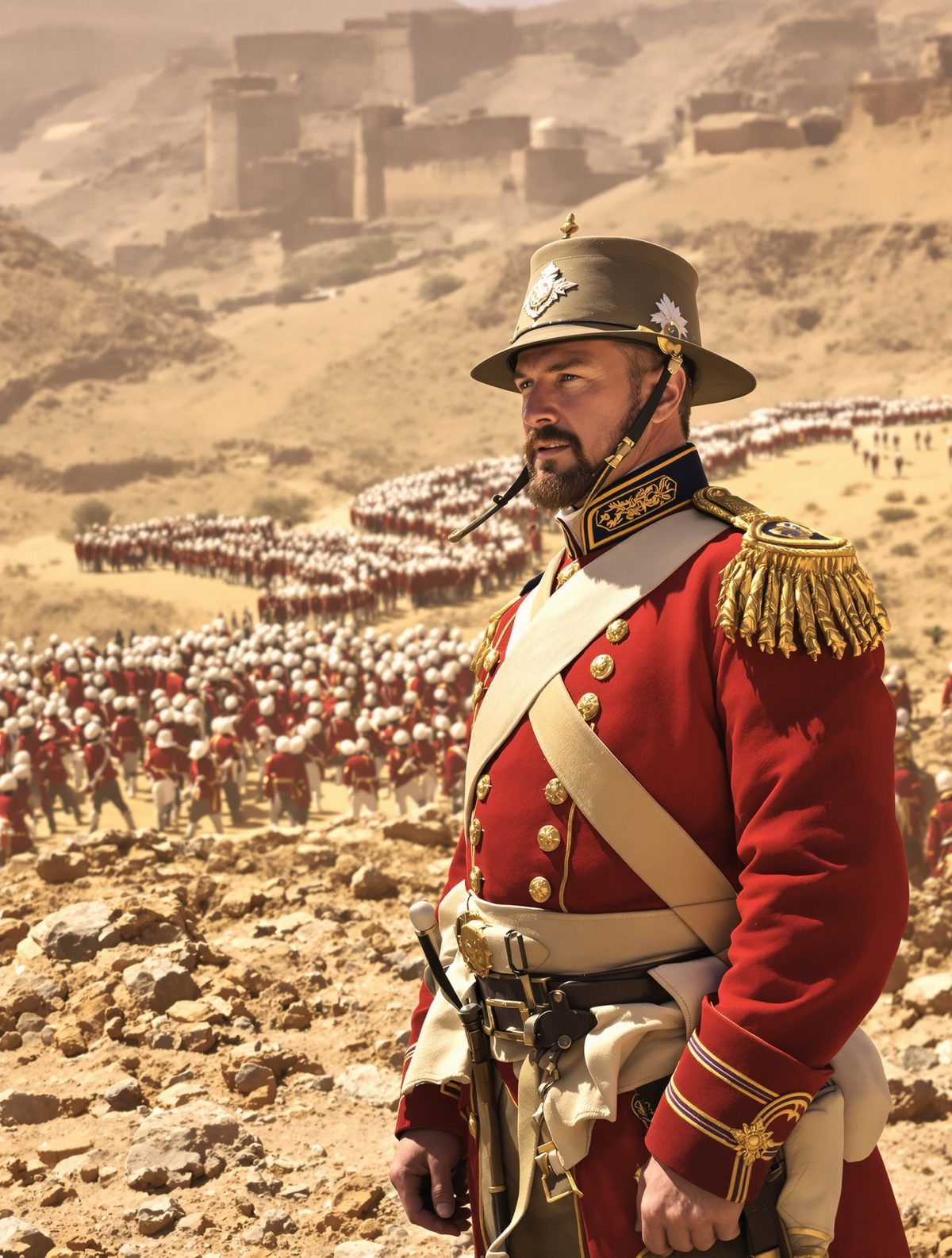
The dust cloud stretched for miles across the Rajasthani plain, kicked up by eight hundred war horses thundering toward the enemy line. At their head rode a man whose very existence defied every rule of colonial India—half-Scottish, half-Rajput, bearing the scars of a dozen battles and the trust of three empires. As the yellow pennants of Skinner's Horse caught the morning sun, enemy commanders knew they faced something unprecedented: cavalry that had never lost a charge, led by a soldier who had never lost his honor, no matter which flag he served.
This is the story of Colonel James Skinner and his legendary Yellow Boys—a tale the history books sanitized because it revealed uncomfortable truths about loyalty, identity, and survival in an age when empires rose and fell with each monsoon season.
The Making of a Legend: Birth of the Yellow Boys
James Skinner entered the world in 1778 as living proof that colonial India was never the neat, segregated society the British later pretended it was. Born to Lieutenant-Colonel Hercules Skinner of the East India Company and a Rajput noblewoman from Kalka, young James grew up speaking Hindustani as fluently as English, equally comfortable with a cricket bat or a curved tulwar sword.
But it was the betrayal of 1803 that forged his destiny. When the British East India Company began purging Anglo-Indian officers from their ranks—men whose mixed heritage had suddenly become inconvenient—Skinner found himself cashiered despite years of faithful service. The Company's new racial policies had no place for soldiers who embodied the very synthesis that had built their empire.
Bitter but unbowed, Skinner took his military genius to the highest bidder: the Maratha Empire. In 1803, he raised his first regiment of irregular cavalry, 300 men mounted on swift horses, dressed in distinctive yellow uniforms that would become their trademark. The choice of yellow was deliberate—basanti, the color of spring and renewal in Indian tradition, but also visible from miles away on any battlefield. Skinner wanted his enemies to know exactly who was coming for them.
Masters of the Irregular Art
What made Skinner's Horse so devastatingly effective wasn't just their horsemanship—though these men could fire a carbine at full gallop and wheel their mounts on a rupee coin. It was Skinner's revolutionary approach to cavalry warfare that blended European discipline with indigenous tactics perfected over centuries on the Indian subcontinent.
Traditional British cavalry charged in neat lines, sabers gleaming, following drill-book formations that worked splendidly on European battlefields. Skinner's irregulars fought like ghosts made flesh. They appeared from dust clouds and vanished into ravines, struck supply lines at dawn and enemy camps at midnight. Each trooper carried a lance, a curved sword, a carbine, and enough ammunition to fight a running battle for days.
The regiment's composition reflected the complex realities of 18th-century India. Punjabi Sikhs rode alongside Rajput warriors, Afghan adventurers fought beside Anglo-Indian officers, and Muslim troopers shared rations with Hindu horsemen. What united them wasn't religion or ethnicity, but loyalty to Skinner and pride in their yellow uniforms. They called themselves fauj-i-khas—the special army—and they meant it.
Between 1803 and 1814, Skinner's Horse fought in over forty engagements for the Marathas, earning a reputation that spread from the Deccan plateau to the courts of Delhi. British officers who had once scorned Skinner's mixed heritage now studied his tactics, trying to understand how his "rabble" consistently outmaneuvered their regular cavalry.
The Great Betrayal: Switching Sides in Style
The Second Anglo-Maratha War of 1803-1805 should have been the end of James Skinner's military career. His Maratha employers were losing, the British were winning, and irregular cavalry had a way of disappearing when the tide turned. Instead, Skinner pulled off one of the most audacious political maneuvers in military history.
In September 1803, as British forces closed in on Maratha positions near Delhi, Skinner requested a private meeting with General Gerard Lake, commander of British forces in northern India. The two men met under a flag of truce on the banks of the Yamuna River, where Skinner made an offer too valuable to refuse: his entire regiment would switch sides, bringing with them intimate knowledge of Maratha tactics, supply routes, and battle plans.
But Skinner demanded more than just amnesty. He wanted his men incorporated into the British Indian Army as a complete unit, with their yellow uniforms intact and their irregular status preserved. Most audaciously, he demanded reinstatement of his own commission—with a promotion to Lieutenant-Colonel.
General Lake agreed on the spot. Within 48 hours, eight hundred yellow-uniformed horsemen who had been hunting British supply convoys were escorting them instead. The Marathas woke up to find their most effective cavalry regiment had vanished in the night, taking their tactical advantages with them.
The switch worked flawlessly because Skinner understood something his contemporaries missed: in the chaos of colliding empires, personal loyalty mattered more than political allegiance. His men followed him, not the Maratha flag, and they continued to follow him under British colors.
The Yellow Boys Ride North: Sikh Wars and Supreme Glory
If switching from Maratha to British service had been impressive, Skinner's performance in the Anglo-Sikh Wars of the 1840s was legendary. By then in his sixties, the old cavalryman faced his sternest test against Maharaja Ranjit Singh's Khalsa—the finest military force in Asia outside of Europe.
The First Anglo-Sikh War (1845-1846) pitted British regularity against Sikh innovation, European discipline against Punjabi ferocity. In this crucible, Skinner's Horse found their perfect role as the army's eyes and ears. They ranged far ahead of British columns, gathering intelligence, disrupting Sikh communications, and fighting the kind of swirling cavalry actions that had been their specialty for forty years.
At the Battle of Aliwal in January 1846, Skinner's Horse pulled off their most famous charge. Facing a Sikh cavalry force that outnumbered them three to one, the Yellow Boys used their classic tactic: a feigned retreat that drew the enemy into broken ground, followed by a devastating flanking charge that shattered the Sikh line. British observers counted over 300 enemy dead in a action lasting less than twenty minutes.
But the most remarkable aspect of the Sikh Wars was what happened afterward. When the British annexed Punjab in 1849, many Sikh cavalry officers sought service with the only regiment that had earned their respect in battle. Skinner's Horse began recruiting former enemies, adding Sikh military expertise to their already formidable capabilities. Once again, personal honor trumped political loyalty.
The Code of the Yellow Boys: Honor Without Borders
What truly set Skinner's Horse apart wasn't their tactical brilliance or their battlefield record—it was their code of honor that transcended the bitter divisions of colonial India. In an age when religious violence tore the subcontinent apart and racial prejudice poisoned military service, the Yellow Boys created their own culture based on martial excellence and mutual respect.
Skinner himself embodied this ethos. A practicing Christian who read the Quran and honored Hindu festivals, he moved effortlessly between worlds that were supposedly irreconcilable. His personal quarters featured a European library, Mughal miniatures, and Rajput weapons, while his table welcomed British colonels, Indian princes, and Afghan mercenaries with equal hospitality.
The regiment's traditions reflected this synthesis. They began each day with a multi-faith prayer ceremony where Sikh, Muslim, Hindu, and Christian troopers sought blessings from their respective deities for the same cause. Their battle cry—"Deen! Dharma! Izzat!"—invoked faith, duty, and honor in languages that spanned the subcontinent.
This wasn't mere tolerance; it was a radical reimagining of what military service could mean in a diverse society. While British and Indian units often maintained strict segregation, Skinner's Horse proved that unity could emerge from diversity if leadership was strong enough and values were clear enough.
Legacy of the Undefeated
Colonel James Skinner died in 1841, but Skinner's Horse outlived their founder by more than a century. The regiment fought in both World Wars, survived the partition of India, and continues today as one of the Indian Army's most decorated armored units. Their yellow pennants still fly over tanks instead of horses, but the spirit remains unchanged.
What makes Skinner's story relevant today isn't just his military success—it's his demonstration that identity need not be singular, that loyalty can transcend politics, and that diversity can become strength under the right leadership. In our own age of rigid tribal loyalties and zero-sum thinking, the Yellow Boys offer a different model: pragmatic idealism backed by unshakeable principles.
James Skinner never lost a charge because he understood something his contemporaries missed: the best warriors fight not for flags or empires, but for the comrades beside them and the honor within them. His legacy reminds us that in the end, character matters more than nationality, and courage speaks a language that every culture understands.