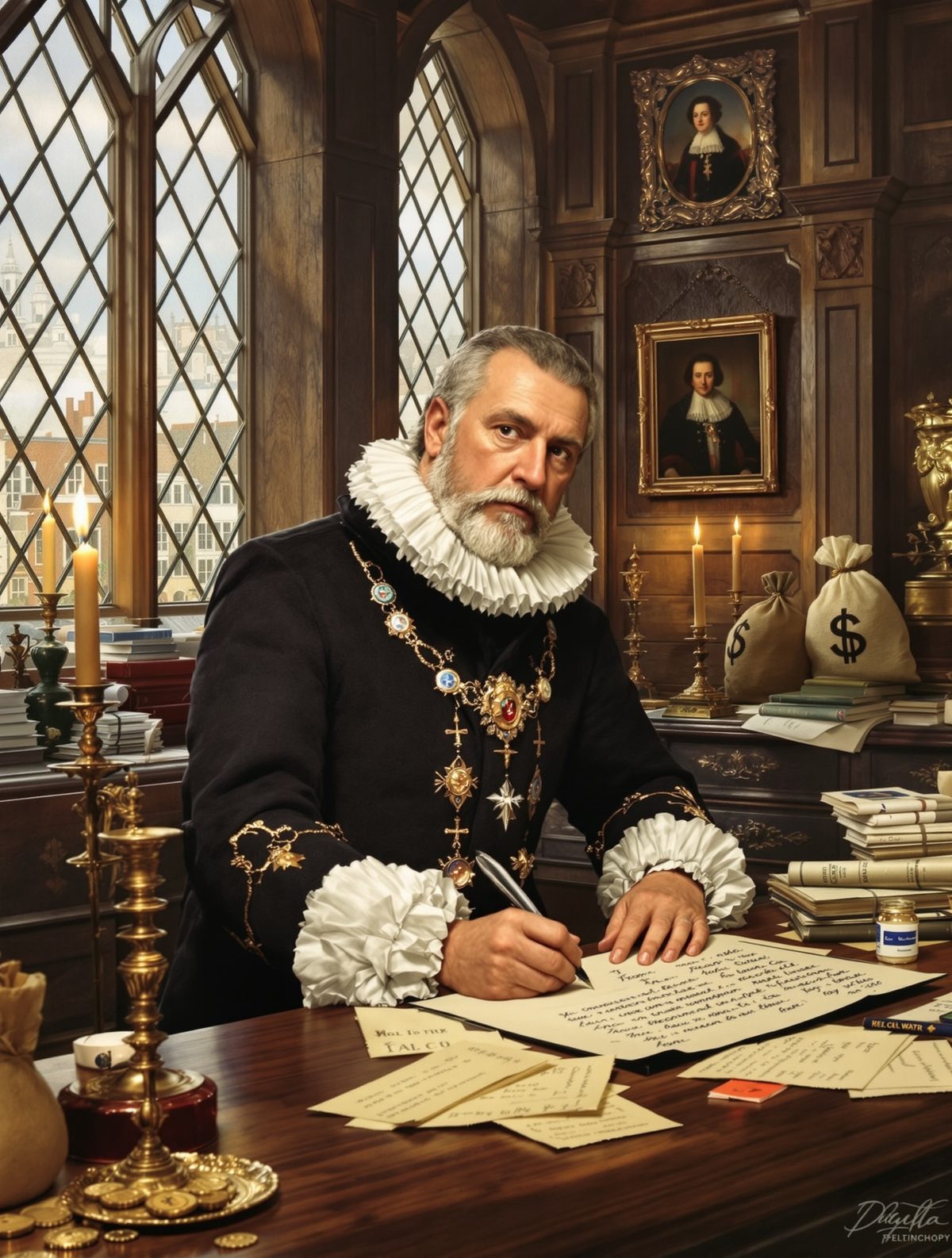
Picture this: It's 1803, and across the dusty plains of northern India, a cavalry charge thunders toward enemy lines. But these aren't ordinary soldiers. They wear bright yellow uniforms that catch the morning sun like burnished gold, their curved sabers gleaming as they ride. Their battle cry echoes across the battlefield in a mixture of Persian, Hindi, and English. Leading them is a man whose very existence defied every rule of colonial society—James Skinner, an Anglo-Indian colonel who built the most notorious mercenary regiment in Indian history.
What made Skinner's Horse legendary wasn't just their fighting prowess. It was their remarkable ability to survive by switching sides with the political winds. Over three decades, these "Yellow Boys" would fight for the Marathas against the British, then for the British against the Marathas, then back again—always following the money, always staying alive in a subcontinent where empires rose and fell like monsoon rains.
The Making of a Mercenary
James Skinner was born into a world that didn't want him. In 1778, in the frontier town of Calcutta, he emerged from a union that colonial society preferred to ignore—a Scottish father from the East India Company and an Indian mother whose name history has cruelly erased. In the rigid hierarchy of British India, Anglo-Indians like Skinner occupied an uncomfortable middle ground: too Indian for the British, too British for traditional Indian society.
But what society saw as a disadvantage, Skinner transformed into his greatest weapon. By his twenties, he spoke nine languages fluently—English, Persian, Hindi, Urdu, Arabic, Turkish, French, Portuguese, and Bengali. This linguistic prowess made him invaluable as both a diplomat and a spy, able to slip between cultures as easily as changing clothes.
Skinner's break came in 1803 when he was just 25 years old. Serving as an ensign in the East India Company's army, he watched his career prospects dim due to the Company's increasing prejudice against Anglo-Indians. When his British commanders passed him over for promotion one too many times, Skinner made a decision that would echo across Indian military history: he resigned his commission and offered his services to the highest bidder.
Birth of the Yellow Boys
The Maratha Empire was crumbling, but it still had gold, and gold was what Skinner needed. In 1803, he approached Maharaja Daulat Rao Scindia with an audacious proposition: give him 500 men and he would create a cavalry regiment that could match anything the British could field.
Scindia, desperate for military edge against the expanding British East India Company, agreed. But Skinner had grander plans than simply training existing soldiers. He began recruiting from the margins of society—Anglo-Indians like himself, British deserters, Indian adventurers, Afghan horsemen, and anyone else willing to fight for pay rather than patriotism.
The yellow uniforms weren't just a fashion choice; they were a psychological weapon. In a land where armies typically wore white, brown, or red, Skinner's cavalry stood out like flames on the battlefield. The distinctive kurtas and tight-fitting trousers, combined with black leather boots and steel helmets, created an image that was both exotic and intimidating. Enemy forces could spot the Yellow Boys from miles away—which was exactly the point.
By 1804, Skinner's Horse had grown to 3,000 men, making it one of the largest irregular cavalry units in India. But their first real test came at the Battle of Delhi in 1803, where they charged British lines with such ferocity that even their enemies grudgingly admitted their courage.
The Art of Strategic Betrayal
Here's where Skinner's story becomes truly fascinating. When the Second Anglo-Maratha War turned decisively against his employers in 1805, Skinner faced a choice that would have paralyzed most soldiers: watch his regiment be destroyed with the Maratha cause, or find a way to survive.
Skinner chose survival, but with characteristic flair. Rather than simply defecting, he negotiated. Using his linguistic skills and personal connections, he opened secret communications with British commanders, offering to switch sides in exchange for guarantees that his men would be incorporated into the East India Company's forces with their ranks and pay intact.
The British, who had been on the receiving end of Skinner's tactical brilliance, jumped at the chance. In a ceremony that must have been surreal for everyone involved, James Skinner's Horse formally transferred their allegiance from the Maratha Empire to the British East India Company in 1805. The Yellow Boys simply changed enemies and kept fighting.
But the most remarkable part? Skinner somehow maintained the personal respect of leaders on both sides. Maharaja Scindia reportedly said of him, "Skinner Sahib fights like a demon, but negotiates like a gentleman." British General Gerard Lake wrote that Skinner was "the finest irregular cavalry commander in India, regardless of nationality."
Mercenaries with Honor
Under British command, Skinner's Horse became the stuff of legend. They fought in the Third Anglo-Maratha War, the First Afghan War, and dozens of smaller campaigns across the subcontinent. Their specialty was reconnaissance and lightning strikes—missions that required the kind of cultural knowledge and linguistic flexibility that only Skinner's polyglot warriors possessed.
The regiment's unusual composition created a unique military culture. British deserters shared campfires with Rajput horsemen. Anglo-Indian officers commanded Pathan fighters. Hindu, Muslim, Christian, and Sikh soldiers served side by side, united not by religion or nationality but by professional pride and mutual profit.
Skinner himself became wealthy beyond imagination. By 1820, he owned estates worth over 100,000 rupees annually—roughly equivalent to millions of dollars today. He built a magnificent haveli in Delhi and commissioned St. James' Church, which still stands as a monument to his remarkable life.
Yet for all their mercenary reputation, Skinner's Horse developed their own code of honor. They never broke a contract once made, never abandoned wounded comrades, and never pillaged civilian populations. In an era when most armies treated local populations as expendable, the Yellow Boys' restraint was remarkable enough to be noted in British military records.
The Final Switch
The most audacious chapter in Skinner's career came during the final phases of British expansion. In 1817, as the East India Company prepared to crush the last independent Maratha strongholds, Skinner found himself in an impossible position. British commanders ordered his regiment to participate in campaigns against people who had once paid their salaries—including some who were personal friends.
Skinner's solution was characteristically bold. He split his regiment. Half remained with the British as the 1st Skinner's Horse, while he personally led the other half back to Maratha service as the 2nd Skinner's Horse. For nearly six months in 1818, there were actually two Yellow Boy regiments operating on opposite sides of the same war.
When the Marathas finally fell, both halves of the regiment reunited under British command, with Skinner somehow managing to retain his colonel's rank and most of his men's positions. It was perhaps the most successful military defection in history—executed twice, by the same man, with the same unit.
Legacy of the Yellow Boys
James Skinner died in 1841, but his regiment outlived the empire that created it. Skinner's Horse served the British Raj until 1947, when it was divided between the Indian and Pakistani armies during Partition. Today, the President's Bodyguard of India traces its lineage directly back to Skinner's original Yellow Boys.
But Skinner's real legacy isn't military—it's the proof that loyalty in the colonial era was far more complex than history textbooks suggest. In a world supposedly divided between colonizer and colonized, Skinner created a third option: the professional soldier whose only allegiance was to his craft and his comrades.
His story challenges our neat narratives about empire and resistance. Was Skinner a patriot or a traitor? A hero or an opportunist? The answer is probably all of the above. In the messy reality of colonial India, survival often required the kind of moral flexibility that peacetime societies condemn but wartime necessities demand.
In our modern world of shifting allegiances and global mercenaries, James Skinner seems less like a historical curiosity and more like a prophet. He understood something that we're still learning: in a complex world, sometimes the most honorable thing you can do is choose your own path, regardless of what the empires around you demand.