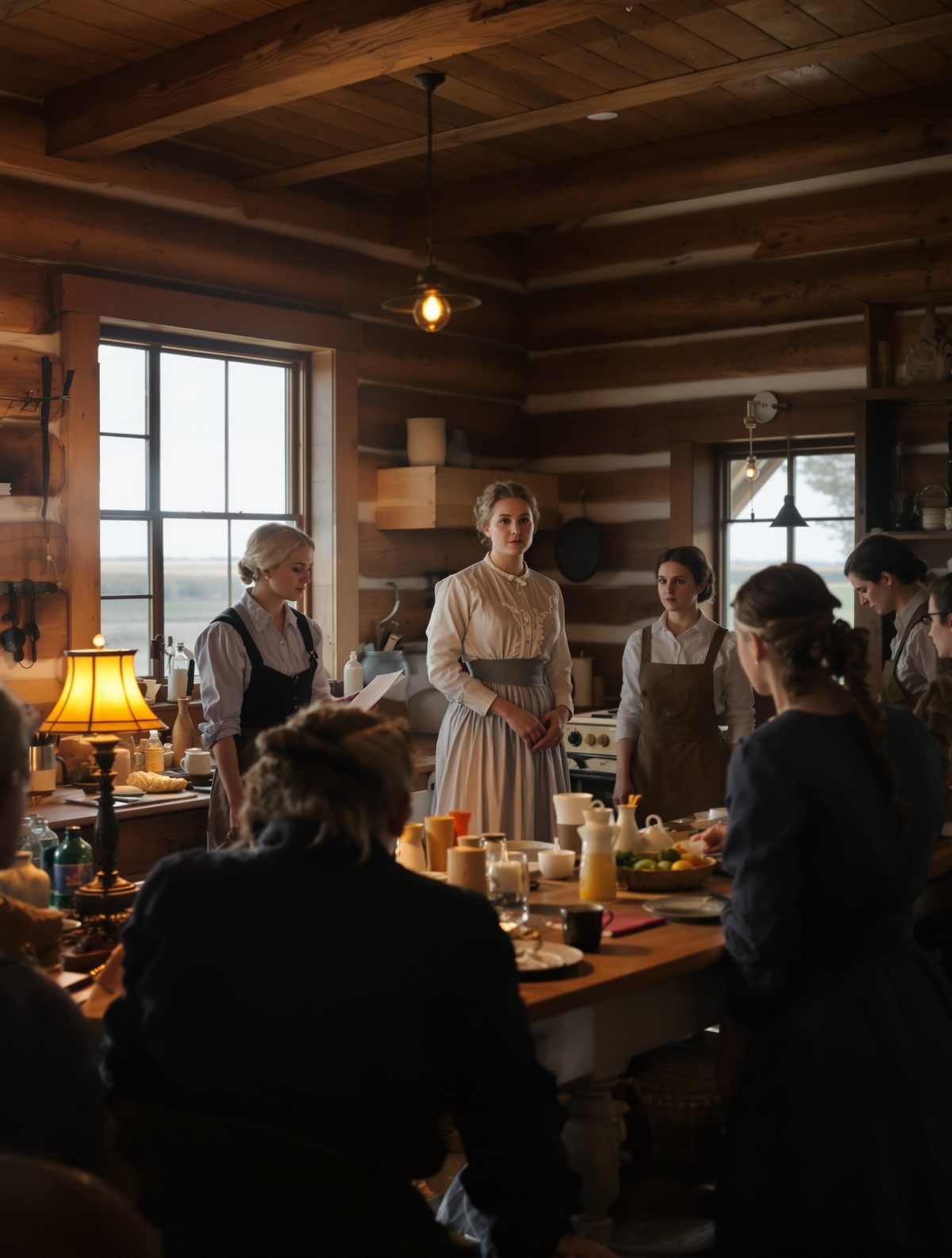
In the sweltering heat of Delhi, 1922, a young British woman stepped off the train carrying nothing but a medical bag and a revolutionary idea. Dr. Margaret Balfour had just become the first qualified female obstetrician to serve in British India, but she had no idea she was about to enter a hidden world where women died in silence rather than break the sacred laws of purdah. Behind the carved wooden screens and flowing curtains of Muslim households, mothers were hemorrhaging to death during childbirth—not from medical complications that couldn't be treated, but because no male doctor could examine them, and no female doctor had existed to help them. Until now.
What Balfour discovered in those first weeks would shock her to her core and set her on a mission that would save thousands of lives over the next two decades. She was about to become the bridge between two worlds: the rigid traditions of purdah and the life-saving advances of modern medicine.
The Silent Crisis Behind the Curtain
The purdah system in 1920s India was far more complex than most Westerners understood. Derived from the Persian word meaning "curtain," purdah wasn't simply about women covering themselves—it was an entire social architecture that governed how Muslim women moved through the world. In wealthy households across Delhi, Lucknow, and other major cities, women lived in separate quarters called zenanas, emerging only when completely veiled and often only for essential purposes.
For centuries, this system had functioned with its own internal support networks. Experienced midwives, known as dais, attended births using traditional knowledge passed down through generations. But by the early 20th century, something had gone terribly wrong. The traditional support systems were breaking down, skilled dais were becoming scarce, and modern medical knowledge wasn't reaching the women who needed it most.
The statistics Balfour encountered were staggering. In some districts of British India, maternal mortality rates in purdah-observing communities were nearly five times higher than among women who could be attended by male doctors. Women were dying from complications that would have been easily treatable—hemorrhaging, obstructed labor, infections—simply because no qualified medical professional could examine them.
Even more heartbreaking were the stories of desperate families who would call male doctors to stand outside bedroom doors, attempting to diagnose and treat patients they couldn't see or touch. One British doctor recorded his frustration at trying to deliver a baby by shouting instructions through a closed door, while the woman's mother-in-law acted as his hands and eyes.
A Revolutionary Arrival
Margaret Balfour wasn't just any doctor—she was a trailblazer who had already shattered barriers back in Britain. Born in 1898, she had fought her way through medical school at a time when female doctors were still a curiosity, graduating with honors from the London School of Medicine for Women in 1921. But what set her apart was her specialization: she was one of the first women in Britain to focus specifically on obstetrics and gynecology, fields that male doctors often found "unseemly" for women to practice.
When the Colonial Medical Service reluctantly agreed to send a female doctor to India—after mounting pressure from British women's groups and progressive Indian reformers—Balfour volunteered immediately. She arrived in Delhi in September 1922, assigned to work primarily with the wives and daughters of Indian Civil Service officers. But Balfour had bigger plans.
Within weeks of her arrival, she had begun reaching out to prominent Muslim families, offering her services. The response was immediate and overwhelming. Word spread through the networks of women faster than official announcements could travel. Here, finally, was a fully qualified doctor who could enter the zenana, who could examine patients properly, who could bring all the tools of modern medicine into spaces that had been medically isolated for generations.
Breaking Barriers, One Birth at a Time
Balfour's first delivery in a traditional Muslim household was a revelation—for everyone involved. The family had expected her to work much like the traditional dais, using intuition and basic techniques. Instead, she arrived with sterilized instruments, chloroform for pain relief, and antiseptics that dramatically reduced the risk of infection. She could identify complications before they became life-threatening and had the surgical skills to intervene when necessary.
But perhaps most importantly, she could see her patients. This sounds almost absurdly simple to modern readers, but it represented a medical revolution. For the first time in generations, women in strict purdah could receive the same quality of medical examination and care as anyone else.
The cultural negotiations were delicate and complex. Balfour had to learn not just medical protocols, but social ones. She discovered that different families had different interpretations of purdah requirements. Some allowed her complete freedom to examine patients; others required her to work by touch alone, with the woman remaining partially covered. Some families insisted on complete darkness; others permitted lamplight.
Rather than imposing Western medical practices wholesale, Balfour adapted. She learned to work by touch when necessary, developed techniques for examining patients who couldn't be completely uncovered, and found ways to use her instruments effectively even in challenging conditions. Most importantly, she treated the cultural requirements with respect rather than seeing them as obstacles to overcome.
The Ripple Effect Across an Empire
By 1925, Balfour was delivering more than 300 babies per year, but her impact extended far beyond individual births. She began training a new generation of female medical practitioners—both British women who came to India and Indian women who were entering the medical profession. Her detailed case notes and reports back to London documented not just medical procedures, but the urgent need for more female doctors across the Empire.
The success was quantifiable and dramatic. In areas where Balfour worked regularly, maternal mortality rates dropped by more than 60 percent within five years. Infant mortality also plummeted as her sterile techniques and ability to handle complications saved not just mothers, but babies who would have died in difficult births.
Word of her work reached the highest levels of British colonial administration. The Viceroy's office began receiving reports of dramatically improved health outcomes in communities served by female doctors. Progressive Indian politicians, including members of the nascent independence movement, pointed to Balfour's work as evidence that the colonial government had been criminally negligent in not providing adequate medical care for Indian women.
By 1930, partly due to Balfour's advocacy and documented success, the Colonial Medical Service had recruited twelve more female doctors specializing in obstetrics and gynecology. The "Balfour model"—female doctors working specifically with communities where cultural restrictions limited access to male physicians—was being replicated across India, Burma, and other parts of the Empire.
More Than Medicine: A Bridge Between Worlds
What made Balfour's work revolutionary wasn't just the medical care she provided—it was her role as a cultural translator. She became one of the few British officials who genuinely understood the daily lives of Indian women across class and religious lines. Her patient notes, preserved in the India Office Records, provide an unprecedented window into women's experiences during this tumultuous period.
She documented not just medical conditions, but social ones: the impact of early marriage on young women's health, the nutritional challenges facing pregnant women in joint family systems, the psychological toll of strict confinement during pregnancy. Her reports to the colonial medical authorities became some of the first official documents to treat Indian women's health as a serious policy concern rather than a marginal issue.
Balfour also navigated the complex politics of the independence movement. Many of her patients came from families involved in the freedom struggle, and she found herself providing medical care across political lines. Her commitment to treating all patients equally, regardless of their families' political affiliations, earned her respect from both British authorities and Indian independence activists.
By the time she returned to Britain in 1942, after twenty years of service, she had delivered more than 3,000 babies and trained dozens of practitioners. But her most lasting contribution might have been proving that medical progress didn't require the destruction of cultural practices—it required understanding, adaptation, and respect.
Legacy Behind the Veil
Dr. Margaret Balfour's story raises uncomfortable questions about the nature of progress and cultural change. Here was a colonial medical officer who succeeded not by imposing Western practices, but by working within existing cultural frameworks. At a time when much of the British Raj operated on the assumption that Indian traditions were obstacles to be overcome, Balfour demonstrated that some of the most dramatic improvements in people's lives could come from respecting those traditions while addressing their practical limitations.
Her work also highlights how often "women's issues" were treated as secondary concerns by colonial authorities, despite affecting literally half the population. It took mounting evidence of preventable deaths and the dramatic success of female doctors before the colonial medical service seriously invested in addressing women's healthcare needs.
Today, as debates continue about cultural sensitivity in healthcare, religious freedom, and women's rights, Balfour's story offers a complex but hopeful example. She proved that it was possible to save lives and respect traditions simultaneously—but only with genuine effort to understand and accommodate different ways of living. In our own era of cultural conflict and medical disparities, perhaps the lesson of those 3,000 births behind the purdah curtain is more relevant than ever: sometimes the most revolutionary act is simply meeting people where they are.