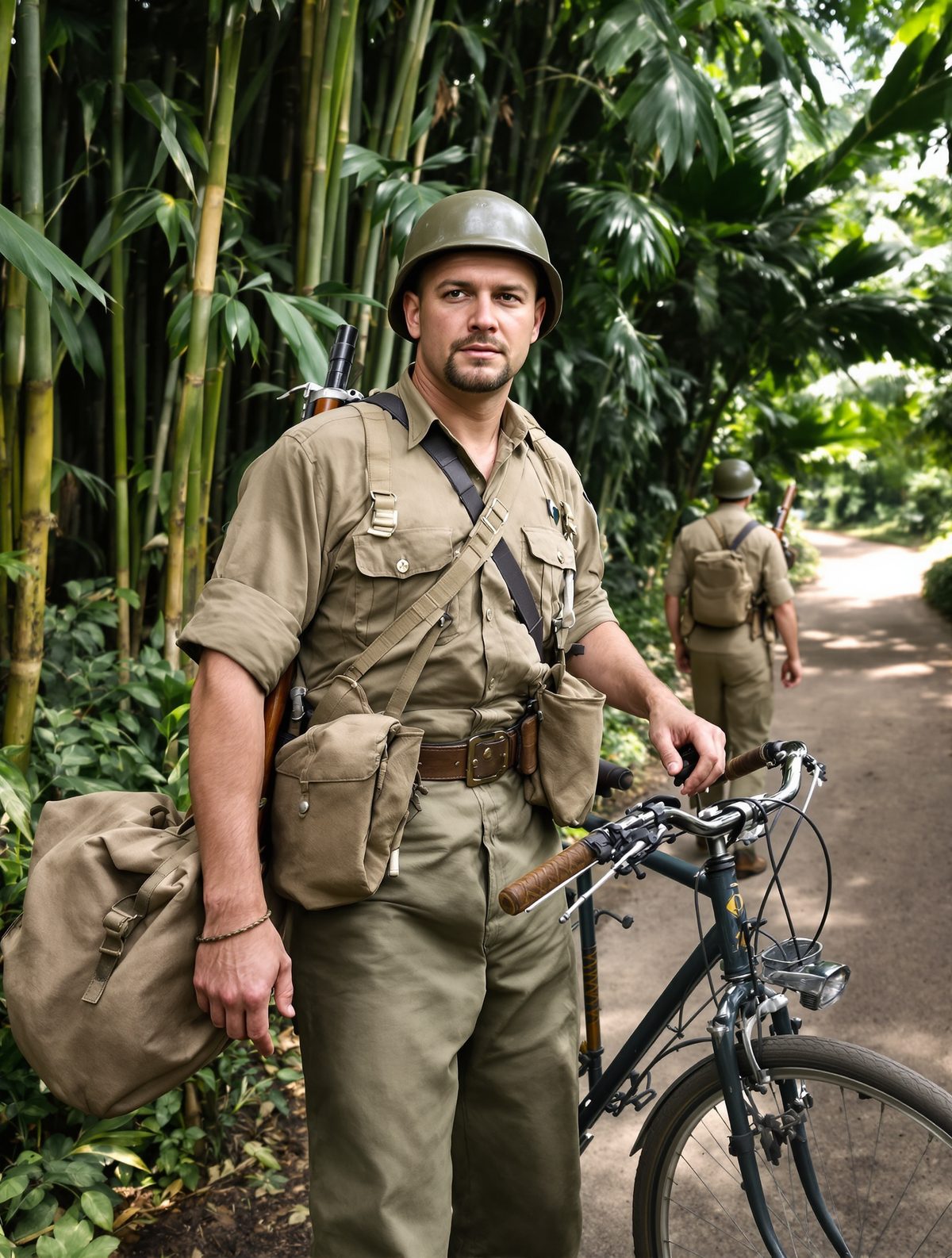
Treading the Path of Legends: An Unlikely Partnership
As the African sun dipped below the horizon, casting its fiery hues across the vast savannah, a duo that history would mark with distinction prepared for another day deep in the heart of untamed Africa. At the head of this unlikely pair walked Frederick Courteney Selous, a man whose mere presence seemed to command the very wilderness through which he traveled. Behind him, former U.S. President Theodore Roosevelt followed with an eager intensity, his voracious curiosity mirroring that of an excitable schoolboy rather than a world-renowned statesman. This was no ordinary expedition — it was a convergence of two kindred spirits, charting a path through a landscape as wild and legendary as the men themselves.
Forging Paths Through a New World
By 1909, Frederick Courteney Selous was no stranger to the wild lands of Africa. Born in 1851, this quintessential British adventurer had spent over four decades immersed in the sprawling tapestry of the African interior. With an insatiable hunger for adventure and an uncanny knack for survival, Selous carved his legacy from the harsh wilderness, often navigating territories that existed only as whispers on the lips of explorers back home. His intimate understanding of the land, its wildlife, and its perils made him a living map with stories etched into every sinew. Known for his extraordinary hunting skills, Selous became the inspiration for Sir H. Rider Haggard’s famous character Allan Quatermain — adventurer, hunter, and a teller of tales few could believe.
The Vision of an Adventurous President
The allure of adventure was not lost on Theodore Roosevelt. The 26th President of the United States, Roosevelt had stepped down from office just months prior, driven by a desire to fulfill lifelong dreams on distant continents. Known for his vigorous approach to both politics and life, he viewed the expedition not just as a personal dream, but as a scientific and cultural mission, determined to bring the wilds of Africa to the American consciousness. Seeking the most knowledgeable guide to lead him into these untrammeled territories, Roosevelt found his answer in Selous, a man whose reputation preceded him and whose expertise was unparalleled.
The Grand Safari Begins: A Journey into the Wild
The Roosevelt-Selous expedition set forth on March 23, 1909, in Mombasa, Kenya. With around 260 porters and a team of scientists, hunters, and family, this was a grand safari in every sense. The baggage of ambition weighed heavy — the expedition aimed to collect specimens for the Smithsonian Institution and the American Museum of Natural History, although their conscience towards conservation was much-debated later on. As they delved deeper into the heart of East Africa, the party became living witnesses to the richness and diversity of an Africa not yet touched by the exploitative, extractive industries that the 20th century would rapidly bring about.
Stalking through savannahs and clambering over mountainous terrain, Roosevelt and Selous encountered wildebeests in numbers that stretched to the horizon, lions that commanded both fear and respect, and the elusive and majestic elephants whose tusks were often their greatest curse. On one significant occasion near the Aberdare Mountains, Roosevelt nearly came too close to a charging rhinoceros — an encounter swiftly averted by Selous's watchful eye.
Selous: A Man Crafted by the Wilderness
Selous's ability to connect with the land and its harsh realities was nearly supernatural. He read the whispers of the wind and the faintest of tracks, guiding the expedition with a calm assurance. Beneath his hard exterior lay a reflective soul, one that had come to love and respect the very land he once hunted with abandon. A surprising fact often overlooked is Selous’s later conservationist tendencies; he recognized the impending threats to wildlife sources long before conservation became a global concern. His deep respect for the wildlife stood in stark contrast to the notion of the era that viewed Africa as a frontier to conquer.
Despite the exhausting days and challenging terrain, Selous’s spirit, much like Roosevelt’s, was unwavering. Together, they shared fireside tales of yesteryears, each story weaving their shared legacy tighter, each recollection a testament to the bond forged through adventure. Over time, their relationship evolved from that of guide and patron to something akin to a mutual admiration between two explorers reveling in their extraordinary journey.
A Legacy Etched in Untamed Lands
When Frederick Courteney Selous and Theodore Roosevelt's paths eventually diverged, they left behind a legacy not just of hunter and president, but of two souls united by an insatiable curiosity for the natural world and a deep-founded respect for its unyielding power. Their story is a testament to the Edwardian Empire’s dreams and a reflection of the complex and sometimes conflicted relationships between men, nature, and empire, during the Scramble for Africa.
The significance of this journey resonates even now, more than a century later. In an age of rapid technological advancement and environmental change, the tale of Selous and Roosevelt asks us to ponder our relationship with the natural world and the importance of understanding and preserving the treasures that remain. Their journey was more than a hunt, more than an expedition — it was a vivid reminder that some paths trodden by the past remain relevant as we seek new ways of understanding the world we inhabit.