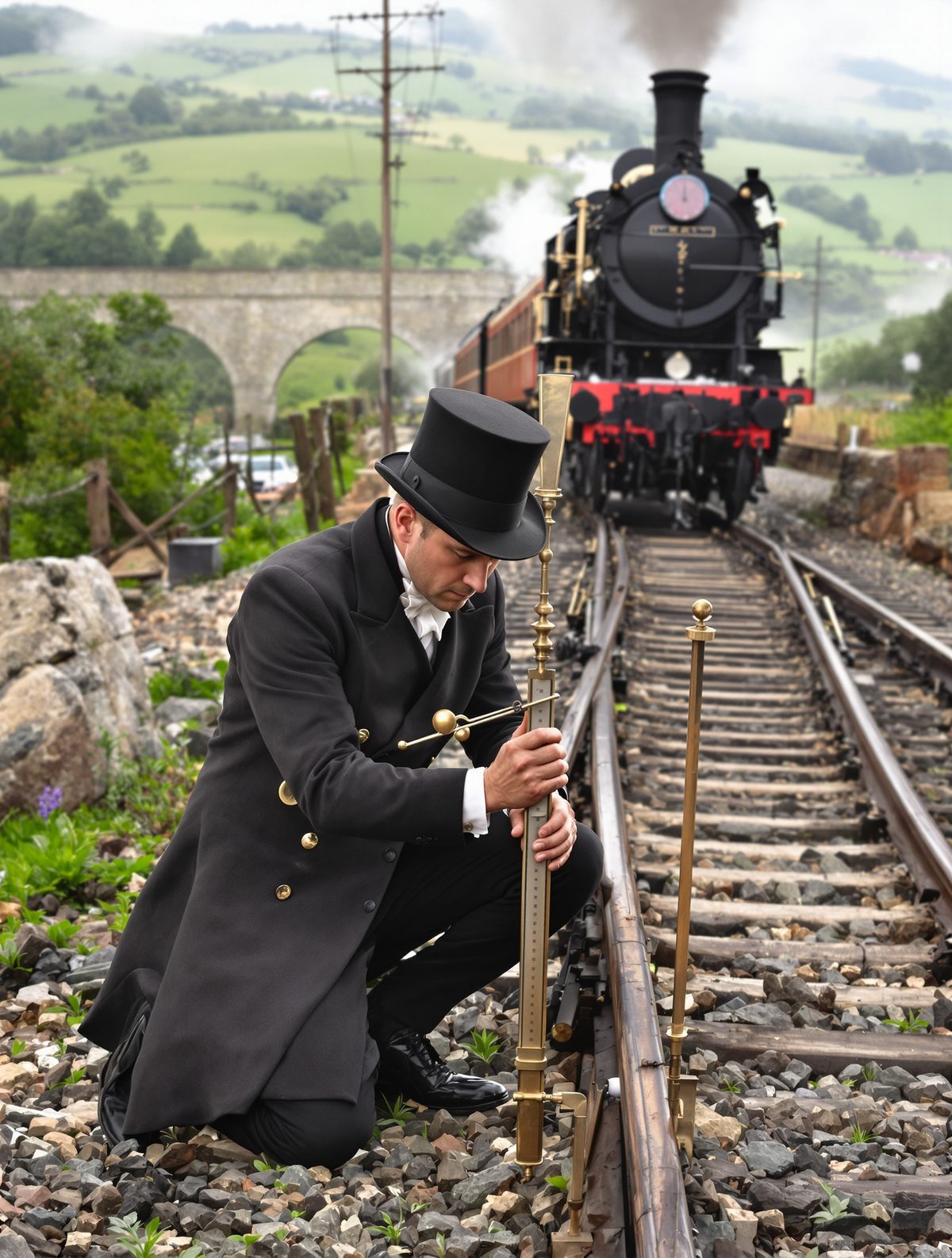
The steam whistle echoed across New Delhi Railway Station with a mournful wail that seemed to announce the death of an empire. It was March 22, 1947, and as the Viceregal train pulled away from Platform 1, few of the scattered onlookers realized they were witnessing history's most understated exit. Inside the mahogany-paneled coach, Field Marshal Archibald Wavell sat alone, watching the Red Fort's ancient walls slide past his window for the final time. Tomorrow, Lord Louis Mountbatten would arrive with fanfare and flash bulbs. But today belonged to the quiet soldier who had tried—and failed—to hold the Raj together.
No bands played. No crowds cheered. The man who had commanded armies across two world wars departed India with less ceremony than a retiring railway clerk. Yet in that silence lay a story more dramatic than any imperial pageantry—the tale of how the world's greatest empire began its final, irreversible slide toward history.
The General Who Never Wanted to Be Viceroy
Wavell had arrived in India three years earlier as an odd choice for Viceroy. While his predecessors were typically aristocrats or career politicians, Wavell was a one-eyed warrior-poet who quoted Browning and had lost his left eye to shrapnel in World War I. Winston Churchill had appointed him reluctantly in 1943, primarily because Wavell understood military logistics—and by then, keeping India fed and fighting was becoming a logistical nightmare.
The appointment was meant to be temporary. Churchill never liked Wavell, considering him too cautious, too intellectual, and worst of all, too sympathetic to Indian independence. "Wavell thinks like a general but feels like a humanitarian," Churchill once complained to his secretary. It was intended as criticism, but it revealed exactly why Wavell would become one of the most tragic figures in imperial history.
What made Wavell unique among Viceroys was his brutal honesty about Britain's position. While politicians in London still spoke of maintaining the Empire, Wavell was filing reports that read like military dispatches from a losing war. His secret telegrams to Whitehall painted a picture of communal violence spiraling beyond control, of British authority evaporating like morning mist, and of an administrative system held together by habit rather than power.
The Impossible Mathematics of Partition
By 1946, Wavell had become obsessed with what he called "the terrible arithmetic" of India's future. His private papers, unsealed decades later, reveal a man frantically calculating impossible equations: How do you divide a subcontinent where Hindus, Muslims, and Sikhs lived in a patchwork so complex that clean borders were a mathematical impossibility?
In his study at the Viceregal Lodge, Wavell worked late into Delhi's sweltering nights with maps and census data, trying to draw lines that wouldn't doom millions. His aides found him once at 3 AM, surrounded by population charts, muttering about "the geometry of human misery." He had identified 127 districts where partition would create "orphaned populations"—communities that would find themselves cut off from their religious majority.
Wavell's proposed solution, codenamed "Operation Madhouse," was characteristically blunt: a planned British withdrawal over eighteen months, with massive population transfers supervised by the military. London rejected it as too expensive and too honest about Britain's imperial bankruptcy. Prime Minister Clement Attlee wanted someone who would make partition look like statesmanship rather than managed catastrophe.
What Whitehall didn't realize was that Wavell had already begun implementing parts of his plan quietly. He had secretly positioned extra troops in Punjab and Bengal—moves that would save thousands of lives during the chaos that followed. Even in defeat, the old general was still thinking like a soldier, trying to minimize casualties in a war he knew was lost.
The Last Supper of Empire
Wavell's final weeks as Viceroy read like a Shakespearean tragedy. On March 15, 1947, he hosted what his secretary called "the last supper of empire"—a dinner party that included Muhammad Ali Jinnah, Jawaharlal Nehru, and other Indian leaders who would soon inherit the subcontinent.
The evening was surreal. Servants in white gloves served courses on china bearing the imperial crown while the guests discussed how to dismantle the very empire whose symbols surrounded them. Wavell, exhausted and knowing his dismissal was imminent, spoke with uncharacteristic emotion about his fears for India's future.
"You are taking on the most beautiful and terrible responsibility in the world," he told Nehru. "I pray you will be wiser than we were." Jinnah, typically sharp-tongued, replied: "At least we cannot be more foolish." The comment drew nervous laughter, but Wavell's diary entry that night was ominous: "They still believe partition can be civilized. God help them all."
What none of the dinner guests knew was that Wavell had already received his recall telegram. In a final act of imperial discourtesy, London had informed him of his replacement through official channels, not personal communication. The Field Marshal who had served his country for four decades learned of his dismissal the same way a clerk might learn of a transfer.
Platform 1: The End of Everything
The scene at Delhi Railway Station on that March morning was deliberately muted. Wavell had requested no ceremony, no speeches, no imperial pomp. He understood that the Raj needed Mountbatten's arrival to look like a new beginning, not a continuation of his failures. But those few witnesses described a moment heavy with symbolism.
The Viceregal train itself was a marvel of imperial engineering—twelve coaches of teak and brass that had carried three generations of British rulers across India. The Viceroy's private coach, built in 1914, was a rolling palace with crystal decanters, Persian carpets, and a bathtub carved from a single piece of marble. Wavell sat in the same chair where Lord Curzon had planned the partition of Bengal and where Lord Irwin had drafted the first tentative offers of dominion status.
As the train gathered speed, Wavell's ADC noted that the Field Marshal opened a book of poetry—Housman's "A Shropshire Lad"—and began reading aloud. The poem he chose was painfully apt: "From far, from eve and morning / And yon twelve-winded sky, / The stuff of life to knit me / Blew hither; here am I."
What makes this moment even more poignant is what we now know from declassified files: Wavell had left behind a sealed letter for Mountbatten containing detailed warnings about flashpoints for communal violence. The letter, opened only after partition, proved grimly accurate. Almost every location Wavell identified as dangerous became a site of massacre in the months that followed.
The Ghost at Mountbatten's Feast
Lord Mountbatten arrived the next day with characteristic flair—press conferences, photo opportunities, and confident pronouncements about achieving independence "with dignity and speed." The contrast with Wavell's departure could not have been starker. Where Wavell saw complexity, Mountbatten saw problems to be solved with charm and decisiveness.
But Wavell's ghost haunted Mountbatten's viceroyalty from the beginning. Every crisis Wavell had predicted materialized with devastating accuracy. The speed that Mountbatten brought to independence—moving the date forward from June 1948 to August 1947—eliminated any chance of the careful preparation Wavell had deemed essential.
In a cruel irony, Mountbatten received praise for the very decisiveness that made partition more chaotic. Wavell's careful, pessimistic planning was forgotten while Mountbatten's confident improvisation was celebrated. History, it seemed, preferred glamorous failure to unglamorous foresight.
The human cost was staggering: at least one million dead, twelve million displaced, and scars that persist across South Asia today. In his retirement, Wavell never publicly criticized Mountbatten, but his private letters reveal a man haunted by what might have been: "Perhaps if they had given us eighteen months instead of four, perhaps if London had listened..."
Why the Quiet Train Still Matters
Wavell's silent departure from Delhi Station represents something larger than one man's career disappointment. It symbolizes the dangerous gap between political theater and ground-level reality that still plagues how nations handle complex transitions today.
Modern parallels abound: from the rushed withdrawal from Afghanistan to the chaotic implementation of Brexit, we repeatedly see leaders choosing speed over preparation, optimism over honesty, and public relations over careful planning. Wavell's story reminds us that sometimes the most important voices are the quiet ones warning of complications, not the confident ones promising simple solutions.
The Field Marshal who left Delhi in silence understood something his flashier successor did not: that endings matter as much as beginnings, and that how empires die shapes how nations are born. In our age of instant communication and shortened news cycles, Wavell's patient, unglamorous approach to impossible problems feels almost revolutionary.
That lonely train pulling away from Platform 1 carried more than one disappointed soldier. It carried the last chance for a different kind of partition—slower, more careful, perhaps less heroic, but almost certainly less bloody. Sometimes the most important moments in history are the quiet ones, heard only in the echo of a train whistle disappearing into the distance.