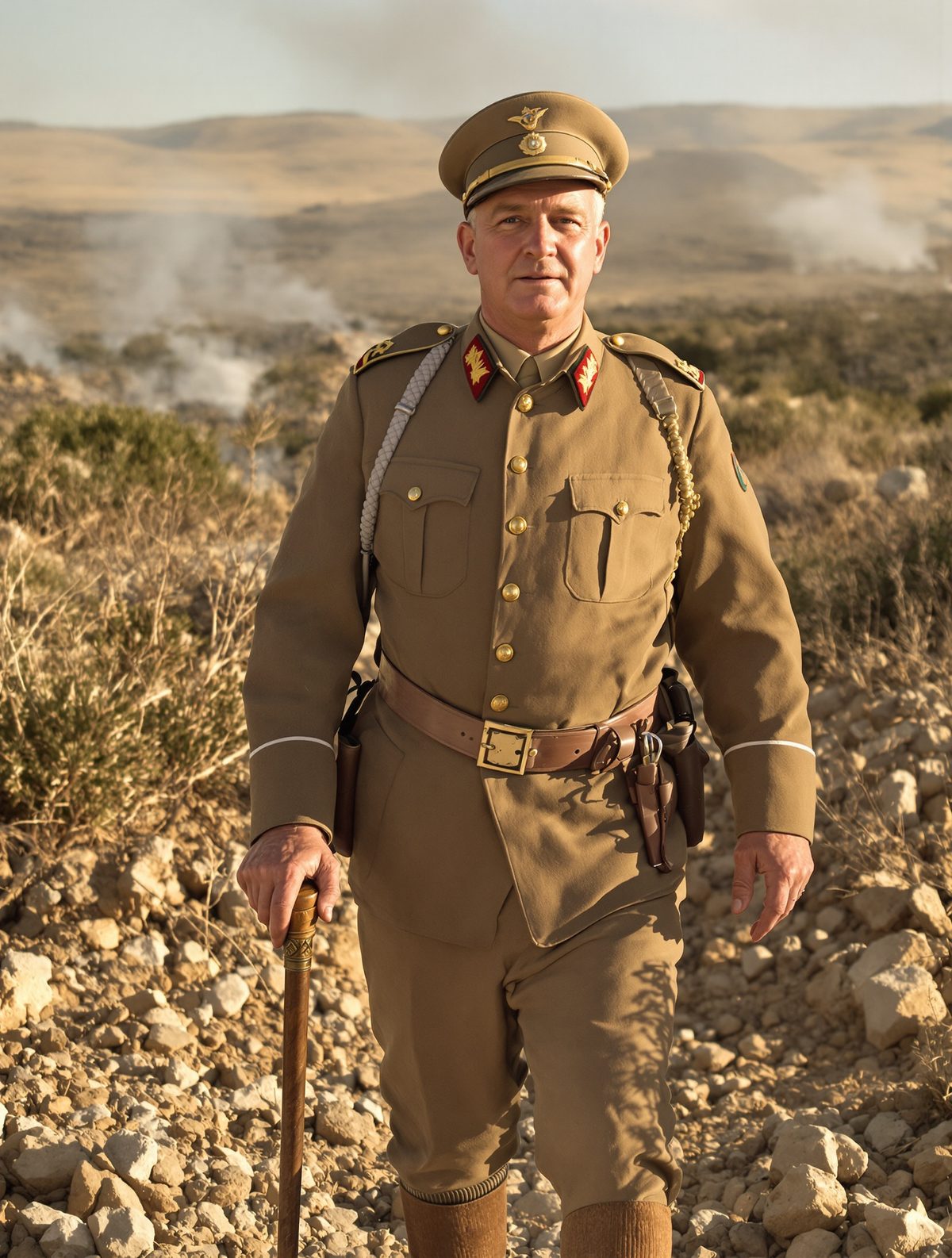
The dust cloud on the horizon stretched for miles, kicked up by three thousand horses thundering across the plains of Hindustan. At their head rode a man who belonged to no single world—half-Scottish, half-Rajput, speaking six languages and loyal to whoever paid his regiment's wages. Major James Skinner's yellow-uniformed cavalry had just switched sides again, and now they were charging straight at their former allies. In the chaotic patchwork of early 19th-century India, where empires rose and fell with the monsoon rains, Skinner's Horse had earned a reputation that made even hardened sepoys cross themselves and mutter prayers.
The Man Between Worlds
James Skinner shouldn't have existed, at least not according to the rigid social hierarchies of colonial India. Born in 1778 to Lieutenant-Colonel Hercules Skinner of the East India Company and a Rajput noblewoman, young James inhabited the dangerous borderland between British and Indian society. His mixed heritage made him suspect to both sides—too Indian for the British clubs, too European for traditional Indian courts.
But in the military chaos of the early 1800s, when the Maratha Empire was crumbling and the British were still decades away from total control, a man like Skinner could carve out his own destiny. Standing six feet tall with piercing eyes and a magnificent beard, he possessed an almost supernatural ability to read the shifting political winds. More importantly, he understood something that most European officers missed entirely: in India, loyalty wasn't about flags or empires—it was about honor, payment, and the bonds between brothers-in-arms.
Skinner began his military career in 1803 with the Maratha chieftain Madhavrao Scindia, but when the Second Anglo-Maratha War erupted, he found himself fighting against the very company his father had served. The irony wasn't lost on him. "I fight not for the British or against them," he reportedly told his men, "but for the brotherhood of the yellow coat."
Birth of the Yellow Boys
The distinctive yellow uniform wasn't chosen for aesthetics—it was born from necessity and grew into legend. When Skinner first raised his irregular cavalry regiment around 1803, he needed colors that would distinguish his men from the bewildering array of armies crisscrossing northern India. The bright yellow kurtas and turbans could be spotted from miles away, serving as both identification and psychological warfare.
His recruits came from everywhere and nowhere—dispossessed Mughal horsemen, Afghan adventurers, Rajput younger sons, Rohilla warriors, and Pathan freebooters. What united them wasn't ethnicity or religion, but their skill with sword and lance and their willingness to follow Skinner into battles that other commanders deemed suicidal. Each man provided his own horse and weapons; Skinner provided leadership, tactics, and most crucially, regular pay.
The regiment's structure defied European military convention. Skinner organized his 3,000 horsemen into flexible squadrons that could operate independently or combine for massive cavalry charges. Unlike the rigid formations favored by British cavalry, Skinner's Horse fought in the fluid, adaptive style of traditional Indian warfare—appearing where least expected, striking hard, and vanishing before the enemy could respond.
Masters of the Double Game
Between 1803 and 1814, Skinner's Horse switched sides so frequently that keeping track required a scorecard. They fought for the Marathas against the British, then with the British against the Marathas. They served various Rajput princes, the Nawab of Oudh, and at one memorable point, fought alongside French officers training Indian troops to resist British expansion.
This wasn't treachery in any conventional sense—it was business. In the fragmented political landscape of early 19th-century India, alliances shifted monthly. A prince might be Britain's ally in January and enemy by March. Skinner understood that survival meant adapting to these changes rather than clinging to abstract notions of permanent loyalty.
The most spectacular example came during the 1806 campaign in Rajputana. Hired by the British to suppress rebellious chiefs, Skinner's Horse spent three months devastating enemy territory. When the British delayed payment, Skinner calmly switched sides, joined the very chiefs he'd been fighting, and spent the next month raiding British supply lines. The British commander, General Lake, was reportedly so impressed by the audacity that he increased his offer and won Skinner back—but not before the Yellow Boys had demonstrated their point about punctual payment.
The Charge That Shook an Empire
Skinner's defining moment came during the chaotic Battle of Dig in 1804. The Maratha fortress-city had withstood British siege for months, and morale among Company troops was cracking. Skinner, then fighting for the Marathas, conceived a plan so audacious that his own allies thought him mad.
On November 13th, as dawn mist still clung to the Yamuna River, Skinner led 800 of his Yellow Boys in a direct cavalry charge against the British siege lines. Contemporary accounts describe a scene from nightmare—hundreds of yellow-clad horsemen materializing from the fog, their war cries echoing off the fortress walls, sabers flashing in the pale sunlight.
The charge smashed through two British infantry squares, scattered a company of sepoys, and came within sword's length of capturing the British artillery park. Only the rapid response of the 76th Regiment prevented complete disaster. Even in tactical defeat—Skinner was forced to withdraw after losing nearly half his men—the psychological victory was complete. Word of the Yellow Boys' fearless charge spread across India, enhancing their reputation as warriors who feared neither death nor overwhelming odds.
British General Gerard Lake, whose own forces had barely survived the assault, wrote in his dispatches: "This Skinner commands cavalry such as I have never encountered. His men would charge the gates of hell if he pointed the way."
The Great Reconciliation
By 1814, the strategic situation had crystallized. The Maratha power was broken, the French threat had receded, and British dominance over northern India seemed inevitable. Skinner, ever the pragmatist, recognized that his regiment's freewheeling days were ending. But rather than fade into obscurity, he engineered one final masterstroke.
Approaching the British with a proposal that was part surrender, part job application, Skinner offered to bring his entire regiment into Company service—not as defeated enemies, but as honored allies. The British, who had spent a decade trying unsuccessfully to destroy Skinner's Horse, suddenly faced the tantalizing possibility of having these legendary warriors on their side.
The negotiations lasted months. Skinner demanded officer commissions for his subordinates, retention of the yellow uniforms, respect for his men's religious practices, and most importantly, recognition of their military honor. The British, perhaps remembering that morning at Dig, agreed to everything.
In 1815, Skinner's Horse officially became the 1st Regiment of Local Horse, Bengal Army. The Yellow Boys were now Her Majesty's cavalry, and their half-caste colonel had achieved something unprecedented—complete integration into the imperial military structure while maintaining his regiment's unique identity and traditions.
Legacy of the Yellow Boys
James Skinner died in 1841, but his regiment lived on, serving with distinction through the Indian Rebellion of 1857, the Afghan Wars, and both World Wars. Today's Indian Army still maintains the Skinner's Horse regiments, their yellow lanyards a direct link to those dust-covered horsemen who once thundered across the plains of Hindustan.
But Skinner's real legacy transcends military history. In an age when racial and cultural boundaries seemed fixed and absolute, he proved that identity could be fluid, loyalty could be practical, and honor could be maintained even while changing sides. His career illuminates a crucial but often forgotten truth about empire—it was built not just by conquerors and conquered, but by intermediaries who belonged fully to neither world and therefore could navigate between both.
In our own era of shifting alliances and complex identities, perhaps there's something to learn from the man who led his Yellow Boys against all comers and somehow emerged victorious. Sometimes the greatest victory isn't choosing the right side—it's creating a space where choosing sides becomes irrelevant.