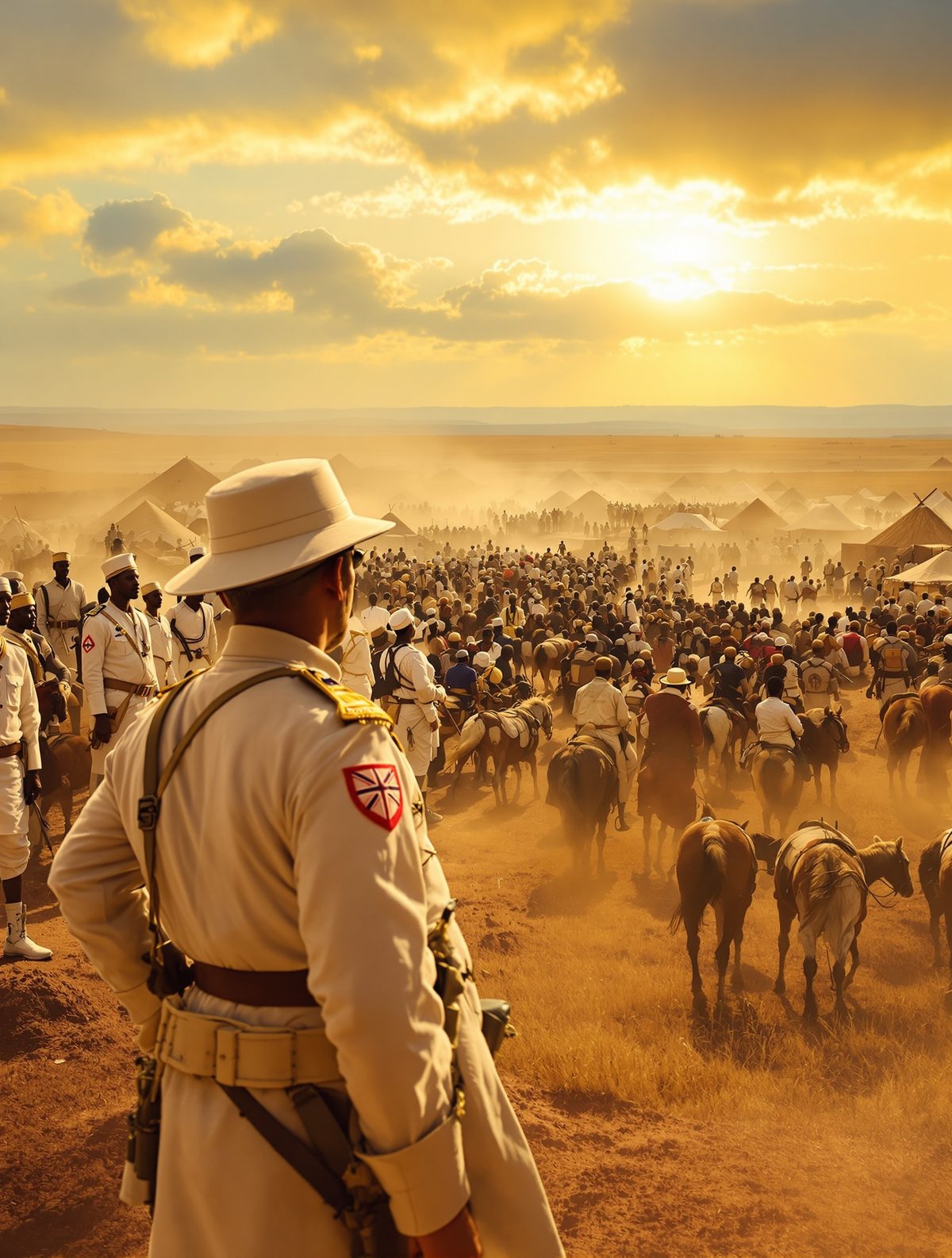
In the autumn of 1879, a lone British officer rode through the most infamous mountain pass in the world, where his predecessors had been murdered and their heads displayed on spikes. The Khyber Pass—that legendary 33-mile corridor between Afghanistan and what is now Pakistan—had already claimed the lives of countless soldiers, administrators, and anyone foolish enough to believe they could tame the fierce Afridi and Shinwari tribes who controlled it. Yet Major Robert Warburton was different. Half-British, half-Afghan, fluent in Pashto, and armed with an almost supernatural understanding of tribal politics, he would do what no European had ever accomplished: turn the Empire's deadliest frontier into its most peaceful.
The Graveyard of Empires' Most Dangerous Post
When Warburton arrived at his new posting as Political Agent of the Khyber, the pass was quite literally littered with the bones of those who had tried to control it before him. The Second Anglo-Afghan War was still raging, and British forces were discovering what Alexander the Great, Genghis Khan, and countless others had learned the hard way: the tribes of the Hindu Kush bow to no empire.
The statistics were sobering. In the previous decade alone, seven Political Agents had been killed or forced to flee the Khyber. The most recent, Captain Cavagnari, had been hacked to pieces in Kabul just months before Warburton's arrival. The pass itself was a 33-mile gauntlet of ambush points, where tribal raiders could appear from the rocky heights, strike a convoy, and vanish into caves that had sheltered their ancestors for millennia.
But Warburton possessed something his predecessors lacked: he was the son of Colonel Robert Warburton and Shah Jehan Begum, an Afghan noblewoman. Born in 1842, he had grown up speaking both English and Pashto, understanding not just the language but the intricate code of honor, hospitality, and revenge that governed Pashtun society. Where other British officers saw only "savage tribes," Warburton saw a complex civilization with its own logic and nobility.
Speaking the Language of Honor
Warburton's first breakthrough came not through force, but through a profound act of cultural understanding. Rather than fortifying himself in the British compound at Jamrud, he did something unprecedented: he moved into the pass itself, establishing his headquarters at Landi Kotal, right in the heart of Afridi territory.
The local tribes watched in amazement as this half-Afghan officer conducted business not in English or Urdu, but in fluent Pashto, quoting their own proverbs and poetry. When disputes arose between clans—as they inevitably did—Warburton didn't impose British law. Instead, he convened traditional jirgas (tribal councils) and helped mediate according to Pashtunwali, the ancient tribal code.
His masterstroke came in 1881 when he established the Khyber Rifles, a force recruited entirely from the local tribes. This wasn't merely pragmatic—it was revolutionary. The same Afridi and Shinwari warriors who had been ambushing British columns were now being paid to protect them. Warburton understood what London didn't: you cannot defeat the Pashtun tribes, but you can earn their respect, and with it, their fierce loyalty.
The Art of Tribal Diplomacy
What made Warburton's success even more remarkable was his mastery of the delicate balance between competing tribal interests. The Khyber was home to multiple clans—the Zakka Khel, Adam Khel, Kuki Khel, and others—each with their own territories, feuds, and traditions. A miscalculation could reignite conflicts that had simmered for generations.
Warburton developed an intricate system of allowances, paying each tribal section for keeping their portion of the pass secure. But this wasn't simple bribery—it was recognition of traditional territorial rights. The Afridis had always controlled the Khyber; Warburton was simply formalizing the arrangement and ensuring British interests aligned with tribal ones.
His diplomatic skills were tested severely in 1897 when the Great Frontier Rising saw tribes across the Northwest Frontier explode in coordinated revolt. From Chitral to Waziristan, British posts were overrun and entire regiments mauled by tribal lashkars (war parties). Yet remarkably, the Khyber remained calm. Warburton's carefully cultivated network of tribal allies held firm, even as their cousins in neighboring agencies joined the rebellion.
The secret lay in Warburton's deep understanding of badal—the Pashtun concept of reciprocal obligation. He had spent years building personal relationships with tribal elders, attending their celebrations, mediating their disputes, and most importantly, keeping his word. In a society where a man's izzat (honor) was worth more than his life, Warburton's reputation for honesty and fairness became his greatest weapon.
The Pax Warburtoniana
By the 1890s, something extraordinary had occurred in the Khyber Pass. What had once been the most dangerous stretch of road in the British Empire had become one of its safest. Caravans moved freely between Peshawar and Kabul. British officials traveled the pass without escort, trusting in Warburton's arrangements with the tribes.
The transformation was so complete that visiting dignitaries would journey to the Khyber specifically to witness this miracle of frontier management. The Viceroy of India, Lord Lansdowne, made the journey in 1892 and found himself dining with Afridi chiefs who, just years before, had been considered irredeemable raiders and murderers.
Warburton's methods became the stuff of legend. He was known to settle disputes with a combination of Quranic wisdom, Pashtun poetry, and practical common sense. When two clans quarreled over grazing rights, he would recite relevant verses about justice and brotherhood. When raiders threatened a caravan, a word from Warburton to the right malik (chief) would see the goods mysteriously returned.
Perhaps most remarkably, Warburton achieved all this with minimal resources. His entire administration consisted of himself, a handful of clerks, and the locally recruited Khyber Rifles. The cost of maintaining peace in the Khyber under Warburton was a fraction of what previous military expeditions had spent—and failed to achieve.
The End of an Era
In 1897, after eighteen years of unprecedented peace, Warburton was forced to retire due to ill health. His departure marked the end of what historians would later call the "Pax Warburtoniana"—a brief golden age when understanding and mutual respect had triumphed over imperial arrogance and tribal hostility.
The contrast with his successors was stark. Within months of Warburton's departure, the old patterns reasserted themselves. His replacement, lacking both linguistic skills and cultural understanding, reverted to the traditional British approach of threats backed by force. The carefully maintained network of tribal relationships began to fray.
By 1919, the Third Anglo-Afghan War would see the Khyber once again become a battleground. The tribes that had remained loyal to Warburton for nearly two decades took up arms against his successors. The pass that had known peace under the half-Afghan major returned to its ancient role as the graveyard of imperial ambitions.
Lessons from the Khyber
Warburton's extraordinary career offers profound lessons that resonate far beyond the dusty archives of imperial history. In an age when cultural understanding is often sacrificed for expedient solutions, his success in the Khyber demonstrates the transformative power of genuine respect for local traditions and values.
His story challenges the simplistic narratives of imperial domination that dominate our understanding of the Victorian era. Here was no swaggering sahib imposing alien values on "backward" peoples, but rather a skilled diplomat who succeeded by recognizing the sophistication and honor of Pashtun society. Warburton's Khyber was proof that even in the most unlikely circumstances, bridges could be built between radically different cultures.
Today, as Western nations continue to grapple with conflicts in Afghanistan and Pakistan—the same tribal areas where Warburton once worked his magic—his example seems almost miraculous. What would be different if modern policymakers possessed even a fraction of his linguistic skills, cultural sensitivity, and genuine respect for local traditions? In our interconnected world, where cultural misunderstanding can have global consequences, Major Robert Warburton's eighteen years of peace in the Khyber Pass remain a testament to what becomes possible when empathy triumphs over arrogance, and when listening proves more powerful than shouting.