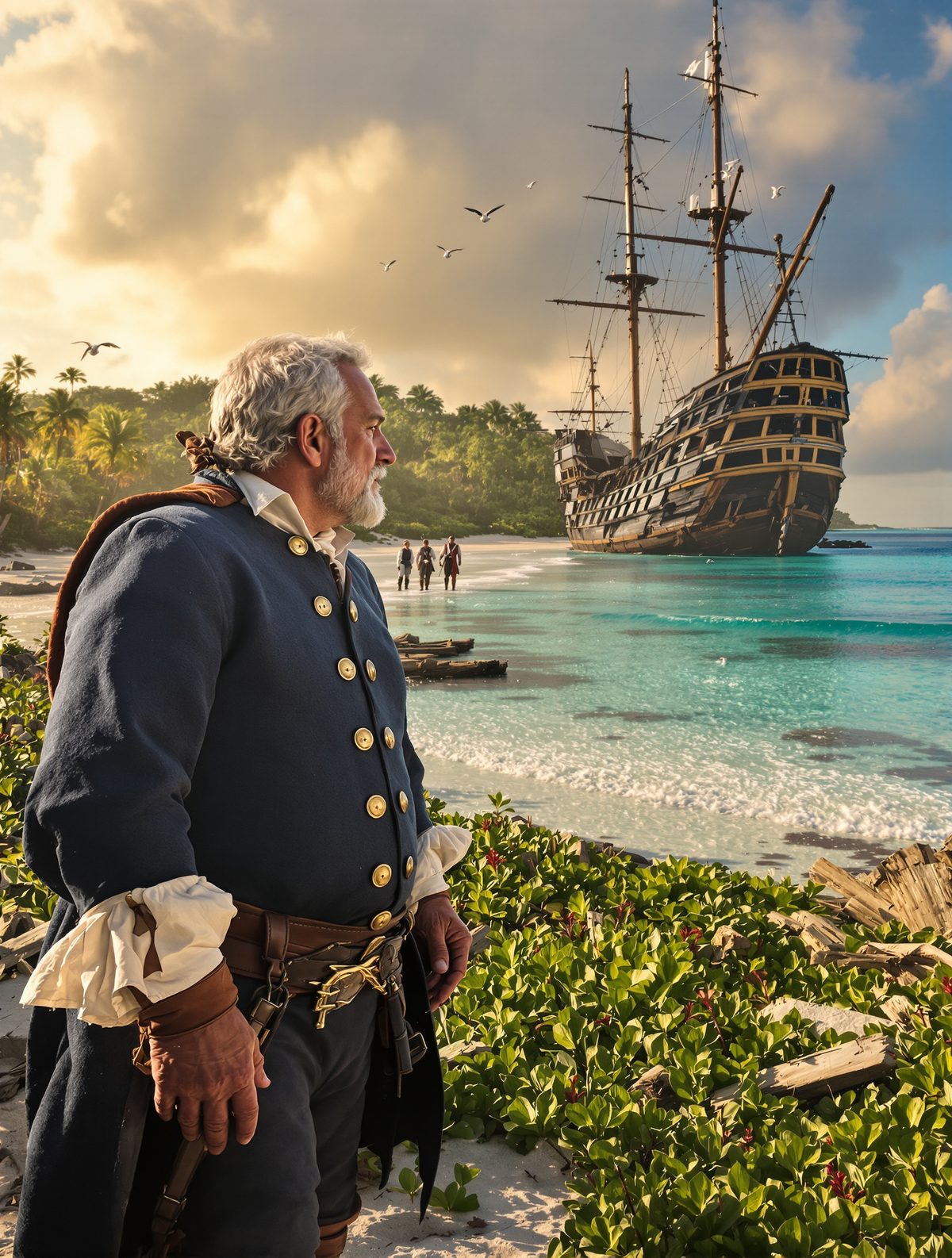
The Arctic wind howled like a banshee across the White Sea as Richard Chancellor watched his compass needle spin wildly in the dancing aurora light. Two months earlier, he had commanded a fleet of three ships. Now, standing on the deck of the Edward Bonaventure in September 1553, he was utterly alone in waters no Englishman had ever seen. His fellow captains Sir Hugh Willoughby and Cornelis Durforth had vanished into the ice somewhere north of Norway, taking 62 men with them into the Arctic void. Chancellor faced a choice that would reshape history: turn back to England with nothing to show for this catastrophic expedition, or sail deeper into the unknown toward what his maps simply labeled "Terra Incognita."
He chose the unknown.
The Merchant Adventurers' Desperate Gamble
The expedition that would accidentally discover Russia began in the counting houses of London, where a group of ambitious merchants calling themselves "The Company of Merchant Adventurers to New Lands" were losing sleep over England's dire economic situation. In 1553, England was essentially a backwater island nation, cut off from the lucrative spice trade by Portuguese and Spanish monopolies. The Mediterranean routes to Asia were controlled by Venice and the Ottoman Empire, while the southern routes around Africa belonged to Portugal.
Sebastian Cabot, the expedition's chief navigator and son of the famous John Cabot, proposed an audacious solution: sail north over the top of the world to reach Cathay (China). It was a theory born of desperation and Renaissance optimism in equal measure. No one had any idea that the Arctic Ocean would remain frozen year-round, or that the continents extended so far north. Maps of the era showed tantalizingly open water beyond Norway, based on nothing more than wishful thinking and ancient Greek theories about climate zones.
The expedition cost £6,000—roughly £2 million in today's money—a fortune that nearly bankrupted its investors. They commissioned three ships: the Bona Esperanza under Sir Hugh Willoughby (the expedition's military commander), the Edward Bonaventure under Chancellor (the chief pilot and navigator), and the Bona Confidentia under Cornelis Durforth. Each vessel carried trade goods worth a king's ransom: fine woolen cloth, precious metals, and samples of England's finest craftsmanship, all intended to dazzle the Emperor of China.
Into the Maelstrom
The fleet departed London on May 11, 1553, to great fanfare. King Edward VI himself came to Greenwich to wish them farewell, though he would be dead before they reached Russian waters. The ships made good time initially, reaching the Lofoten Islands off Norway by late July. But as they pushed further north into the Barents Sea, the weather turned vicious.
What happened next became one of maritime history's most haunting mysteries. A massive Arctic storm struck near modern-day Novaya Zemlya, separating the three ships in mountainous seas and driving snow. The predetermined rendezvous point at Wardhouse (modern Vardø), a small fishing village at Norway's northeastern tip, became their salvation and their curse. Chancellor waited there for weeks, but Willoughby and Durforth never arrived.
Unknown to Chancellor, both ships had been driven far to the northeast, where they eventually found shelter in a river mouth on Novaya Zemlya. When their frozen hulls were discovered the following year by Russian fishermen, all 62 men aboard were found dead in their bunks, apparently victims of carbon monoxide poisoning from their heating fires in the sealed ships. Willoughby's logbook, preserved by the Arctic cold, recorded their final days as they waited for rescue that never came.
The Fishermen Who Changed History
Chancellor, meanwhile, had made the decision that would alter the course of two empires. Rather than return to England, he sailed east into the White Sea, guided only by rough charts and the position of the stars. On August 24, 1553, the Edward Bonaventure dropped anchor in Dvina Bay, near what would later become the city of Arkhangelsk.
The sight that greeted him was unlike anything in his experience: a handful of crude wooden huts scattered along a shoreline that stretched endlessly in both directions, inhabited by fishermen who spoke an incomprehensible language and had never seen a Western European ship. These Pomor fishermen, hardy souls who made their living from the cruel Arctic waters, initially fled at the sight of the strange vessel with its foreign flags and exotic rigging.
But curiosity overcame fear, and soon Chancellor found himself attempting to communicate through gestures and drawings with people whose very existence proved he had sailed beyond the edge of the known world. The fishermen, it turned out, were subjects of someone they called the "Great Sovereign"—Ivan IV, better known to history as Ivan the Terrible, Tsar of all the Russias.
1,500 Miles to Moscow
What happened next defied every expectation Chancellor had harbored about his voyage. Through a combination of sign language, broken Latin from a local priest, and sheer determination, he managed to convey that he was an ambassador from England seeking trade. The local governor, a man named Feofan, made a decision that would echo through centuries: he sent word to Moscow and invited Chancellor to make the journey to meet the Tsar in person.
The overland journey to Moscow took Chancellor through a landscape that seemed to exist outside of time. Traveling by horse-drawn sledge as winter set in, he crossed nearly 1,500 miles of wilderness, through forests so vast that England could have been lost in them without a trace. He passed through Vologda, Yaroslavl, and dozens of settlements that subsisted on fishing, hunting, and primitive agriculture.
Chancellor's own account describes his amazement at the sheer scale of this unknown empire: "The country is very large and full of people, and the towns are well fortified, but the roads are very difficult in winter." He was particularly struck by the Russian treatment of horses, which were allowed to forage for grass beneath the snow, and by the elaborate wooden architecture of Orthodox churches, unlike anything in Protestant England.
Face to Face with Ivan the Terrible
In December 1553, Richard Chancellor became the first Englishman ever to enter the Moscow Kremlin. The audience that followed was a clash of two worlds: the weather-beaten sea captain from Protestant England and the 23-year-old Orthodox Tsar who ruled the largest country on Earth.
Ivan IV was at this point still in the early phase of his reign, before the paranoia and violence that would earn him his terrible epithet had fully manifested. He was fascinated by Chancellor's arrival and saw immediately the potential for an alliance that could benefit both nations. Russia needed Western technology, military expertise, and access to European markets. England desperately needed new trade routes and markets for its wool.
The Tsar received Chancellor in the Palace of Facets, a ceremony of almost unimaginable splendor for a man who had been sleeping in fishing huts just months before. Chancellor described halls lined with gold, elaborate feasts featuring dozens of courses, and a level of court ceremony that rivaled anything in Western Europe. Ivan personally served Chancellor wine, an honor typically reserved for the highest nobility.
More importantly, Ivan granted Chancellor and the Muscovy Company (as the merchant adventurers were now known) extraordinary trading privileges: the right to travel freely throughout Russian territory, exemption from taxes, and virtual monopoly status for English trade. These privileges were more extensive than those granted to any other foreign power, making England Russia's preferred Western partner overnight.
The Door That Never Closed
Chancellor returned to England in 1554 with a cargo of furs, wax, and honey worth a fortune, but his real treasure was the trading agreement that opened Russia to the Western world. The Muscovy Company, operating from their base at the mouth of the Dvina River, became one of England's most profitable enterprises, funding everything from Elizabeth I's naval expansion to early colonial ventures in America.
The irony is exquisite: in seeking a route to China, Chancellor had found something far more valuable—a vast empire rich in natural resources and desperate for Western goods. The connection he established would survive wars, revolutions, and centuries of political upheaval. Even today, the relationship between Britain and Russia, however complicated, can trace its roots to that moment when a lost English sea captain knocked on the door of a fishing village and was invited to meet the Tsar.
Chancellor's accidental diplomacy proved that sometimes the greatest discoveries come not from reaching your intended destination, but from having the courage to explore where you never meant to go. In an age when we can map every corner of the Earth from space, his story reminds us that the most profound journeys are often the ones that take us furthest from home—and closest to understanding how vast and surprising our world really is.