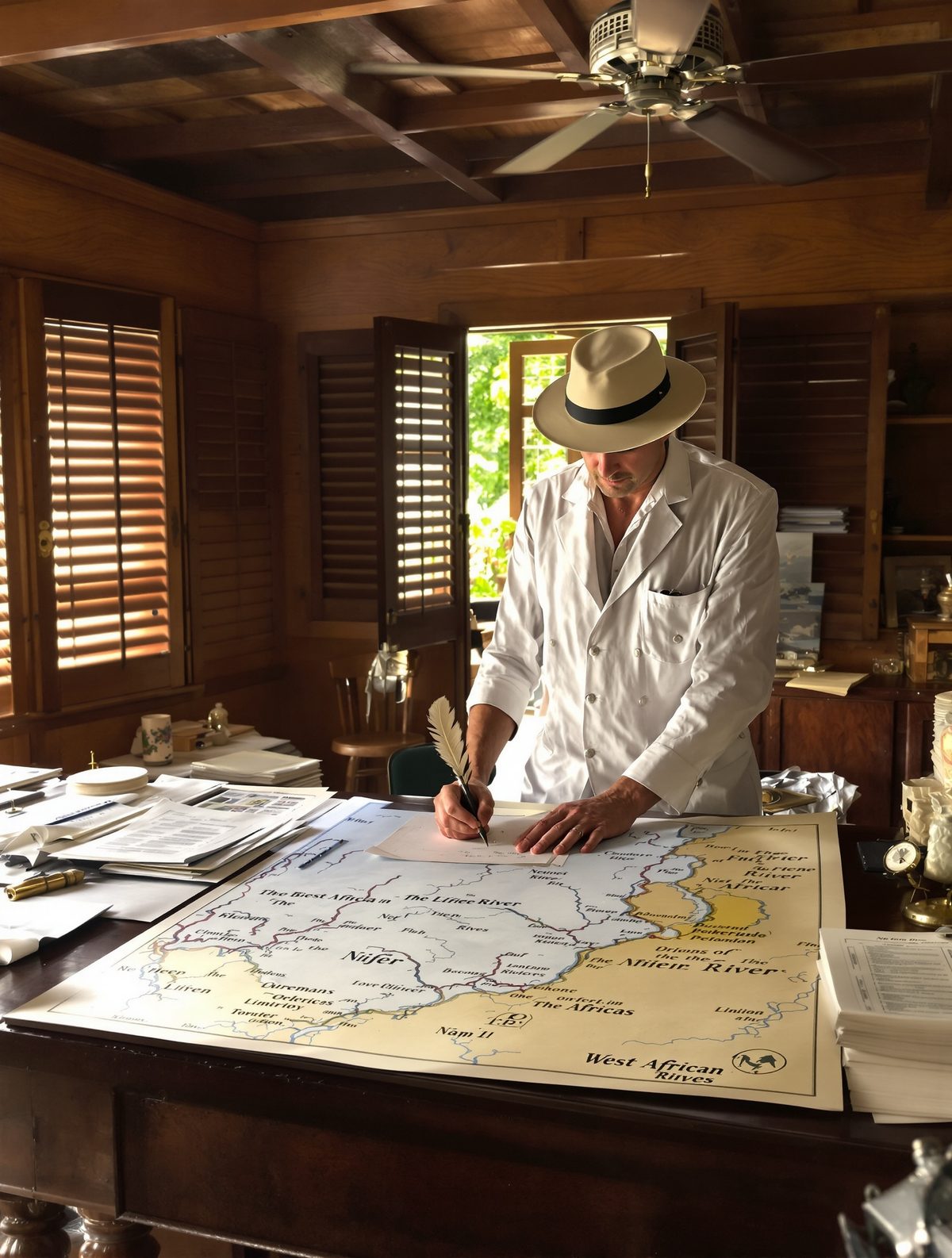
Picture this: It's a muggy afternoon in Lagos, 1886. French warships patrol the Niger Delta while German officers stride through coastal trading posts, planting flags and making proclamations. Meanwhile, in a modest London office thick with pipe smoke, a middle-aged Scottish trader named George Goldie stares at a hand-drawn map of West Africa. He has no army. No navy. Just a handful of ramshackle trading stations scattered along Africa's third-longest river. What he does next will hand Britain an empire the size of France and Germany combined—with nothing more than audacious paperwork and the greatest bluff in imperial history.
The Great African Chess Game Begins
The year 1886 found Europe's great powers locked in what historians would later call the "Scramble for Africa." Following the Berlin Conference of 1884-85, the continent had become a giant chessboard where nations moved pieces of territory with breathtaking speed. The rules were deceptively simple: if you could prove "effective occupation" of a territory—meaning actual control, not just a flag on a beach—you could claim it for your empire.
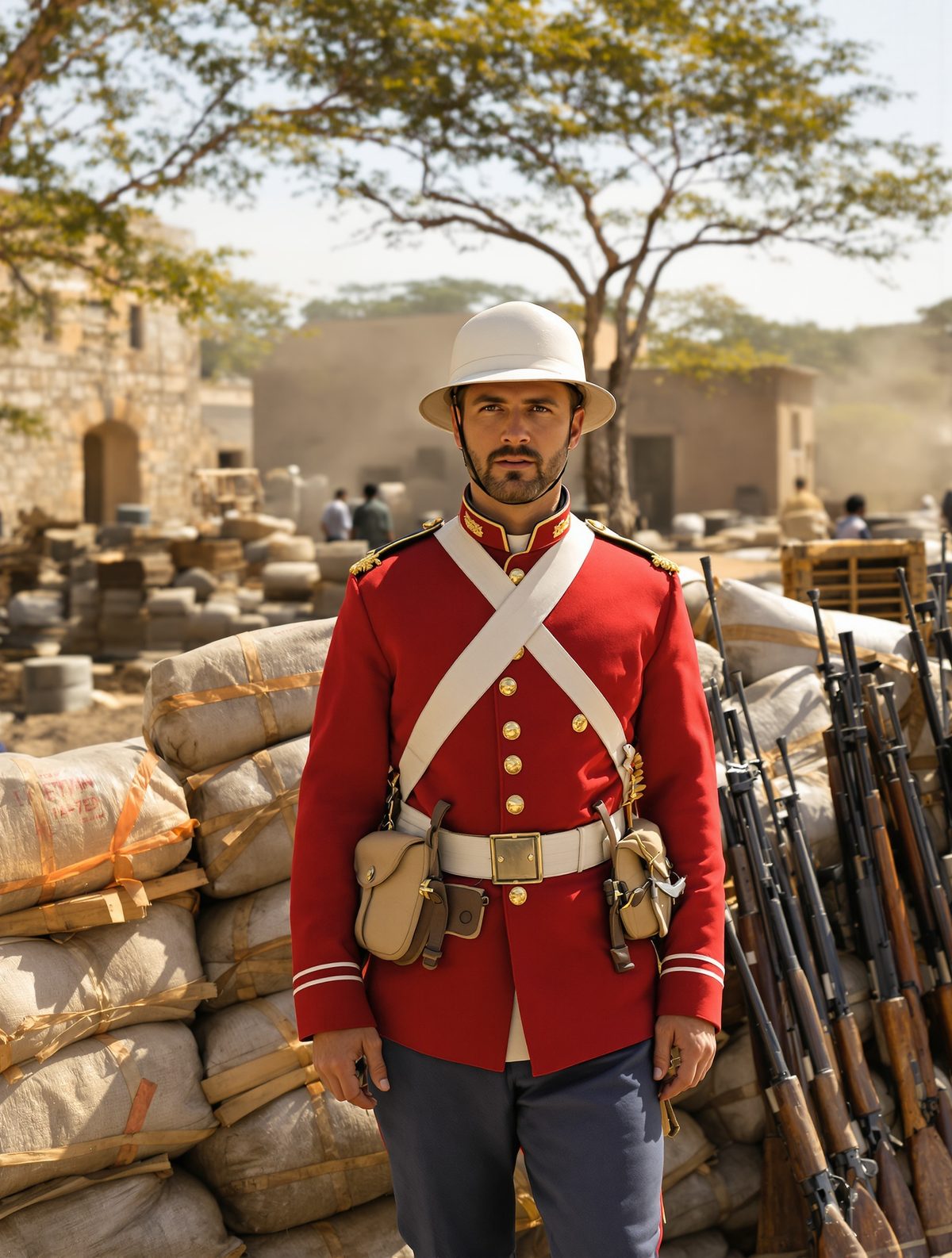
Nowhere was this scramble more intense than along West Africa's Niger River. The waterway snaked 2,600 miles through the heart of the continent, offering access to palm oil, ivory, and rumors of gold that had European merchants salivating. French forces, fresh from their conquests in Senegal, were pushing eastward with military precision. German traders, backed by Bismarck's new imperial ambitions, had already planted their flag in Cameroon and were eyeing Nigerian territory with Teutonic efficiency.
And Britain? Britain had George Goldie.
Born George Dashwood Taubman in 1846 on the Isle of Man, Goldie was an unlikely empire builder. He'd failed at Cambridge, scandalized his family by running off with the governess, and only ended up in West Africa after inheriting his father's struggling palm oil business. Yet this restless Scotsman possessed something his European rivals lacked: an intimate understanding that in Africa, paper could be mightier than the sword.
The Man Who Collected Treaties Like Stamps
While French and German officials were busy building forts and training colonial troops, Goldie was orchestrating a very different kind of conquest. Throughout the early 1880s, he had been dispatching agents up and down the Niger with satchels full of treaty forms, bottles of gin, and instructions to secure agreements with every tribal chief, village headman, and minor king they could find.
These weren't particularly impressive documents by European standards. Most were hastily scrawled agreements where local rulers granted trading rights to Goldie's Royal Niger Company in exchange for modest payments—often just a few cases of gin, some bolt-action rifles, or annual stipends of twenty pounds. The chiefs, many of whom couldn't read English, probably viewed them as little more than trading licenses with some oddly theatrical white men.
But Goldie saw something else entirely: legal proof of British presence throughout the Niger basin. By 1886, his agents had collected over 300 such treaties, creating a paper trail that stretched from the Niger Delta to the ancient trading cities of the Sahel. Each document, however humble, represented a potential British claim to sovereignty that could be wielded at the diplomatic tables of Europe.
The brilliance of Goldie's strategy lay in its sheer scope. While his competitors focused on securing strategic ports and river mouths with military force, he was quietly accumulating legal claims to the vast interior—territories that contained millions of people and resources beyond imagination, but which appeared on most European maps as blank spaces marked simply "unexplored."
The Bluff That Conquered an Empire
The moment of truth arrived in August 1886. French forces had seized several trading posts along the lower Niger, and German merchants were pressuring their government to formalize claims in the region. The British government, distracted by crises in Egypt and Afghanistan, seemed ready to concede West Africa to their European rivals rather than commit military resources to what many saw as a commercial backwater.
That's when Goldie made his move. On August 10, 1886, he walked into the Colonial Office on Downing Street carrying a leather portfolio that would change the map of Africa forever. Inside were those 300-odd treaties, carefully organized and annotated, covering an area of roughly 500,000 square miles—larger than the entire German Empire.
What happened next was bureaucratic theater worthy of Shakespeare. Goldie didn't claim the territories for himself or even for his trading company. Instead, he formally petitioned the British Crown to grant his Royal Niger Company a royal charter—essentially, legal permission to govern these vast territories as a private entity on behalf of the British Empire.
The audacity was breathtaking. Goldie was asking the government to grant him administrative control over lands that contained an estimated 20 million people, based entirely on commercial treaties with local rulers who had never intended to surrender political sovereignty. He had no administrative apparatus, no colonial army, and no realistic means of enforcing British law across such a vast area.
But he had those treaties. And in the legalistic world of 19th-century diplomacy, that was enough.
When Paperwork Becomes Empire
On July 10, 1886, Queen Victoria signed the royal charter establishing the Royal Niger Company as the de facto government of what would become northern Nigeria. With the stroke of a pen, Goldie's commercial enterprise became a sovereign entity with the right to collect taxes, maintain armed forces, and administer justice across an area larger than France and Spain combined.
The international reaction was swift and incredulous. French diplomats protested that Britain was claiming territories where no British official had ever set foot. German newspapers mocked the "paper empire" built on treaties with "illiterate African chiefs." They weren't entirely wrong—many of Goldie's treaty partners had probably never imagined they were signing away their independence to a distant European monarch.
But the bluff worked. When French forces attempted to challenge British claims along the upper Niger, Goldie's agents simply produced their treaties, stamped with official seals and filed in triplicate with the Colonial Office. Under the rules established at Berlin, these documents constituted legal proof of "effective occupation," regardless of the actual British presence on the ground.
The French and Germans found themselves in the peculiar position of having to militarily conquer territories that were already legally British, transforming what should have been simple colonial expansion into potential acts of war against the British Empire. Faced with this diplomatic checkmate, they gradually withdrew their claims, leaving Goldie's paper empire to become very real indeed.
The Reckoning
Of course, claiming an empire and governing one proved to be very different challenges. Goldie's Royal Niger Company spent the next two decades struggling to impose actual control over territories that existed primarily in filing cabinets. Local rulers who had signed trading agreements found themselves subject to British courts and tax collectors. Resistance was frequent and often bloody, culminating in military campaigns that revealed the hollow nature of many treaty relationships.
By 1900, the British government had revoked Goldie's charter and assumed direct control over what became the Colony and Protectorate of Nigeria. The paper empire had become too real, too complex, and too expensive for a private trading company to manage.
Yet Goldie's achievement remains remarkable. Through a combination of legal acumen, strategic thinking, and sheer audacity, he had secured for Britain one of Africa's largest and most populous territories without firing a shot or spending a pound of government money. The Nigeria he created through diplomatic sleight-of-hand would become one of the jewels of the British Empire, and eventually Africa's most populous nation.
The Pen That Shaped a Continent
Today, as we grapple with the legacies of European colonialism in Africa, Goldie's story offers a fascinating glimpse into how empires were actually built—not through the dramatic military campaigns that dominate our textbooks, but through patient accumulation of legal claims, bureaucratic maneuvering, and carefully orchestrated bluffs.
Modern Nigeria, with its 200 million people and position as Africa's largest economy, exists largely within the boundaries that Goldie drew in London offices during the 1880s. The ethnic tensions, administrative challenges, and economic inequalities that define contemporary Nigerian politics can be traced directly back to those hastily signed treaties that merged hundreds of distinct communities into a single colonial entity.
Perhaps most remarkably, Goldie's methods weren't entirely unique. Across Africa and Asia, European empires were built through similar combinations of legal manipulation, diplomatic bluffing, and the strategic exploitation of international law. The "Scramble for Africa" wasn't just a military conquest—it was history's largest real estate transaction, conducted with fountain pens rather than field guns.
In our modern world of international law and corporate globalization, Goldie's story feels surprisingly contemporary. His ability to transform commercial relationships into political sovereignty, to leverage legal technicalities into territorial control, and to build an empire through paperwork rather than military force offers lessons that extend far beyond the dusty archives of colonial history. Sometimes the most powerful weapon isn't the one that makes the loudest noise—it's the one that whispers quietly in the language of law.