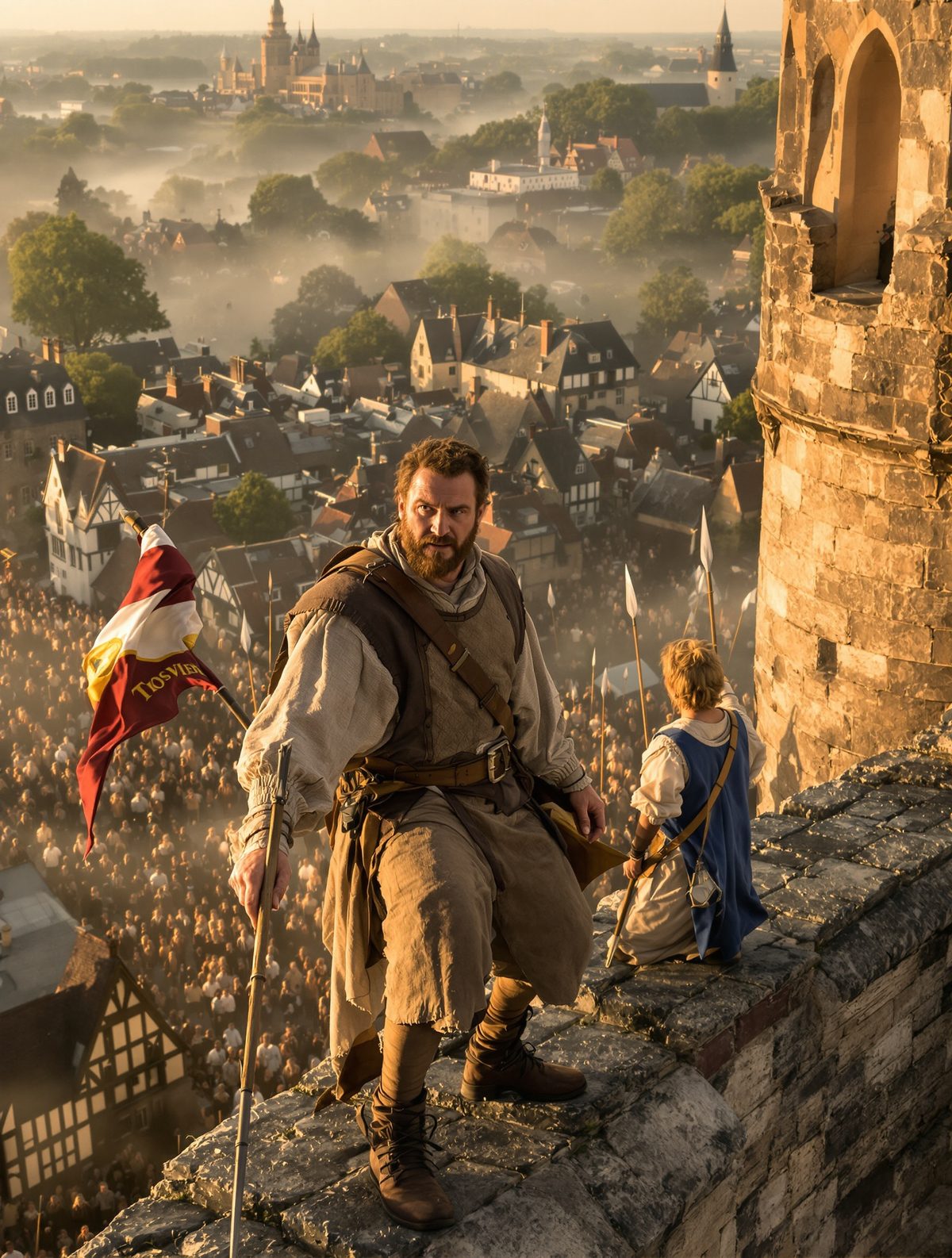
The Pacific Ocean stretched endlessly in every direction, its blue waters masking the most jealously guarded secret of the Spanish Empire. It was June 1594, and somewhere off the coast of Ecuador, a single English warship had committed the ultimate act of defiance—sailing into Spain's private sea. Aboard the Dainty, Sir Richard Hawkins peered through his spyglass at the horizon and felt his blood turn to ice. Seven massive Spanish galleons were bearing down on his solitary vessel, their hulls bristling with cannon and their decks swarming with over 1,500 battle-hardened marines. Hawkins had just 76 men. What happened next would become the most spectacular David-versus-Goliath sea battle of the Elizabethan Age—and one of history's most forgotten acts of heroism.
Into the Forbidden Sea
To understand the audacity of Hawkins' voyage, you must first grasp what the Pacific Ocean meant to 16th-century Spain. This wasn't just any body of water—it was Mare Nostrum, "Our Sea," a Spanish lake stretching from California to Chile. The Treaty of Tordesillas in 1494 had carved up the unknown world between Spain and Portugal, and Spain had claimed everything west of an imaginary line through the Atlantic. For nearly a century, Spanish treasure fleets had sailed these waters unmolested, ferrying Peruvian silver and Oriental spices back to Seville in convoys so regular you could set your calendar by them.
Only three English ships had ever dared enter these waters before Hawkins: Francis Drake's Golden Hind in 1578-80, Thomas Cavendish's Desire in 1586-88, and John Chidley's ill-fated expedition of 1589. Drake had returned home with £160,000 in Spanish treasure—roughly £48 million in today's money. Cavendish had captured the Manila galleon itself, the richest prize in the Pacific. But Chidley had vanished without a trace, his ships and 250 men swallowed by the vast ocean.
Richard Hawkins knew these odds when he set sail from Plymouth in June 1593. The son of the legendary slave trader and naval commander Sir John Hawkins, he had grown up breathing salt air and dreaming of glory. His ship, the Dainty, was a 400-ton masterpiece of English shipbuilding—sleeker and faster than any Spanish galleon, armed with 36 guns, and crewed by hand-picked veterans of the Spanish wars.
The Longest Route to Glory
Hawkins' journey to his date with destiny took nearly a year. After leaving England, he sailed south along the African coast, crossed the Atlantic to Brazil, then attempted the treacherous passage through the Strait of Magellan. Here's a detail that rarely makes it into the history books: Hawkins spent two months battling the notorious winds of the strait, at one point being blown backward for three weeks straight. His men began to whisper that the voyage was cursed.
When the Dainty finally emerged into the Pacific in February 1594, Hawkins faced an immediate problem. His food supplies were running dangerously low, and his men were showing signs of scurvy. He made the fateful decision to raid Spanish settlements along the Chilean and Peruvian coasts—not for treasure, but for basic survival. At Valparaíso, he captured three ships loaded with wine and provisions. At Coquimbo, his men seized 12,000 pesos worth of silver.
Each raid was a calculated risk. Spanish colonial administrators were frantically sending messages north along the coast, alerting every port and garrison to the presence of the English pirate ship. In Lima, the Viceroy of Peru, García Hurtado de Mendoza, was assembling the largest Spanish fleet ever sent against a single enemy vessel. Six massive galleons and one patache (a smaller warship) were fitted out with the best artillery in the Pacific and crammed with soldiers from the elite tercios—Spain's legendary infantry formations that had conquered half of Europe.
The Hunters Become the Hunted
By June 1594, Hawkins had transformed from hunter to hunted. Spanish intelligence networks—surprisingly sophisticated for the era—had tracked his movements with remarkable precision. The colonial authorities knew he would have to sail north toward Mexico to seek fresh water and supplies, and they positioned their fleet accordingly. The trap was set off the coast of Ecuador, near the town of Atacames.
On June 20th, Hawkins' lookouts spotted the Spanish fleet emerging from behind a headland like wolves from a forest. The sight must have been terrifying: seven towering galleons with names like San Bartolomé and Santa Margarita, their sides studded with bronze cannon, their mainmasts flying the crimson and gold banners of Spain. The flagship alone carried 44 guns and 400 men.
A lesser captain might have fled immediately, but Hawkins faced an impossible dilemma. The Dainty was faster than the Spanish ships, but his crew was exhausted from a year at sea, and several of his men were too sick with scurvy to fight effectively. Moreover, the Spanish had positioned themselves expertly—escape routes to the north and south were blocked, and the eastern route led only to hostile coastline bristling with fortifications.
Hawkins made a decision that still astonishes naval historians: he would fight.
Three Days in Hell
The battle that began at dawn on June 21, 1594, defied every principle of naval warfare. By all logic, it should have lasted perhaps an hour—just long enough for seven galleons to surround and pound a single English ship into splinters. Instead, it became a three-day epic that pushed human endurance to its absolute limits.
Hawkins' strategy was brilliant in its simplicity: keep moving, never let the Spanish ships coordinate their attacks, and use the Dainty's superior speed and maneuverability to fight them one or two at a time. For hour after hour, the English ship danced around her massive opponents like a wasp tormenting bears, darting in to deliver devastating broadsides before wheeling away from their return fire.
The Spanish, meanwhile, faced a frustrating tactical puzzle. Their ships were individually more powerful than the Dainty, but in trying to surround her, they often ended up firing into each other. Contemporary Spanish accounts—preserved in the Archive of the Indies in Seville—describe the confusion and rage of commanders who couldn't bring their numerical superiority to bear.
By the end of the first day, both sides had taken terrible casualties. The Dainty's mainmast was shot through, her hull was holed in a dozen places, and eight of Hawkins' men lay dead on the blood-slicked deck. But two of the Spanish galleons had also suffered severe damage, and one had been forced to withdraw from the fight with her rudder destroyed by English cannon fire.
The second day brought fresh horrors. Spanish marines, frustrated by their inability to close for boarding, resorted to firing incendiary shot to try to set the English ship ablaze. Hawkins' men fought fires even as they manned the guns, beating out flames with their bare hands while cannon balls screamed overhead. At one point, the Dainty's powder magazine nearly exploded—disaster averted only when a teenage ship's boy named Thomas Ellis threw himself on a burning cartridge, suffering severe burns but saving the ship.
The Last Stand of the Dainty
Dawn of the third day revealed a scene from maritime hell. The Dainty was barely recognizable as a ship—her masts hung in splinters, her sides were shot through like a sieve, and her deck was carpeted with the wounded and dying. Of Hawkins' original crew of 76, only 18 men were still capable of fighting. Yet somehow, impossibly, the ship still floated and her guns still fired.
The Spanish, too, had paid a fearful price. Three of their galleons were so badly damaged they could barely stay afloat, and their casualties numbered in the hundreds. Spanish commanders later admitted they had never encountered such ferocious resistance from such a small force.
The end came not from enemy fire, but from simple physics. The Dainty's hull, riddled with shot holes and taking on water faster than her exhausted crew could pump it out, finally began to settle in the water. With his ship dying beneath him and his surviving men too wounded to continue fighting, Hawkins made the hardest decision of his life: he struck his colors in surrender.
Even in defeat, the English maintained their defiance. As Spanish marines swarmed aboard the sinking ship, Hawkins allegedly told their commander: "You have captured my ship, but you have not captured my spirit, nor that of England." The Spanish, who had expected a quick victory, found themselves staring at the survivors with something approaching awe.
Legacy of the Impossible Battle
Sir Richard Hawkins spent the next eight years as a prisoner in Spain, finally ransomed for £3,000—an enormous sum that reflected Spanish respect for his courage. He returned to England in 1602 to find himself a legend, his three-day battle already entering the folklore of the Elizabethan navy. Elizabeth herself reportedly said that Hawkins had done more for England's reputation with his defeat than many captains had accomplished with their victories.
But the true significance of Hawkins' last stand goes far beyond individual heroism. In fighting seven Spanish galleons to a standstill, the Dainty had shattered the myth of Spanish naval invincibility in the Pacific. Spanish confidence in their monopoly over "their" ocean was permanently broken, opening the door for later English expansion into Asian markets and the eventual establishment of the East India Company's dominance.
In our modern age of drone warfare and satellite surveillance, it's easy to forget what courage looked like when 76 men faced 1,500 in wooden ships powered by wind and human will. Hawkins' battle reminds us that the greatest victories are sometimes won not by conquering others, but by refusing to be conquered ourselves. In those three desperate days off Ecuador, a single English ship proved that determination and skill could triumph over overwhelming odds—a lesson as relevant today as it was four centuries ago.