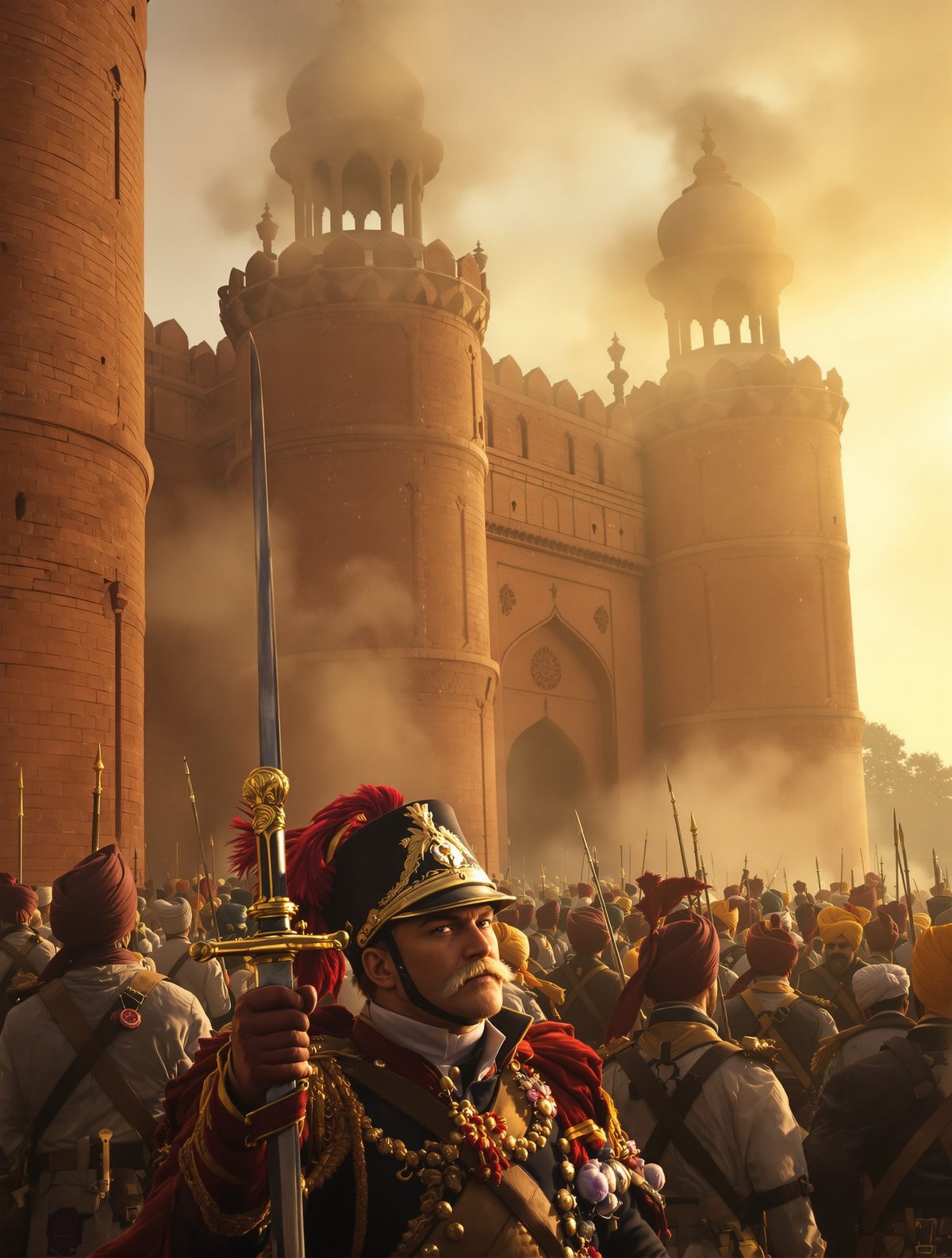
The morning mist clung to the Straits of Malacca like a shroud as HMS Indiana dropped anchor off a forgotten island on January 29, 1819. Sir Thomas Stamford Raffles stepped onto the muddy shore of what the locals called Singapura—the Lion City—and gazed across 239 square miles of swampy jungle that would become one of history's greatest commercial empires. He had six days to pull off the most audacious diplomatic coup of the 19th century, defying his own government, outwitting the Dutch Empire, and gambling his entire career on a handshake with a man who might not even be the rightful ruler.
What happened next would reshape the map of Asia forever.
The Rogue Lieutenant-Governor's Impossible Mission
Raffles wasn't supposed to be there. The 38-year-old Lieutenant-Governor of Bencoolen had explicit orders from the East India Company directors in London: do not antagonize the Dutch. The Treaty of London, signed just months earlier, had carved up Southeast Asia between Britain and the Netherlands, leaving the British squeezed out of the crucial spice trade routes. But Raffles saw what his superiors couldn't—or wouldn't. Britain needed a strategic foothold in the Straits of Malacca, the narrow waterway through which passed the lifeblood of Eastern commerce.
Standing barely five feet tall with piercing blue eyes and an encyclopedic knowledge of Malay culture, Raffles had already defied convention throughout his meteoric rise from clerk to colonial administrator. Born the son of a ship's captain, he'd taught himself Malay, immersed himself in local customs, and earned a reputation as the rare Englishman who actually understood the region he governed. Now, with his career hanging in the balance, he was about to make the biggest gamble of his life.
The strategic prize was obvious to anyone who understood maritime commerce. Singapore sat at the southern tip of the Malay Peninsula like a cork in a bottle, commanding the narrow strait between the Indian Ocean and the South China Sea. Every ship carrying silk from China, spices from the Indies, or opium from India had to pass within sight of its shores. Control Singapore, and you controlled the golden highway of Asian trade.
A Swampy Island and a Succession Crisis
What Raffles found when he arrived was hardly impressive. Singapore in 1819 was home to perhaps 1,000 people—mostly Malay fishermen, Chinese traders, and a handful of Bugis pirates. Tigers roamed freely through the dense jungle, and the air hung thick with the smell of mangrove swamps. The island's only significant settlement clustered around the Singapore River, where a modest trading post conducted business under the watchful eye of the Temenggong, the local Malay chief who served as the Sultan's representative.
But Raffles had done his homework. The Sultanate of Johor, which nominally controlled Singapore, was torn by a succession dispute that offered exactly the opportunity he needed. When the old Sultan had died in 1812, the Dutch had installed his younger son, Abdul Rahman, as their puppet ruler. The rightful heir, Tengku Long, had been conveniently absent during the funeral ceremonies—and under Malay law, a Sultan could only be crowned in the presence of the royal regalia.
Here was Raffles' opening. Tengku Long, living in exile on the nearby Riau Islands, had never formally renounced his claim to the throne. If Raffles could find him, recognize him as the legitimate Sultan, and secure a treaty in his name, he could establish British rights to Singapore while maintaining at least a veneer of legality.
It was a plan so audacious it bordered on fantasy. The Dutch controlled these waters with their formidable fleet. The East India Company would almost certainly disavow him if things went wrong. And he was betting everything on backing a claimant who hadn't set foot in his supposed kingdom for seven years.
The Six-Day Miracle
What followed was a masterclass in colonial diplomacy conducted at breakneck speed. Raffles immediately dispatched his aide, Captain John Crawford, to track down Tengku Long while he began negotiations with Temenggong Abdu'r Rahman, the local chief who actually controlled the island day-to-day.
The Temenggong found himself in an impossible position. Acknowledging Tengku Long's claim would mean defying the Dutch-backed Sultan Abdul Rahman—his own nominal superior. But the British were offering something the Dutch never had: free trade. Instead of the restrictive monopolies that choked commerce throughout the Dutch East Indies, Raffles promised that Singapore would be a free port, open to merchants of all nations.
On February 6, 1819—just six days after his arrival—Raffles achieved the impossible. In a makeshift ceremony on the banks of the Singapore River, Tengku Long was proclaimed Sultan Hussein Shah of Johor, with the Temenggong standing beside him as witness. In exchange for British recognition and protection, the new Sultan granted the East India Company the right to establish a trading post on Singapore in perpetuity, along with full administrative control over the settlement.
The ceremony itself was a hastily improvised affair that would have seemed almost comical if the stakes weren't so high. With no royal regalia available, Raffles had to make do with what ceremony he could muster, conducting the recognition under a canvas tent while local Malays looked on in bewilderment. But legal or not, it was done. Britain now had a foothold in the Straits of Malacca.
David vs. Goliath in the Spice Islands
The Dutch reaction was swift and furious. Governor-General Godert van der Capellen dispatched warships to Singapore within weeks, demanding that the British withdraw immediately. Dutch officials arrived with documents proving that Singapore belonged to the Sultan Abdul Rahman—their Sultan—and therefore any agreement with his rival was null and void.
But Raffles had anticipated this. He'd positioned himself not as a conqueror but as a protector of legitimate authority, backing the rightful Sultan against a Dutch-imposed usurper. When Dutch Admiral Wolterbeek arrived with a squadron of warships in May 1819, he found Raffles calmly continuing his work, treating the Dutch protests as the complaints of interlopers in sovereign Johor territory.
The confrontation could easily have escalated into open warfare, but neither side was quite ready for that step. The Dutch had their hands full with rebellions across their Indonesian territories, while the British government was still hoping to avoid a complete breakdown in Anglo-Dutch relations. Instead, what followed was a tense diplomatic standoff that would last for five years, with Singapore developing rapidly under British protection while the Dutch fumed and plotted.
Raffles had correctly calculated that possession would prove nine-tenths of the law. Every month that Singapore remained under British control, every ship that called at its free port, every merchant who established a warehouse on its shores, made it harder for anyone to roll back what he had accomplished.
From Swamp to Empire in Record Time
The transformation of Singapore from malarial backwater to thriving commercial hub happened with stunning speed. Raffles' promise of free trade acted like a magnet for merchants throughout the region. Chinese traders, chafing under Dutch restrictions in Batavia and Malacca, flocked to Singapore. Indian merchants established branches of their family firms. Even Arab and European traders found Singapore's liberal policies irresistible.
By 1821, just two years after Raffles' arrival, Singapore's population had exploded to over 5,000. The port was handling more than 2,500 vessels annually, and the settlement was generating enough revenue to pay for its own administration. The swampy trading post had become the fastest-growing city in Asia.
The Dutch, watching their centuries-old monopoly crumble, finally accepted reality. The Anglo-Dutch Treaty of 1824 formally recognized British control over Singapore in exchange for British withdrawal from Sumatra. Raffles had won his gamble completely—Singapore was officially British, and the Dutch had been permanently shut out of the Straits of Malacca.
But for Raffles himself, victory came with a bitter personal cost. The East India Company directors, while ultimately accepting his fait accompli, never forgave him for his insubordination. He was recalled to London in 1823, his health broken by years in the tropics, his finances ruined by unsuccessful investments. He died in 1826, just 44 years old, never living to see Singapore become the crown jewel of Britain's Eastern empire.
The Bluff That Built an Empire
Today, as massive container ships pass through the Singapore Strait carrying a fifth of the world's traded goods, it's worth remembering that this global crossroads exists because one ambitious colonial administrator was willing to risk everything on an impossible bluff. Raffles' gamble in 1819 didn't just create a successful port—it established a template for the modern global economy, where free trade and strategic location could triumph over traditional monopolies and imperial control.
Singapore's transformation from swamp to metropolis in just six days of frantic diplomacy proves that history's most decisive moments often turn on individual audacity rather than grand institutional plans. Sometimes it takes one person willing to ignore their orders, defy conventional wisdom, and bet everything on their vision of what's possible. Raffles saw the future of global commerce more clearly than the directors in London or Amsterdam—and had the courage to seize it with both hands, even when everyone told him it was impossible.