Bernard Montgomery nearly died in October 1914. Few know that, or how it shaped his remarkable military career.
The Young Lieutenant and the Forgotten Battle
It was the autumn of 1914, barely a month into what would become the protracted agony of World War I. In the fields around a small village in northern France—a place that history itself has almost forgotten—British forces found themselves in a grim, muddy stalemate with the Germans. Among the countless young men thrust into the frontline horror was a junior lieutenant by the name of Bernard Law Montgomery.
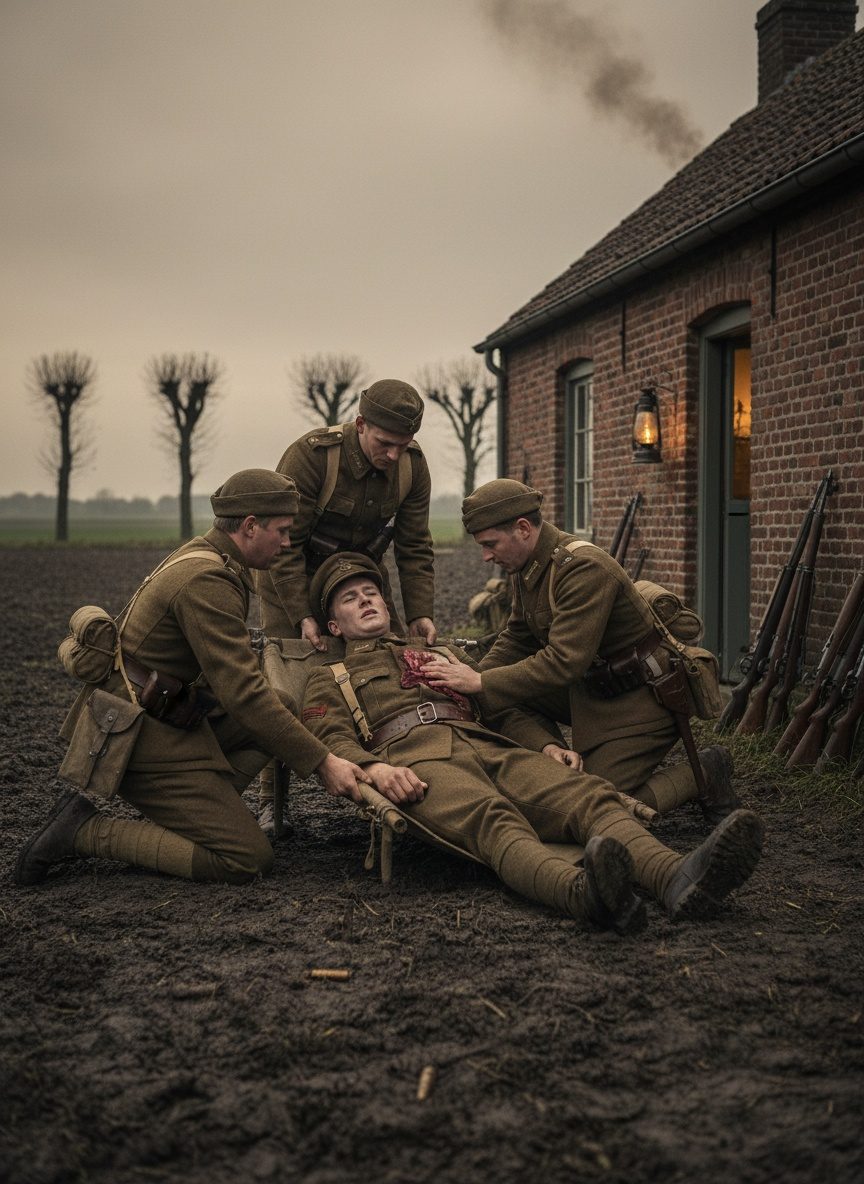
On October 13, 1914, at the village of Meteren, Montgomery's unit faced fierce German resistance. The roar of artillery was relentless, the ground a treacherous blend of mud and barbed wire. It was in this cauldron of chaos that a single sniper's bullet found its mark. The projectile tore through the 26-year-old's right lung, leaving him sprawled in the grime of no man's land, lifeblood seeping away.
As his comrades scrambled to recover the wounded from the battlefield, the prognosis for Montgomery was grim. The doctors, overwhelmed by the sheer scale of casualties, ordered a grave to be dug. Yet destiny seemed not yet done weaving its tapestry around this young officer’s life.
The Dressing Station: A Crucible of Survival
Bernard Montgomery was carried off the battlefield with the expectation of death hanging over him. At a dressing station, tent flaps snapping in the chill wind, medics worked desperately to stabilize him. The bullet had barely missed his heart, but still, the injuries were severe, and infection was a constant specter.
It was here, on the thin line between life and death, that something remarkable happened. Against the odds, Montgomery's body began to rally. As the days stretched on, turning into weeks, each shallow, labored breath was a triumph of tenacity.
But as much as this early brush with death was a test of physical endurance, it was also a crucible for his developing mind. The experience etched into him a profound awareness of the cost of war—to body and spirit—and planted the seeds of what would become his meticulous attention to detail and cautious strategy. These qualities would later define his command style during the Second World War.
Months of Pain, an Army of Demons
The path to recovery was arduous. What began as days in the dressing station turned into months at various hospitals, a period of intense pain and rehabilitation. It was during this time that Montgomery's iron will began to harden, each day of recovery a battle of its own.
Following his discharge from the front, Montgomery was assigned to roles away from direct combat, deepening his understanding of military strategy and operations from a position of safety—ironic for a man whose future would involve leading from the very front lines. His survival ignited an insatiable desire for growth; he delved into military philosophy and began formulating the cautious yet effective strategies that would one day distinguish him.
Murrow's Law of Collateral Growth applies here: when one narrowly escapes fate's grim scythe, the path forward is often marked by a different kind of relentless pursuit. Montgomery extracted every lesson possible from his ordeal, resolving to spare his future men the horror of being rendered helpless on the field by a lack of preparation or strategy.
The Legacy of Leadership Forged by Fire
The strategic brilliance that Montgomery exhibited during the Second World War can be traced back to these crucible moments. Known for his fastidious planning and cautious advancement, “Monty,” as he was affectionately called by his troops, came to be respected for his tireless efforts to minimize unnecessary combat losses. This was no small feat in the brutal theaters of North Africa and Europe from 1939 to 1945.
Montgomery’s leadership in battles such as El Alamein was characterized by painstaking planning, his strategies rooted in the deeply personal understanding of the cost of life and the chaos he experienced in 1914. It spoke volumes to his ability not only to survive a near-fatal shot but to use the experience to inform his leadership philosophy.
Why This Story Matters
History often turns on moments of unforeseen consequence. Bernard Montgomery's life nearly ended on the fields of Meteren—a forgotten battle amidst a forgotten village. Yet in surviving, Montgomery adapted and emerged as one of Britain's most celebrated generals, his strategies influencing the very fabric of modern military thought.
Montgomery's transformation from a young lieutenant facing a sniper’s bullet to the mastermind of pivotal Allied victories is a testament to the unpredictable ways in which character is forged. His story underscores the raw reality that the greatest leaders often rise not in spite of adversity, but because of it. In remembering Montgomery’s journey, we find more than a recounting of military history; we glimpse the resilient human spirit enduring beyond the reach of death—a legend that could easily have remained untold, yet offers lessons that resonate through time.