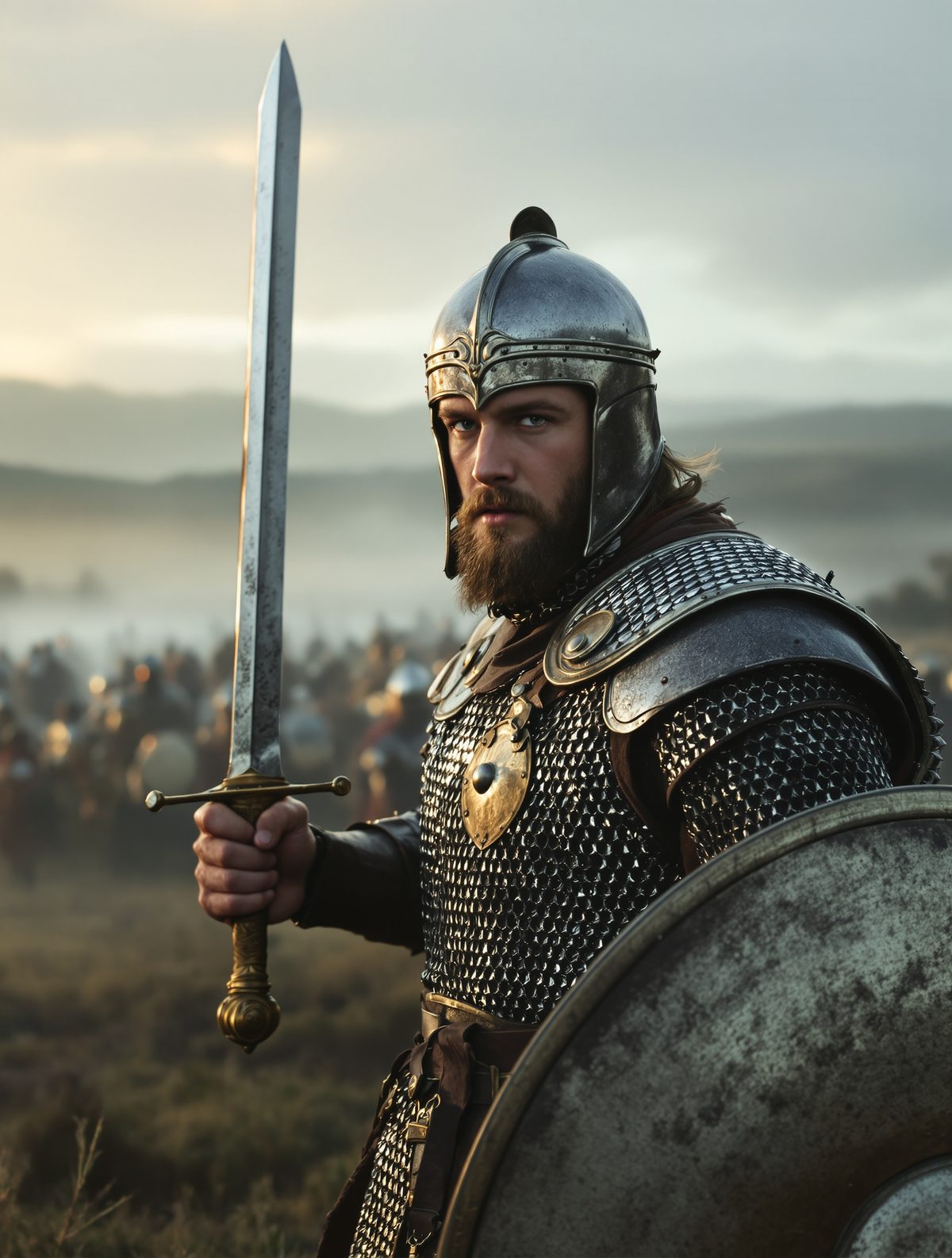
The mud squelched beneath ten thousand boots as dawn broke over Penselwood on 1 October 1016. King Edmund Ironside, barely twenty-five and crowned just months earlier, gripped his war-axe and surveyed the Viking horde assembled across the Somerset field. This would be his fifth major battle in twelve brutal months—five desperate stands against Canute the Great's relentless advance across England. Most kings would have fled or surrendered by now. Edmund had earned his iron nickname for a reason.
Behind him stood the last free army of Anglo-Saxon England. Before him stretched the greatest Viking invasion force since the days of Alfred the Great. In a few hours, one of these armies would be broken forever. The fate of England hung in the balance, and the young king who refused to bend was about to fight for his life one more time.
The Wolf at the Gate
By 1016, England was a kingdom on its knees. For decades, Viking raiders had grown bolder and more organized, evolving from hit-and-run pirates into a sophisticated invasion force. Canute the Great—son of Sweyn Forkbeard who had briefly conquered England in 1013—commanded not just Danish warriors but a truly international army: Norwegians, Swedes, even Saxon mercenaries who had switched sides for Danish silver.
When Edmund's father, the notoriously weak Æthelred the Unready, died in April 1016, he left his son a poisoned inheritance. The royal treasury was empty, drained by years of paying Danegeld—essentially protection money to Viking raiders. Whole swathes of northern England already acknowledged Danish rule. Many nobles had lost faith in the House of Wessex entirely.
But Edmund Ironside was cut from different cloth than his father. Where Æthelred had earned his nickname "Unready" (from the Old English unræd, meaning "ill-advised"), Edmund would forge his reputation in fire and blood. His strategy was audacious in its simplicity: he would fight Canute everywhere, every time, until one of them was dead.
Five Battles for a Crown
Edmund's war began before he was even officially king. In early 1016, while his father still clung to life, the young prince launched a surprise campaign to reclaim Wessex territories lost to Danish settlers. His first major engagement came at the Battle of Stamford Bridge—not the famous 1066 clash, but an earlier, lesser-known fight where Edmund's Saxon cavalry smashed through Danish shield walls in a preview of Norman tactics fifty years early.
The second battle erupted at Sherston in Wiltshire, where Edmund faced not just Vikings but English traitors. Eadric Streona, the duplicitous Earl of Mercia, had switched sides to support Canute. Contemporary chronicles describe the fighting as so fierce that "the dead lay three deep" and the River Avon ran red for days. Edmund held the field, but at enormous cost—losses his smaller army could ill afford.
By summer, Edmund had won a crucial victory at Brentford, using brilliant tactical deception to scatter Canute's forces as they tried to cross the Thames. The young king had learned to exploit his enemy's overconfidence. Danish sources admit they underestimated the Saxon "boy-king," expecting easy victories against Æthelred's inexperienced son.
The fourth clash came at Assandun (modern Ashingdon in Essex) in October, where Edmund's fortunes finally turned. Despite fighting with characteristic fury, his army was betrayed at the crucial moment. Eadric Streona, who had seemingly switched sides back to Edmund, fled the battlefield with his Mercian troops at the height of the fighting—possibly as part of a pre-arranged deal with Canute. The Saxon army collapsed, and Edmund barely escaped with his life.
The Last Stand That Never Was
It was after Assandun that the most remarkable episode of Edmund's war unfolded—the fifth "battle" that was actually a duel. Canute, perhaps respecting his opponent's relentless courage, proposed single combat to end the bloodshed. The idea of two kings settling a war through personal combat sounds like medieval romance, but multiple contemporary sources confirm it actually happened.
On a small island in the River Severn, near Deerhurst in Gloucestershire, the two young kings met in full armor. Edmund, wielding his famous war-axe, faced Canute armed with sword and shield. Chroniclers describe a brutal fight lasting over an hour, with both men taking wounds. Neither could gain decisive advantage—Edmund's raw strength matched against Canute's superior technique.
Finally, breathing hard and bleeding from multiple cuts, Canute called for a halt. "You fight like three men, Edmund Ironside," he reportedly said. "But England bleeds while we play at war." What followed was even more extraordinary: the two exhausted kings agreed to partition England between them, with Edmund keeping Wessex and Canute taking everything north of the Thames.
A Crown That Slipped Away
The Deerhurst agreement might have saved Anglo-Saxon England, creating two rival kingdoms that could have competed for centuries. But history had other plans. On 30 November 1016, barely a month after making peace with his greatest enemy, Edmund Ironside died under mysterious circumstances. He was just twenty-six years old.
The official cause was given as illness, but rumors swirled immediately. Some whispered of poison. Others spoke of assassins sent by Eadric Streona or even Canute himself. The most scandalous account, recorded by later chroniclers, claimed Edmund was murdered while using a latrine—stabbed from below by a hidden assassin in what must rank as history's most undignified royal death.
Whatever the truth, Edmund's death handed Canute the entirety of England on a silver platter. Within weeks, the Danish king was crowned ruler of all England, beginning a Scandinavian dynasty that would rule for nearly three decades.
The Iron Legacy
Edmund Ironside's story poses fascinating "what if" questions. Had he lived, would Anglo-Saxon England have survived? Could his partnership with Canute have created a different kind of medieval Europe? His son Edward the Exile was smuggled away to Hungary, and his descendants would later return to claim the English throne—but that's another story entirely.
What we know for certain is that Edmund represented something precious that died with him: the last flicker of purely Anglo-Saxon kingship before the Norman Conquest reshaped England forever. His five battles in twelve months—from Stamford Bridge to the duel at Deerhurst—represent perhaps the most concentrated display of royal courage in English history.
In our age of political compromise and calculated risks, there's something both inspiring and tragic about a king who simply refused to surrender. Edmund Ironside earned his nickname not through clever strategy or diplomatic cunning, but through the simple, stubborn refusal to let his kingdom die without a fight. Sometimes the greatest victories are measured not in crowns kept, but in the courage shown when all seems lost.