March 1944. The air was thick with the acrid scent of gunpowder and the subtle undertone of despair that lingered amongst soldiers entrenched in a protracted struggle. As the spring battle unfolded, the ancient stones of Monte Cassino bore silent witness to a clash that would become one of the most brutal engagements of the Italian Campaign.
The strategic monastery of Monte Cassino stood defiantly on the rocky mountainside, caught in the unforgiving web of war. It was more than just a monastery; it was a symbol of endurance. It dominated the landscape, its weathered stones holding secrets of centuries past while overlooking the raging battles below. For the Allies, taking Cassino meant unlocking the path to Rome. For the Germans, it was the cornerstone of the Gustav Line—a bastion against the relentless advance of the tide of war.
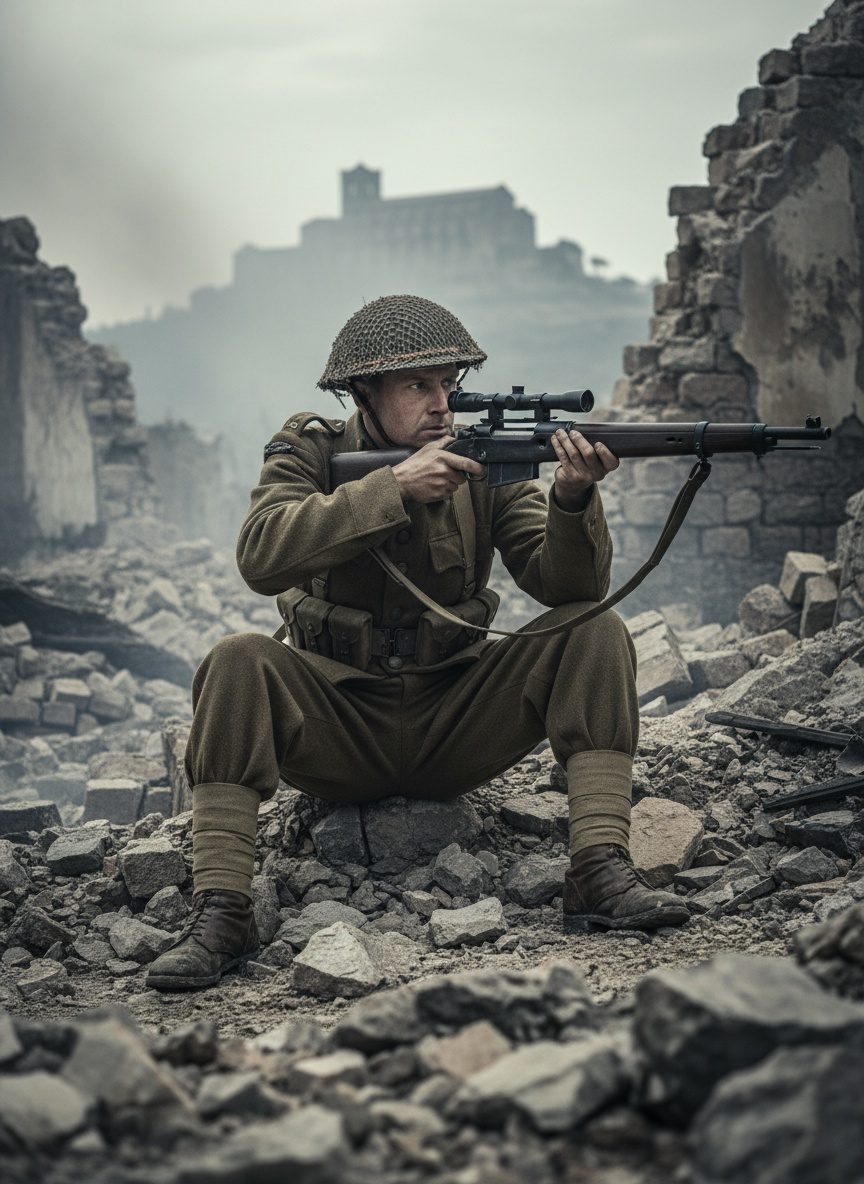
In the midst of this grand theatre, amidst the roar of artillery and the marching of boots, there lay the solitary figure of a British sniper. Motionless, breathing in sync with the landscape itself, he was the personification of patience and precision. Unlike the chaotic, large-scale maneuvers surrounding him, his world was a silent duel, the target only yards away, yet seemingly distant across ten leagues of death.
Snipers during this period were specialists, chosen for their aptitude for remaining still in arduous conditions and firing accurately in perilous circumstances. The sniper’s role was both tactical and psychological. Each shot that rang out from the ruins seemingly whispered promises of fear into enemy ranks, shattering their morale and disrupting their strategies. But the British sniper’s role in this drama was more than just playing a game of deadly hide-and-seek; it was to protect his comrades with deadly precision. He understood that one bullet could alter the course of a day, a battle, perhaps even the war itself.
The ridge around Monte Cassino was a maze of rubble, a wasteland created by relentless bombardment. Buildings reduced to ghostly skeletons offered scant cover, their jagged remains a testament to the fury they had endured. Yet, it was here, amidst the ruins and despair, that the sniper found his sanctuary. In the day’s harsh glare and under the watchful eyes of the enemy, he became one with his surroundings, his camouflage as much mental as physical.
As daylight threatened to fade, each breath became a silent prayer for victory in the solitude of his vigil. He lay prone, his rifle an extension of his will, his gaze fixed infinitely down its barrel. Every sound was heightened, every movement scrutinized to ensure that not even a whisper of his presence was discerned by the Germans entrenched in their positions above.
For the men around him, hope rested on breaking the deadlock of the ridge. Mired in mud and dire conditions, entire divisions were sacrificed in the grueling attacks up these treacherous inclines. The Germans, entrenched and well-prepared, made each advance agonizingly costly. The sniper, however, embraced a different form of warfare; his was a game of patience, of waiting for opportunity rather than creating it.
When the opportunity finally did slide into view—a German officer, brazenly moving into the open, believing his fortifications impenetrable—the sniper’s world narrowed to this target. Time stretched, his finger slowly tightening on the trigger, heartbeats counted among eternity. The crack of his rifle echoed—a singular note amidst the cacophony, precise and deadly. The target fell, chaos rippling across the enemy lines, confusion sewn where there had been order.
The power of that single shot resonated not just in its immediate consequence but in the disruption it caused among the enemy's meticulously crafted plans. The officer’s absence threw a spanner into the works, turning well-laid strategies to dust. And that, too, was the essence of the sniper’s role: to be the unseen force that tipped the balance in favor of those who fought for the right causes in the valley below.
As dawn broke the next day over Monte Cassino, the call to arms went out once more. For the men who fought there, including the solitary sniper who had woven fate with gunpowder and steel, the battle was far from over. Many more would fall, each side armed with their resolve fortified by purpose and homeland. But in the shadows, the sniper went unnamed, just another element of the war’s intricate tapestry.
The assaults on Monte Cassino would eventually culminate in liberation, the monastery’s fall symbolizing a critical breach in the German defenses. The sniper’s role, a solitary chapter in a series of orchestrated campaigns, stood as a reminder of the quiet, often unsung acts of valor that carved pathways to broader victories. It was a testament to strategic silence and deadly accuracy, that despite the overwhelming odds and chaos, singular resolve could strike significant blows for what mattered.
The story echoes through the annals of military history—not for grand speeches or declarations but for illustrating the resilient spirit inherent to the human condition. As modern readers pause to reflect, it is essential to remember that history often unfolds not only in the thunderous roar of battle but also in the silent breath held by an unseen marksman defying the tides of change, one patient shot at a time.