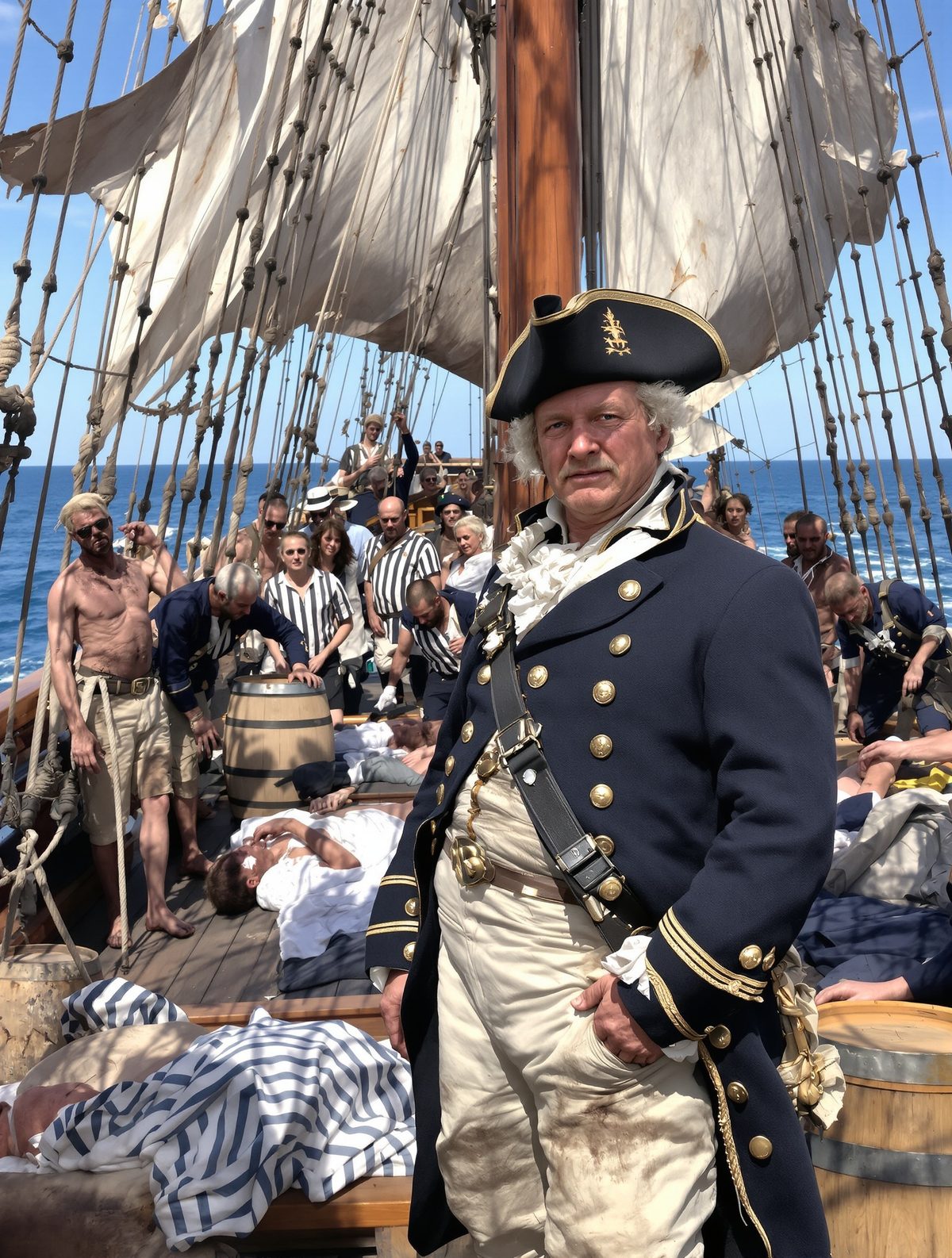
The Caribbean sun blazed mercilessly down on the azure waters off Dominica as Admiral George Rodney peered through his spyglass at the enemy formation ahead. It was April 12, 1782, and stretched across the horizon lay the pride of the French Navy—thirty-three ships of the line commanded by Admiral François Joseph Paul de Grasse. For two centuries, naval warfare had followed the same rigid playbook: fleets would form parallel lines and blast away at each other until one side retreated. But as Rodney watched the French ships maintaining their perfect formation, a revolutionary idea crystallized in his mind—one that would either save the British Caribbean empire or send his fleet to the bottom of the sea.
The Desperate Stakes of Imperial Chess
By 1782, Britain's empire was hemorrhaging. The American colonies had slipped away, and now France threatened to deliver the killing blow by seizing Jamaica and the sugar-rich Caribbean islands that funded the Royal Navy itself. Admiral de Grasse had already humiliated the British at the Battle of the Chesapeake the previous year, enabling Cornwallis's surrender at Yorktown. His mission was clear: escort a massive convoy of 150 merchant vessels to Cap-Français in Saint-Domingue, then join with Spanish forces for the final assault on Jamaica.
Rodney knew the mathematics were grim. De Grasse commanded not just superior numbers, but some of the finest ships in the world, including his magnificent flagship Ville de Paris—a floating fortress mounting 104 guns. The French admiral was no mere aristocratic appointment either; he was a seasoned warrior who had already outmaneuvered three British admirals. If de Grasse succeeded in his mission, the Union Jack would likely disappear from the Caribbean forever.
But Rodney possessed something his opponent didn't expect: a willingness to tear up 200 years of naval orthodoxy in a single, desperate gambit.
The Art of Breaking Everything
Naval tactics in 1782 followed rules as rigid as a minuet. Since the Anglo-Dutch Wars of the 1600s, the "Fighting Instructions" had mandated that fleets engage in parallel lines, ships matching their opposite numbers gun for gun. It was civilized, predictable, and almost ritualistic—rather like two gentlemen dueling with pistols at dawn. Admirals who deviated from this sacred formation risked court-martial.
Admiral John Byng had been executed in 1757 partly for failing to maintain proper line formation. The lesson was clear: better to lose honorably in line than risk innovation. This tactical straitjacket had cost Britain dearly—most enemy fleets simply retreated when overmatched, preserving their ships for future battles.
Rodney had been thinking about this problem for months. At 63, this was likely his final command, and he had nothing left to lose. His secret weapon wasn't just audacity—it was his meticulous study of wind patterns around the Caribbean islands. He had noticed something fascinating: the trade winds that normally blew steadily from the northeast would sometimes shift unexpectedly near land masses, creating brief windows of tactical opportunity.
As dawn broke on April 12, Rodney's meteorological gamble paid off. The wind began shifting southward, giving his fleet the weather gauge—the tactical advantage of approaching from upwind. More crucially, gaps started appearing in the French line as some ships struggled to maintain position in the changing breeze.
The Moment That Changed Naval History
At approximately 9:15 AM, sailing aboard his flagship HMS Formidable, Rodney made a decision that would echo through naval warfare for the next century. Instead of forming the traditional parallel line, he ordered his ships to aim directly for the gaps appearing in the French formation. The signal flags fluttered up the mainmast: the fleet would "break the line."
His captains were stunned. Captain Lord Cranstoun reportedly shouted across the water, "Sir, the enemy are in line of battle!" Rodney's reply was ice-cold: "I know it. That's exactly where I want them."
What happened next was like watching a sword slice through silk. HMS Formidable punched through the French line between the Glorieux and Diadème, her 90 guns raking both enemy ships with devastating broadsides. Following Rodney's lead, HMS Duke smashed through another gap, then HMS Bedford. Within minutes, the mathematically perfect French formation had been shattered into chaos.
The effect was catastrophic for the French. Ships designed to fight enemies on one side suddenly found British vessels on both flanks, pouring concentrated fire into their vulnerable sterns and bows where the heaviest armor was thinnest. The Glorieux, caught between two British ships, was pounded into submission within an hour. Captain du Pavillon died at his post, his ship a splintered wreck.
When Giants Fall
The real prize, however, was de Grasse himself aboard the mighty Ville de Paris. Cut off from the main French fleet by Rodney's breakthrough, the 104-gun giant found herself surrounded by five British ships of the line. For over two hours, the most powerful warship in the world fought a heroic but hopeless battle against impossible odds.
Witnesses described the scene as apocalyptic. The Ville de Paris was gradually dismasted, her beautiful gilded stern galleries smashed to splinters, her decks carpeted with the dead and dying. De Grasse himself was wounded by flying debris but refused to leave the quarterdeck. When his ship's colors finally came down at 6:15 PM, over 300 of his crew lay dead or wounded.
The French admiral's capture sent shockwaves through European courts. Here was the man who had sealed American independence, the terror of the Caribbean, now a prisoner aboard Rodney's flagship. When the two admirals met, de Grasse reportedly said, "Sir, your victory is complete, but your method is entirely new to me."
The final tally spoke for itself: five French ships captured, one destroyed, and their entire battle formation scattered. British losses were minimal—under 250 casualties across the entire fleet. More importantly, the vital French convoy was left defenseless, forced to scatter and abandon its mission to reinforce Saint-Domingue.
The Ripple Effects of Revolution
News of the victory electrified London. Church bells rang for three days, and Parliament voted Rodney a peerage and £2,000 per year for life. But the real impact went far beyond celebration. Jamaica was saved, the Caribbean remained British, and the sugar revenues continued flowing into the Treasury. Without these funds, Britain might never have been able to finance the coming wars against Napoleon.
The tactical revolution Rodney unleashed would reshape naval warfare forever. Nelson studied Rodney's dispatches obsessively, later writing that "breaking the line" was the key to his own victories at the Nile and Trafalgar. The rigid Fighting Instructions were quietly abandoned, replaced by aggressive new doctrines that encouraged initiative and innovation.
Perhaps most remarkably, the French never recovered their naval confidence. The psychological impact of seeing their finest admiral and most powerful ship captured through an unprecedented tactical maneuver left lasting scars. French naval strategy became increasingly defensive, contributing to Britain's eventual mastery of the seas during the Napoleonic Wars.
Why This Battle Still Matters
The Battle of the Saintes offers a masterclass in what happens when established thinking meets innovative disruption. Rodney succeeded not because he had better ships or more guns, but because he was willing to question assumptions that everyone else took for granted. In an age when naval tactics had fossilized into ritual, he chose adaptation over tradition—and changed the course of empire in a single afternoon.
Today, as industries from technology to finance face their own moments of tactical disruption, Rodney's gamble reminds us that sometimes the greatest risk is refusing to take any risks at all. The admiral who broke France's battle line didn't just save an empire—he proved that in the most crucial moments, innovation trumps convention, and audacity can overcome overwhelming odds.
The Caribbean waters off Dominica look peaceful now, but they still whisper the story of that April day when a 63-year-old British admiral decided to tear up the rulebook and, in doing so, secured Britain's path to global naval supremacy for the next century.