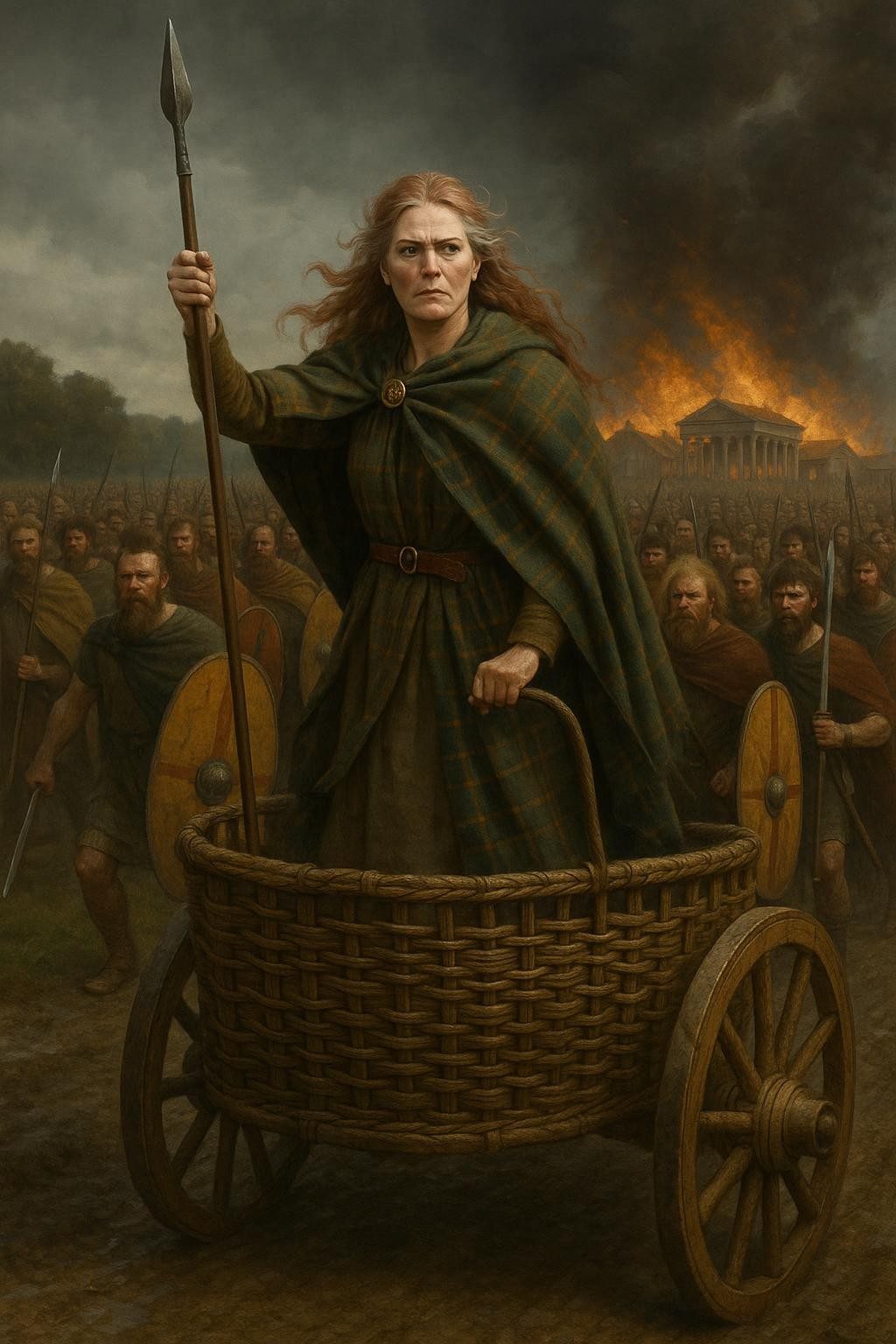
Three mighty cities reduced to ash. Few know how this daring rebellion nearly upended Rome's grip on Britain.
The Spark of Rebellion
In 60 AD, Roman Britain was a study in contrasts—glittering Roman cities had sprung up amidst ancient Celtic lands. Ruling with swaggering certainty, Rome’s governors underestimated the resolve stewing beneath the surface. When King Prasutagus of the Iceni tribe died, his peaceful and strategic alliance with Rome turned sour. His widow, Queen Boudica, found herself and her daughters in the clutches of a brutal Roman regime that saw power where others might see partnership.
Boudica's humiliation was a calculated move. After being flogged and her daughters violated, she became the symbol of defiance against Roman oppression—a rallying point for tribes weary of crushing taxes and enforced servitude. Underestimating the indignation seething among the subdued, the Roman administration failed to see the tempest stirring on the distant horizon.
This was not just a rebellion; it was a declaration of independence, a shared roar of outrage that would soon set the very heart of Roman Britain ablaze.
The March of the Iceni
The visions of flaming settlements etched into history’s annals began with the gathering storm of 100,000 warriors. Boudica, the fiery-haired queen wielding vengeance as her shield, became a force of nature. Together with the Trinovantes—a neighboring tribe equally vexed by Roman greed—she amassed an army that swept down from their northern strongholds, setting its sights on Roman constructions that symbolized foreign oppression.
Camulodunum, modern-day Colchester, fell first. The once-imposing Roman colonia, touted as a testament to Roman superiority, crumbled under the fury of Boudica and her rebels. Archaeological whispers suggest that her onslaught was relentless, reducing temples and public buildings to smoldering ruins. Countless Roman settlers were left to fate’s merciless whim, demonstrating the frailty of Rome's iron grasp.
Panic spread like a prairie fire. In its wake, Londinium (now London) awaited the same doom. Governor Suetonius Paulinus, racing back from subduing the distant island of Mona, realized his meager forces were outmatched. Londinium, overflowing with despairing citizens, could not be saved. Abandoned to its fate, the streets of Londinium burnt, whispering tales of empires undone by hubris.
The rebellion’s fury was not yet sated, and Verulamium (modern-day St. Albans) became its final sacrifice. By the rebellion's end, it was not merely buildings and statues that lay in ruin, but the very image of Roman invincibility.
The Roman Response
Panic churned through the hierarchy of Roman power. The bacillus of invulnerability that Rome prided itself on had been pierced. Yet even in such turmoil, the empire was an ironclad behemoth with resources far exceeding those of the warring tribes. Governor Suetonius, although shelved from relishing a pomposity of victory, regrouped what legions he had. Meanwhile, Emperor Nero, that flickering flame of whims and tyrannies, was rumored to have considered abandoning the British isles.
In a fateful confrontation thought to have occurred somewhere along Watling Street, Suetonius exploited the narrower confines to negate the Iceni's numerical advantage. The ferocity of Boudica's insurgents slammed against Roman discipline in a savage tableau. The Roman legions, hardened and drilled to brutal efficiency, clung to formation, spearing their way to an eventual victory.
The cost was staggering. Boudica, the embodiment of Celtic wrath, is said by some to have taken her own life to escape capture, forever shrouded in the mists of legend—the once-roaring revolution collapsed, dissolving like smoke carried on the wind.
A Legacy of Defiance
History's flowing tapestry entwines Boudica’s fight with threads of defiance that echo through millennia. Though the Roman Empire ultimately retained control, this ferocious stand rippled through time. For those stifled under the weight of conquerors, Boudica remains a towering symbol of resilience and the unyielding spirit of a people who, if only for a fleeting moment, challenged the mightiest empire of their time.
The tale of Boudica isn't just an account of fiery retribution and tragic heroism. It is a reminder of how imbalance and injustice can ignite revolutions not easily quelled. Today, the charred layers beneath modern cities bear witness to those who dared to rise against the unstoppable tide, leaving behind more than ash—Boudica left a legacy of courage that refuses to be forgotten.