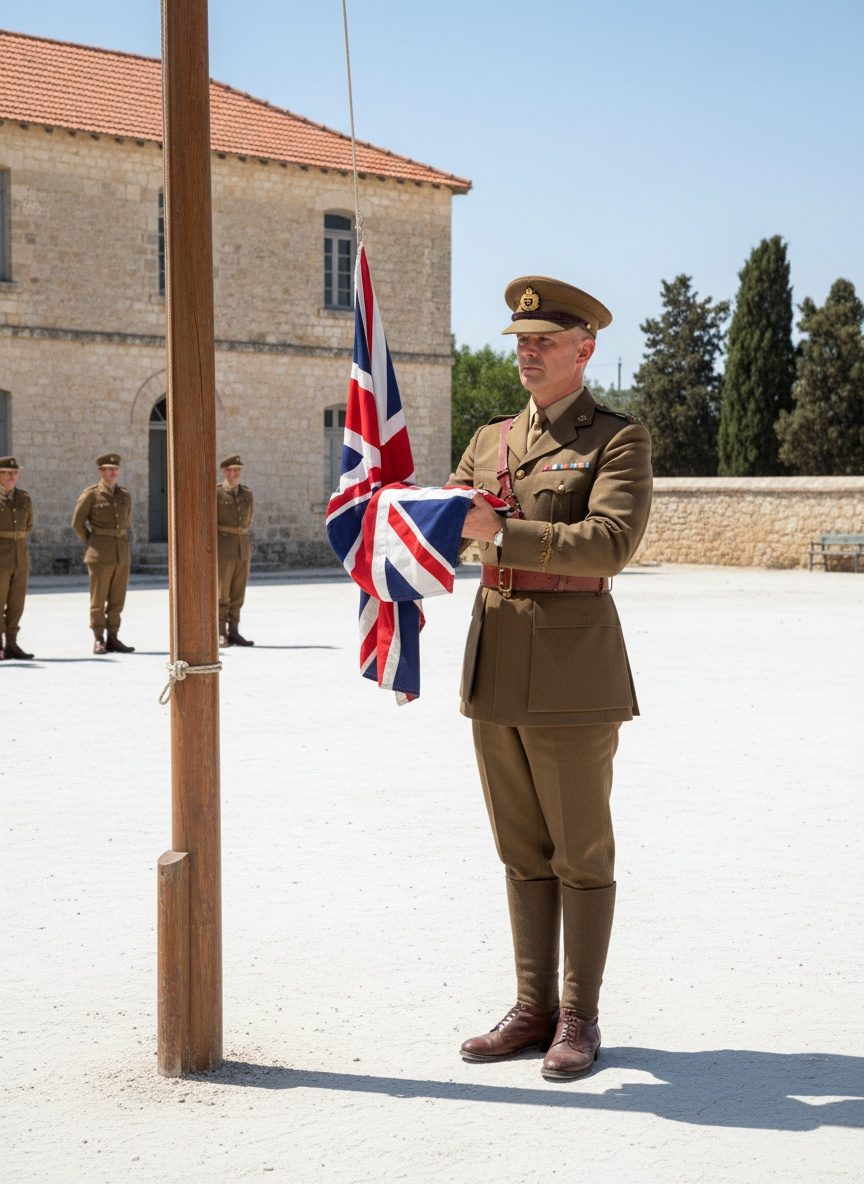
As the sun dipped below the Mediterranean horizon on a warm August evening in 1960, the Union Jack was lowered over Cyprus for the last time. In a moment heavy with history, silence blanketed the gathered crowd. Among those witnessing this poignant transition was Sergeant Parker, a veteran of the British garrison, his heart a mix of duty fulfilled and dreams unrealized. A chapter of colonial history quietly drew to a close, even as a new Cypriot dawn promised a future of self-determination and hope.
The Jewel of the Eastern Mediterranean
For nearly eight decades, Cyprus had been the strategic jewel in the crown of the British Empire, anchoring its presence in the tumultuous eastern Mediterranean. Enveloped by azure seas, Cyprus was not merely a picturesque island; it was a military keystone, positioned at the crossroads of Europe, Asia, and Africa. Britain had administratively wrested control of Cyprus from the Ottoman Empire in 1878 under a lease agreement, eventually annexing it in 1914 amid the Great War.
British development in Cyprus was reflected in the cities, most notably in the capital, Nicosia, where colonial architecture mixed with ancient relics to create a singular blend of historical epochs. The British constructed roads and railways, modernized the infrastructure, and established bases. Famagusta and Limassol thrived as bustling hubs of commerce, their ports welcoming ships from empires far and wide.
Yet beneath the veneer of colonial progress simmered a discontent—a yearning for *enosis* (union) with Greece among many Greek Cypriots, contrasting with Turkish Cypriots' apprehension of being subsumed in such a union. This duality of identity set the stage for geopolitical complexities that bubbled beneath the island’s sun-soaked surface.
The Road to Independence
Cyprus's path to independence was neither serene nor straightforward. During World War II, the allegiance of Cypriots to the British cause was undeniable, with thousands serving in the British Army. But post-war hopes for self-determination went unmet, leading to growing unrest. The mid-20th century saw tensions escalate into violence between the British forces and EOKA, a Greek Cypriot paramilitary organization led by General Georgios Grivas, committed to achieving enosis through armed struggle.
As EOKA's grenades echoed across the island and British soldiers patrolled with increasing tensions, a shift in imperial policy unfurled in the corridors of power in London. By the 1950s, the waning days of the British Empire were evident, and the Suez Crisis of 1956 highlighted the diminishing control Britain exerted on its former holdings. In realizing this, the British government, led by Prime Minister Harold Macmillan, began seriously considering a diplomatic transfer of power in Cyprus.
Negotiations culminated in the London and Zurich Agreements of 1959, which established the framework for an independent Republic of Cyprus. Crucially, the accords ensured the creation of military bases under British sovereignty, allowing Britain to retain a strategic foothold in the region.
The Silent Farewell
As the exquisite strains of the "Last Post" resonated on August 16, 1960, the last of Britain's regiments prepared to depart. It was a day laced with mixed emotions — pride in decades of dedicated service, sorrow at the end of an era, and hope embodied in the birth of a new nation. As the Union Jack was lowered from the flagpole, many British soldiers and their families faced an uncertain future. For some, like Sergeant Parker, it was the archaeological magic of Salamis or the scents of a Nicosian bazaar they would miss most. For others, it would be the warm Cypriot hospitality that lingered in their hearts.
Yet independence day did not signal an untroubled beginning for the newly formed republic. Lingering tensions between Greek and Turkish Cypriots, exacerbated by external pressures from Greece and Turkey, foreshadowed challenges ahead. Archbishop Makarios III, the newly elected first president and a towering figure in the independence movement, carried the weighty ambition of balance and peace between the island's ethnic factions.
After the Empire
The lingering vestiges of British presence remain indelible in Cyprus. The Sovereign Base Areas of Akrotiri and Dhekelia remain under British control to this day, a quirk of non-colonial sovereignty that reflects broader geopolitical strategies beyond mere nostalgia. These bases, along with their complex jurisdictional statuses, continue to play vital roles in British military operations, evidencing the enduring legacy of empire.
Cyprus’s journey into self-governance has not been without travails. The geopolitical landscape of the island has continued to be shaped by historical fractures and contemporary diplomatic tensions. However, the spirit of hope and tenacity that imprinted 1960 remains a source of resilience for Cypriots navigating the waters of sovereignty.
Echoes of the Past, Lessons for Today
The departure of Britain's last soldiers from Cyprus underlines broader themes of empire and colonization echoed globally. It conjures reflections on the power dynamics of imperial politics, the anomalies of negotiated sovereignty, and the enduring human struggle for autonomy and cultural identity. The resilience of Cyprus since 1960 serves as a poignant reminder that even in a world of geopolitical tethering, new narratives of national identity can emerge with vibrancy and voice.
As we reflect on the events of August 1960, we see not just a conclusion to colonial rule but an enduring dialogue on identity, power, and justice—one that reverberates across the centuries, even as it shapes our modern world. In the shadows of empire's twilight, the lessons of Cyprus beckon us to consider our histories and their impact on our futures, urging us to craft a narrative for tomorrow that is inclusive and hopeful, yet unflinchingly honest.