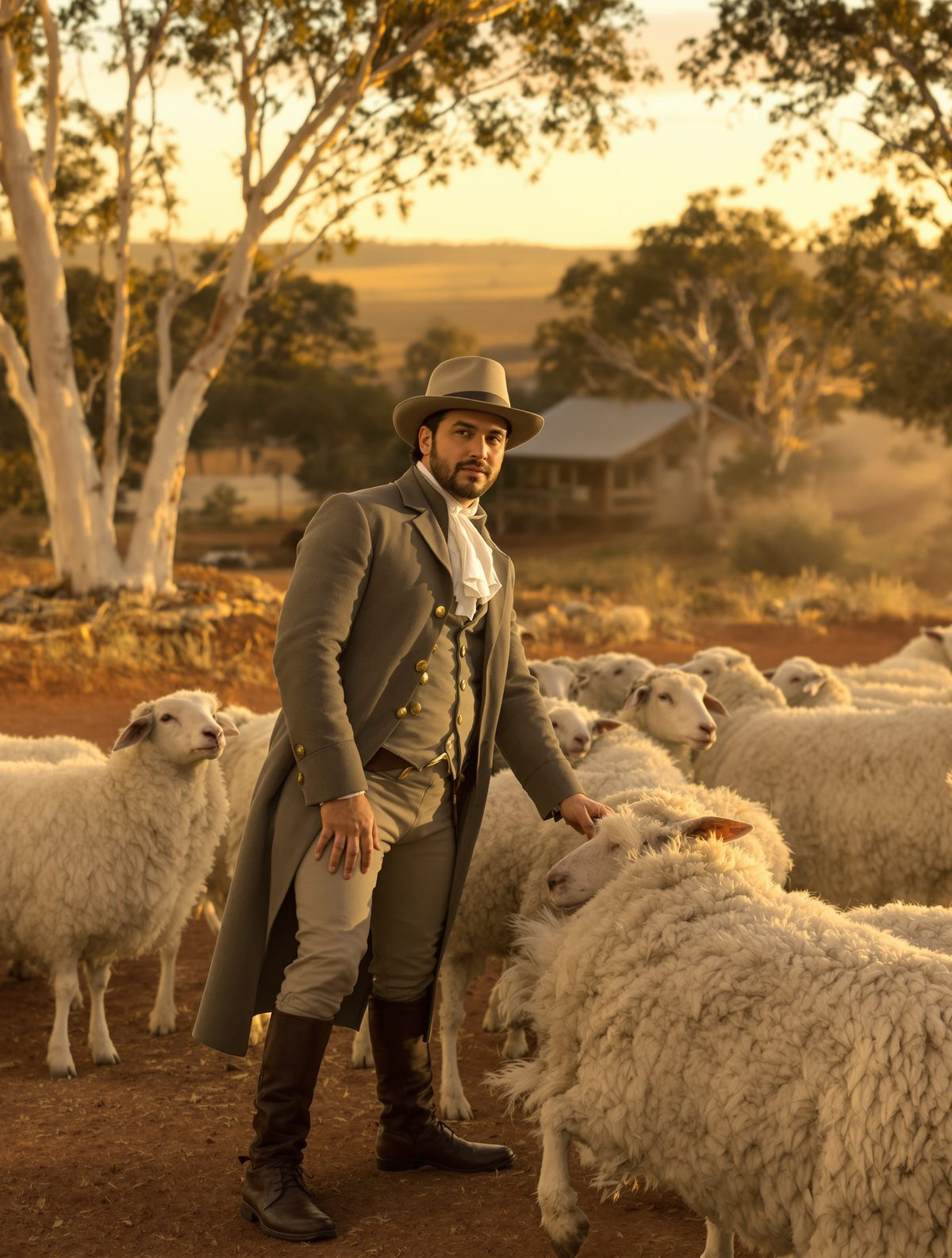
Sydney, 1805. As the first rays of dawn crept over the sprawling Australian landscape, a figure cut through the early morning mist. He was a man of contradictions — a former soldier turned agricultural pioneer, with vision as fierce as his temper. Disgraced yet undeterred, John Macarthur had gambled everything on the backs of scrawny sheep. But in the wool of these unassuming creatures, Macarthur saw threads of destiny that would weave a nation’s fortune.
The Bold Visionary in a Land Untamed
Born into modest circumstances in Devon, England, in 1767, John Macarthur was a man not easily deterred. After a contentious military career that involved a notorious duel with a superior officer, Macarthur found himself exiled to the penal colony of New South Wales in 1790, a land as rugged and untamed as his own spirit. Here, amidst the unforgiving Australian bush, Macarthur saw opportunity where others saw only banishment. He would seize it and etch his name into history.
By 1805, the colony of New South Wales was still in its infancy — a rough-hewn outpost at the very edges of the British Empire. The government-issued livestock were coarse-haired and unremarkable, ill-suited for wool production. Yet, while others lamented the colony’s isolation and scarcity of resources, Macarthur saw the perfect environment to raise what he believed could be the finest wool-bearing sheep in the world.
The Spanish Secret
The story might have ended with an idle dream if not for Macarthur's serendipitous acquisition of a handful of sheep with prized Spanish Merino bloodlines. Originally bred in Spain, where their fleece was the crown jewel of European textiles, Merinos were fiercely safeguarded by the Spanish crown. Smuggling the sheep out of Spain was prohibited by law, punishable by death. Yet, through murky channels and providential circumstances, these sheep found their way to the antipodes.
Determined to unlock their potential, Macarthur dedicated himself to breeding. He was meticulous, pairing the hardy but mediocre English sheep with the Merinos' mélange of elegance and endurance. The results were soon transformative — the new breed was resilient against the harsh Australian climate and produced wool unrivaled in its fineness.
Resolution and Rebellion
However, Macarthur’s path was never smooth. The British authorities were skeptical of colonial ambitions and against private enterprise that operated outside governmental control. In 1807, when Macarthur shipped a sample bale of his superlative wool back to England, the reaction was one of astonished applause. But recognition was a double-edged sword.
Ever the provocateur, Macarthur soon found himself embroiled in the 'Rum Rebellion' of 1808 — a peculiar coup against Governor William Bligh — which led to Macarthur's arrest and return to England to stand trial. But it was tempestuous Macarthur's penchant for conflict and indefatigable spirit that would inadvertently secure his legacy. While in England, the fleece’s quality had spoken for itself, igniting demand and proving Macarthur's assertions of excellence.
The Wool That Wove a Nation
Upon his return to New South Wales in 1817, begrudged respect and greater support followed. John's flock had grown. By 1820, over a third of the colony’s wool shipped to England origin traced back to Macarthur. As demand for quality wool surged during the Industrial Revolution, Australia, once a convict colony, stood on the brink of an economic transformation, all thanks to Macarthur's daring foresight.
By his death in 1834, Macarthur's vision had planted the seeds of an industry that would become Australia's chief economic artery. From modest beginnings, Australia's sheep population would burgeon into the tens of millions, each animal a testament to Macarthur's gritty determination and extraordinary foresight.
The Threads of Legacy
In the face of adversity, John Macarthur reshaped the Southern seas, leaving an indelible mark on the looms and economies of the world. His legacy survives in Australia’s thriving wool industry, an industry that laid the foundations for its transformation from a remote penal colony to a nation flexing its independent economic might.
What can we learn today from a man like Macarthur? Perhaps it's a reminder of the audacity it takes to see amidst discomfort and doubt the shimmering threads of an unimagined future. In every fleece, there lies the whisper of innovation, waiting for the bold to take hold and weave it into a tapestry of change.
In the quiet brilliance of dawn, with the first of many proud Merino flocks at his feet, John Macarthur saw more than just sheep. He saw a nation. And in many ways, he was correct.