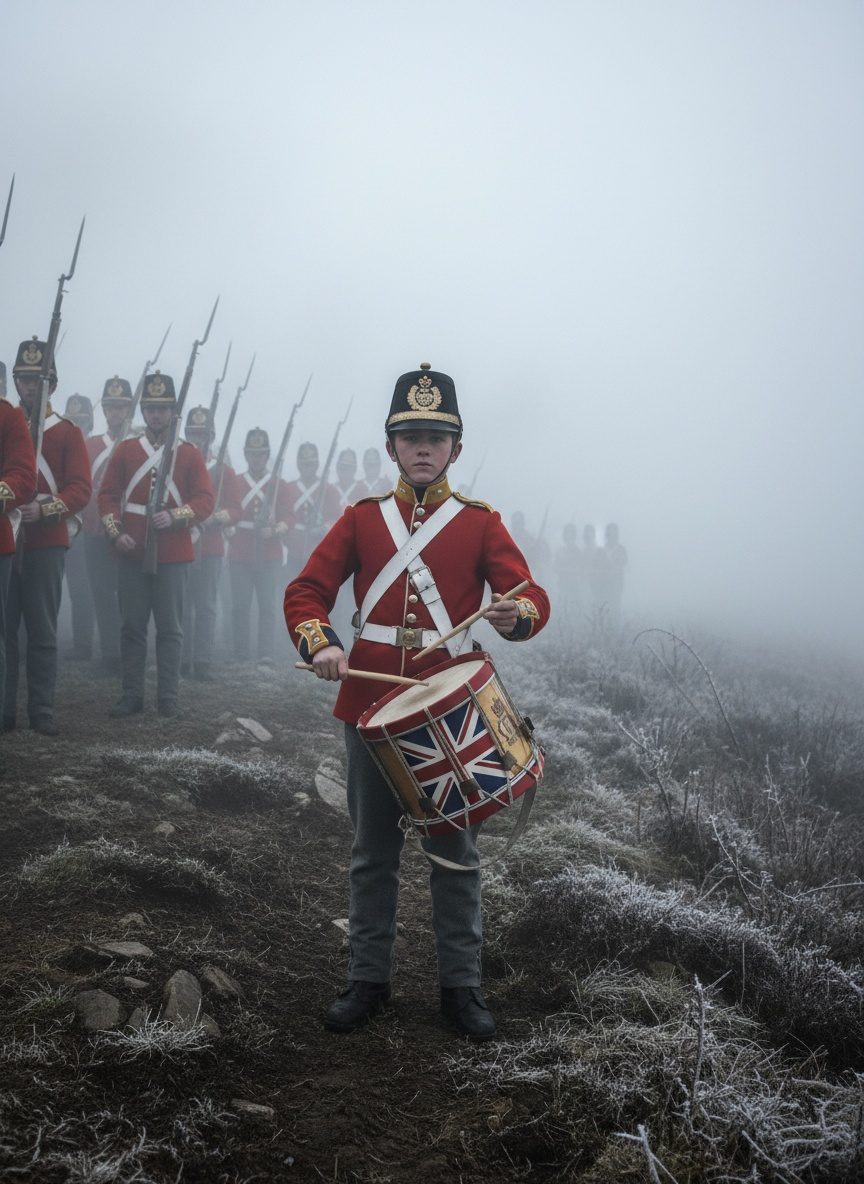
The misty dawn of November 5, 1854, unfurled like a shroud over the ridge at Inkerman, cloaking the landscape in a ghostly fog. As the first rays of a reluctant sun strained to penetrate the gloom, an ominous silhouette solidified: the massive Russian force of 42,000 troops advancing through the mist, a relentless wave threatening to crush the scant 8,000 British soldiers at the Crimean front. Amid this tumultuous orchestra of chaos, a lone, unwavering heartbeat of resistance emerged—backed by nothing more than the rhythmic beat of a drummer boy.
A Murky Battlefield
The Battle of Inkerman, a conflict shrouded in mist as much as confusion, unraveled on the heights surrounding the city of Sevastopol. This was not a battle planned and orchestrated by generals from gilded war rooms; it was an accidental storm of violence where instinct, survival, and the courage of ordinary men dictated the course of history.
As dawn broke, the fog trapped within the valleys and along the ridge lines served both as a veil and a curse. An unsuspecting British encampment, roused from slumber without the sound of gunfire, faced an appalling foe that appeared as if conjured from the vapors. Officers scrambled, hastily pulling on uniforms and seizing swords, while the less glamorous but no less valorous drummers set to their instruments—a call to arms that reverberated through the soul of every sleeping soldier.
The Young Heartbeat of War
It was amidst this churning battlefield, where sight was thwarted by fog and sound alone guided action, that one drummer boy became legend. While his name, as many such heroes' names, is lost to the ages, his drum was not. It beat a relentless cadence through the cacophony of clashing swords and the cries of the wounded. His rhythm reached across the foggy expanse like a lifeline, rallying scattered units and inspiring soldiers to form ranks against the looming Russian tide.
The life of a drummer boy was fraught with the dual challenge of youth and war—a contradiction embodied yet transcended by the courage shown at Inkerman. These boys, some as young as twelve, bore the crucial role of communication amidst the din of battle, their drums articulating commands and coordinating troop movements in a language as vital as Morse code during subsequent conflicts.
Fog of War: An Equalizer
The fog that morning not only concealed men but leveled the playing field. High-ranking officers were rendered as sightless as the rank and file, forced to make split-second decisions without the clarity of reconnaissance. As Russian forces pressed on, their numbers forcing back the thin red line of British defenders, it was the steadfastness of individual soldiers that held the line—an effort no longer dictated by ranks or status but by shared valor.
This was a fight won not by strategy but by the grit of British and allied French forces, whose courage under indiscriminate concealment drew the moniker "The Soldiers' Battle". With visibility reduced to mere feet at times, and positions changing hands again and again, the opacity of the fog mirrored the chaos below, where lines formed and reformed around the relentless rallying drumbeats.
Unexpected Allies Amidst the Fog
Within this confusion, the French Division, led by General Pierre François Bosquet, appeared as a saving grace. Heard long before they were seen—the distinct tricolore uniforms materializing through the mist—these allies contributed not only numbers but critical momentum, catching the Russians unaware at a moment when fatigue threatened to undo the British stand.
While the French entrance helped stem the Russian advance, the courage clearly visible throughout that day came from lower ranks. It was often the younger forces—like the drummer boys—who reminded hardened soldiers of their commitments, reviving spirits and turning tides. Their beats were more than noise; they were symbols of order amidst chaos, continuity amidst disruption.
Why Inkerman Matters Today
The story of Inkerman is more than a tale of military strategy; it's a testament to the spirit of perseverance and unity against overwhelming odds. It highlights how wars, while often remembered for their strategies and leaders, are frequently won by the courage of unnamed individuals united by a shared cause. The drummer boy at Inkerman, tirelessly beating amidst the dead and dying, exemplifies this—a reminder of how the smallest actions can contribute to the greatest victories.
In our own times, the fog of uncertainty looms large in many spheres—whether global conflicts, personal struggles, or societal change. The lesson from Inkerman is clear: perseverance, courage, and unity matter. The drummer boy who held the line represents the power of each life to make a difference—a legacy as resonant today as it was on that cold November morning.