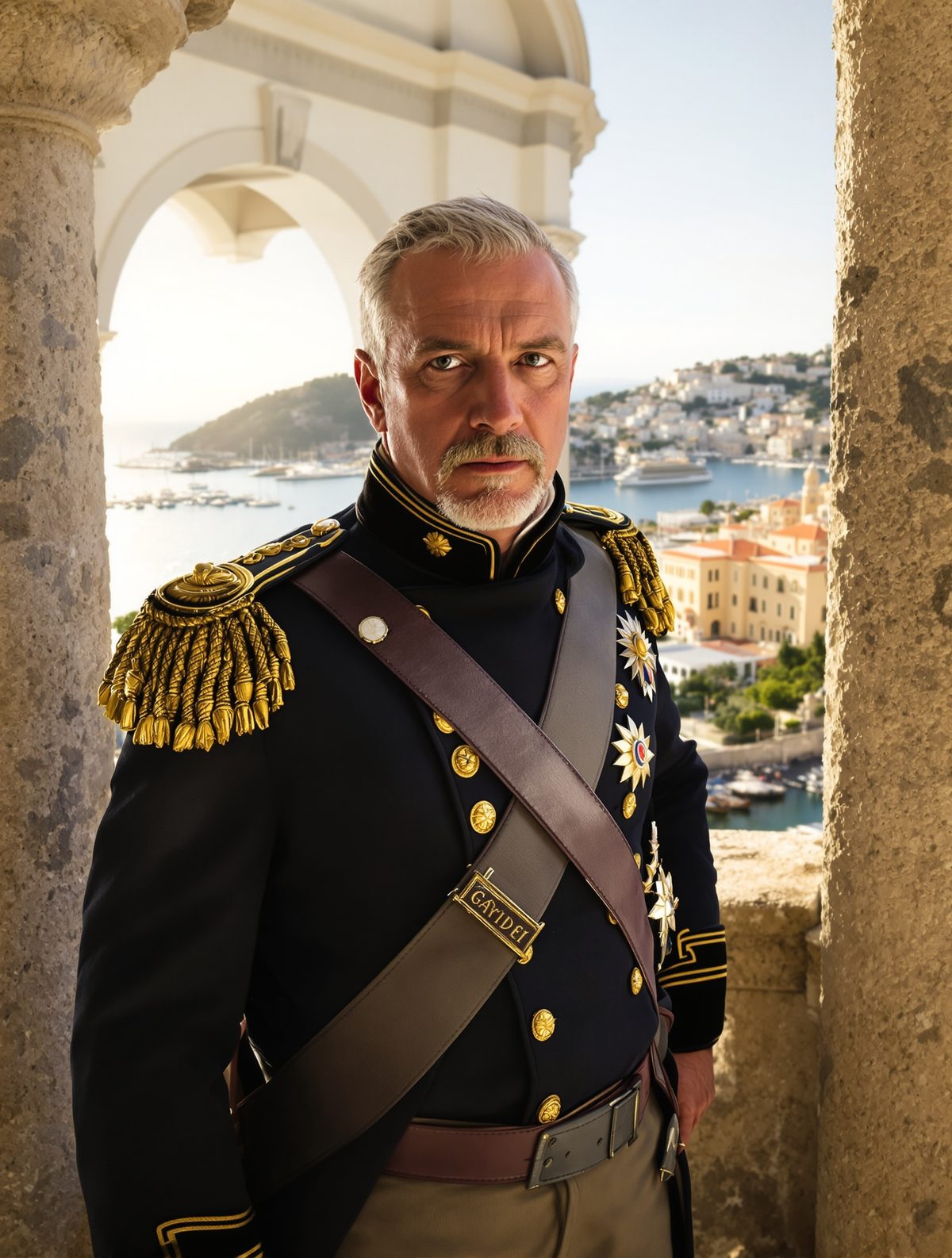
Picture this: a battered warship limping into Portsmouth Harbor in June 1744, her hull scarred by cannon fire and storms, her crew reduced to skeletal shadows of their former selves. Below deck, 32 wagons wait to carry away treasure so vast that it takes six hours just to unload it all. This is the Centurion, sole survivor of what began as Britain's most ambitious naval expedition—and the vessel that pulled off the greatest heist in maritime history.
When Captain George Anson set sail four years earlier, he commanded six proud warships and nearly 2,000 men. Now, of that mighty fleet, only his flagship remained, carrying just 188 survivors and a fortune that would be worth over £500 million in today's money. But the price paid for that treasure would haunt the Royal Navy for generations.
The Fool's Errand That Became Legend
In September 1740, as Britain slid inexorably toward war with Spain, the Admiralty hatched an audacious plan. Captain George Anson, a methodical 43-year-old naval officer with a reputation for getting things done, would lead a squadron around Cape Horn into the Pacific—Spain's private lake—and wreak havoc on their colonies and treasure fleets.
On paper, it looked magnificent. Six warships including the 1,005-ton flagship Centurion, bristling with 244 guns between them. The plan called for 2,000 experienced sailors and marines, plus a battalion of regular infantry. They would coordinate with Admiral Edward Vernon's assault on the Spanish Caribbean, creating a two-pronged attack that would cripple Spain's colonial empire.
Reality, as usual, had other plans. When Anson's squadron finally departed Portsmouth on September 18, 1740, his "crack troops" included 259 pensioners from Chelsea Hospital—many so decrepit they had to be carried aboard in stretchers. Instead of seasoned marines, he got 210 raw recruits who had never seen the ocean. The promised supplies arrived late, spoiled, or not at all. Even the ships were suspect: several had been hastily patched up after years of neglect.
Here's what the textbooks don't tell you: Spanish spies had been watching Portsmouth for months. Before Anson even cleared the English Channel, enemy agents had dispatched fast ships to warn every Spanish colony and naval base in the Americas. The element of surprise—crucial to the mission's success—was lost before the expedition truly began.
Into the Jaws of Hell
The first hint of disaster came off the coast of Brazil in October 1740, when typhus swept through the overcrowded ships. Men began dying by the dozens, their bodies sewn into hammocks and slipped over the side with grim regularity. By the time the squadron reached the Juan Fernández Islands (where Alexander Selkirk, the real-life Robinson Crusoe, had been marooned), they had already lost 626 men to disease.
But the real killer was Cape Horn.
For two months, from March to May 1741, Anson's ships battled some of the most savage weather in maritime history. Waves the size of cathedral towers smashed over their decks. Winds howling at over 100 mph shredded sails and snapped masts like twigs. The cold was so intense that men's fingers froze to the rigging, and several had to have frostbitten limbs amputated with carpenter's saws.
The Wager, a converted merchant ship carrying the expedition's supplies, was driven onto the rocks of a desolate island. Her survivors would endure months of starvation, mutiny, and cannibalism before the few remaining men were eventually rescued. The Severn and Pearl were so badly damaged they turned back for England, their crews more dead than alive.
When the battered remnants of the squadron finally staggered into the Pacific, only three ships remained: the Centurion, the Gloucester, and the Tryal. Of the original 1,955 men, fewer than 700 were still breathing. Most of those were dying of scurvy, their teeth falling out, their bodies covered in putrid sores.
The Pacific Rampage
Any reasonable commander would have limped home. Anson, however, was not reasonable. With his three surviving ships, he began systematically terrorizing the Spanish Pacific coast like some 18th-century Viking.
His first major prize was the port of Paita in Peru, captured in November 1741. The Spanish, convinced no enemy fleet could possibly survive Cape Horn, had left the town virtually undefended. Anson's men seized provisions, silver, and anything else of value before burning the place to the ground. Local Spanish officials, caught completely off-guard, fled into the mountains in their nightclothes.
But the expedition continued hemorrhaging men and ships. The Tryal, her hull eaten through by shipworms, had to be scuttled. The Gloucester was barely afloat, her pumps working around the clock to keep her from sinking. By August 1742, when Anson reached the Mariana Islands, only the Centurion remained seaworthy.
Here's the detail that will blow your mind: At one point, Anson had so few healthy men left that he couldn't properly sail his flagship. The Centurion required at least 400 sailors to operate effectively. Anson was down to fewer than 200 men total, many of them sick or wounded. They had to rig an ingenious system of pulleys and mechanical aids just to raise the anchor.
The Ultimate Prize
After repairs in Portuguese Macau—where Chinese merchants treated the exotic British sailors like tourist attractions—Anson made a decision that would cement his place in naval legend. Instead of sailing home with his single, undermanned ship, he would attempt to capture the Manila Galleon.
This was the Spanish treasure ship that sailed annually from the Philippines to Mexico, carrying a full year's worth of Asian trade goods: Chinese silks, Japanese silver, Indonesian spices, and chests of gold coins. It was also one of the most heavily armed merchantmen in the world, designed specifically to fight off pirates and enemy warships.
On June 20, 1743, after months of patient waiting, Anson's lookouts spotted their quarry: the Nuestra Señora de Covadonga, a massive galleon bristling with 36 guns and carrying 550 men. The Spanish captain, Jerónimo de Montero, was confident his ship could destroy the lone British vessel that dared challenge him.
The battle lasted ninety minutes of thunderous cannon fire. Anson, displaying the tactical brilliance that had made him a captain, used the Centurion's superior sailing qualities to stay in the galleon's blind spots while his gunners systematically demolished the Spanish rigging. When the smoke cleared, 67 Spaniards were dead and their ship was a floating wreck.
In the galleon's hold, Anson's men discovered treasure beyond their wildest dreams: 1,313,843 pieces of eight in silver coins alone, plus 35,682 ounces of virgin silver, and countless chests of gold, pearls, and precious stones. The total value exceeded £400,000—more money than most English counties collected in taxes during an entire year.
The Richest Survivors in History
The Centurion finally anchored at Spithead on June 15, 1744, after circumnavigating the globe in three years and nine months. News of her arrival spread like wildfire through Portsmouth and London. Crowds gathered to gawk at the exotic survivors and their incredible treasure.
Each surviving sailor received prize money equivalent to twenty years' wages. Ordinary seamen who had departed England as paupers returned as wealthy men. Anson himself received over £90,000—enough to purchase a vast estate and live like a lord for the rest of his days.
But the cost was staggering. Of the 1,955 men who had departed England, only 188 returned alive—a mortality rate of over 90%. Most had died not from enemy action, but from disease, starvation, and the brutal conditions of 18th-century seafaring. Entire families had been wiped out. Portsmouth alone counted over 300 widows created by the expedition.
The detail that haunts historians: Anson's expedition lost more men than some entire wars. Yet because they returned with such incredible wealth, the Admiralty hailed it as a magnificent success. The human cost was simply written off as the price of empire.
Legacy of Gold and Ghosts
Anson's voyage became the template for Britain's Pacific strategy for the next century. It proved that British ships could reach and dominate Spain's Pacific territories, setting the stage for later conquests in India, Australia, and the Far East. The treasure he captured helped fund Britain's expanding naval supremacy.
Yet the expedition also revealed the horrifying human cost of 18th-century imperialism. Those 1,767 men who never returned home were not just statistics—they were fathers, sons, brothers, each representing a family destroyed by Britain's imperial ambitions. Their sacrifice bought not just treasure, but the foundation of an empire built on bones.
Today, as we grapple with the legacies of colonialism and the true cost of historical "progress," Anson's voyage serves as a stark reminder that every golden age casts dark shadows. The greatest naval heist in history succeeded brilliantly—but at a price that should make us question whether any treasure is worth 1,767 lives.