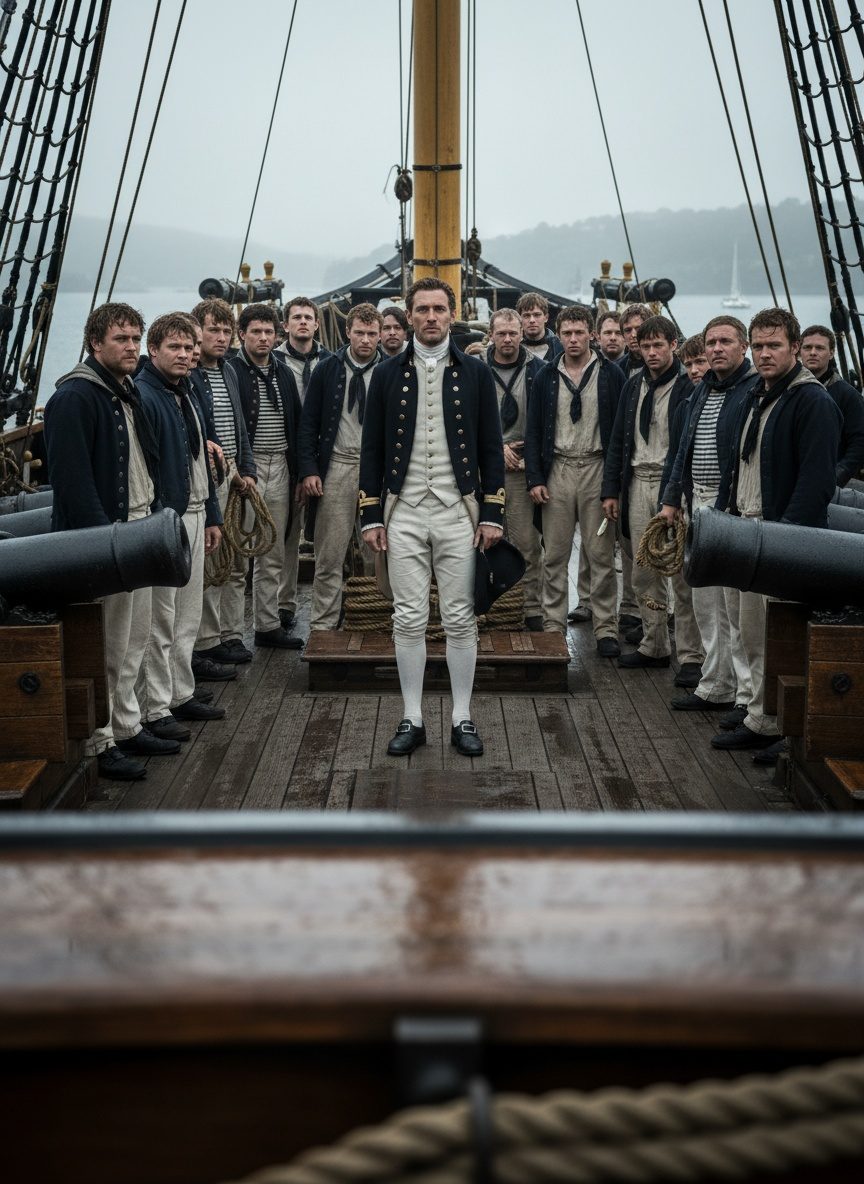
The air was thick with tension and the acrid smell of salt lingered as Captain Edward Pellew walked steadily across the wooden deck of HMS Nymphe, anchored off Plymouth. The murmurs of discontent among the crew of forty sailors ebbed and flowed like the sea, a stark reflection of the unrest spreading through the ranks of the Royal Navy. With no weapon to brandish but his resolute presence, Pellew cut through that charged atmosphere with a calmness that belied the chaotic scene brewing around him.
It was 1797, a year wrought with turmoil and mutiny for Britain's naval forces. Already, the echoes of rebellion from the fleet at Spithead had reached the highest echelons of the government, shaking the very core of the British Admiralty. Faced with the gravity of another potential insurrection aboard the Nymphe, Pellew was left without the standard tools of enforcement at his disposal. The absence of marines or firearms aboard the ship that day meant Pellew would have to pacify this uprising with words alone — a feat as daunting as steering a ship through a tempest without sails or rudder.
Pellew was no stranger to perilous situations; his distinguished career in the Royal Navy, peppered with battles and accolades, had forged him into a leader respected and sometimes feared by his men. Yet, what lay before him was unlike any battle he had encountered. The sullen faces of sailors driven by grievances shared by many across the fleet stared back at him, waiting for his first move. Their complaints were not frivolous; they dealt with pay issues and poor conditions at sea, a harsh reality for the men who carried Britannia's might across the world's oceans.
As Pellew looked into the eyes of those men — his men — he wasn't just addressing a group of dissatisfied sailors; he was confronting a microcosm of the larger unrest that threatened the Royal Navy's supremacy. Understanding this, he spoke not with the authority of rank, but with the empathy of a fellow seafarer and a leader who had sailed alongside them, weathered storms, and shared in their victories. His words carried the weight of experience and a deep-seated commitment to their shared purpose.
The minutes stretched on like hours as Pellew addressed the crew, weaving a narrative that reminded them of their collective triumphs and the honor that came with serving aboard such a storied vessel. His voice, unwavering and resonant, filled the silence that had fallen upon the deck. Pellew invoked the spirit of their missions, the adventures that had taken them across perilous waters, and the bond that such experiences had forged among them. With each sentence, he chipped away at the wall of discontent that had threatened to engulf his ship.
As Pellew spoke, the specter of mutiny began to fade, replaced by a sense of solidarity and shared destiny. The sailors, once poised on the cusp of defiance, began to recall the camaraderie and pride of their service. Slowly, the nooses of tension slackened as Pellew’s words cast a spell that no musket or threat of force could conjure. Inspired by their captain's unwavering belief in their mission, the men took up their ropes and set about their duties with renewed determination.
The Nymphe's sails unfurled to the wind, and as the anchor was raised, the ship once again became a symbol of Britain's naval prowess, ready to face whatever challenges lay ahead. This episode of near-mutiny avoided was not just a testament to Pellew’s remarkable leadership, but also a reflection of the complexity and vulnerability within the lower decks of His Majesty's ships during this precarious time. The victory was not only in quelling the beginnings of an uprising but in reaffirming the bonds that held together this microcosm of the British Empire.
It's tempting to paint this story with broad strokes of heroism and valor, but to do so would overlook the nuanced reality of what transpired that day aboard the Nymphe. Pellew’s courage in the face of potential rebellion was unmatched, yet it highlighted the precarious position of the sailors who felt unheard and undervalued. His actions served as a reminder of the indispensable power of morale and trust in maintaining the discipline and effectiveness of a crew.
In the grand tapestry of the British naval legend, Captain Pellew's handling of the near-mutiny aboard HMS Nymphe may seem like a footnote, yet its implications resonate far beyond the confines of those ships. It was a moment when the intangible qualities of leadership — empathy, eloquence, and honor — proved mightier than any cannon or sword. As the Nymphe sailed forward, it carried with it not only its crew but also a powerful reminder of the thin yet resilient thread upon which the power of an empire is oftentimes balanced.