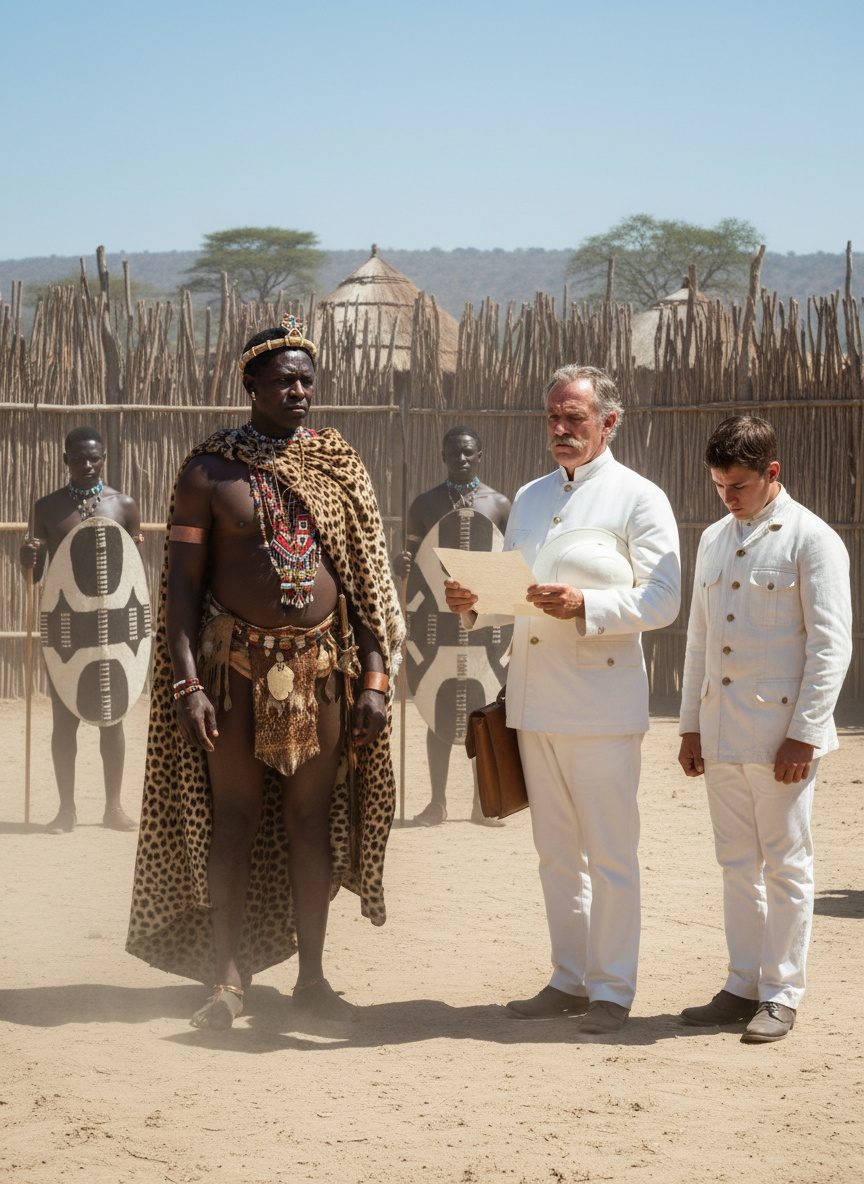
The skies over Zululand in December 1878 were a vast expanse of platinum grey, lingering heavily with the threat of rain. The air crackled with anticipation amidst the parched rustle of dry grasses swaying in the early summer breeze. In the center of this tense stage looming over southern Africa, stood the indomitable figure of King Cetshwayo kaMpande. He faced a challenge that would alter the course of his nation’s history: an ultimatum from a distant empire, cloaked in the formalities of diplomacy, yet ringing with the iron clang of oppression.
The Envoy's Decree
Amidst the solemn hush of the Zulu court, the British envoy Richard South African emissary stood with an air of imperial authority, his words carrying the weight of an empire behind them. The terms were stark and unyielding: the Zulu kingdom was to disband its formidable army, accept the presence of a British resident, and essentially relinquish its sovereignty. The clock was ticking—thirty days to compliance or face the dire consequences of war. For Cetshwayo, this was more than a demand; it was an affront to the dignity and freedom of his people.
Cetshwayo, a fierce patriot and astute leader, knew well the implications of such disarmament. The Zulu military strength was not merely for defense; it was the very fabric of their society and culture, meticulously honed through centuries of tradition. To dismantle it would be to unravel the unity and spirit of his nation. The projection of strength, symbolized by the spears and shields that each warrior bore, was essential to resist assimilation into the British Empire’s expanding dominion across southern Africa.
The Gathering Storm
All around, the whispers of war spread like wildfire—the murmur of warriors preparing, families saying farewells, shields being strengthened, and spears sharpened to a needle's point. The Zulu impis, regimens renowned for their discipline and unparalleled bravery, stood ready. Meanwhile, across the veld, British forces, methodically trained with modern weaponry, began preparations of their own, anticipation chilling the charged summer air.
The stakes were clear: the stage was set for a confrontation of ideals and power—traditional African sovereignty versus European colonial expansion. For the Zulu nation, preservation lay not in submission but in resistance. Cetshwayo had inherited a legacy of resilience, and under his command, the Zulu’s would not kneel without a fight, regardless of the odds set against them by the tides of colonial influence.
Between Two Worlds
With the ultimatum looming large, Cetshwayo faced not just military strategies but a philosophical conflict—a clash between progress as defined by the victors of the industrial age against a time-honored system of governance that held communities together for generations. Those who wished for peace could see the logic in a compromise, but for Cetshwayo, ceding control was tantamount to erasing their identity.
Despite the geopolitical reality pressing upon them, Cetshwayo's decision stemmed from a place deep in the psyche of his nation. The Zulus had, for centuries, thrived on the unity fostered by a shared confidence and solidarity. The affront of the British demands posed a critical question: was it preferable to risk annihilation on the battlefield or live under the yoke of domination, powerless to preserve the Zulu way of life for posterity?
The Unyielding Choice
As skies darkened with the weight of their collective fate, King Cetshwayo made the pivotal decision to reject the British ultimatum. It was an act that demonstrated both defiance and desperation, transcending the mundane choices of men and echoing across centuries of ancestral uplands calling for self-determination. His choice was less a call to arms than a call for dignity; it was a choice to fight for the principles of sovereignty, freedom, and cultural preservation.
Thus, with conviction hammered out of necessity, Cetshwayo mobilized his warriors. Their proud shields rose like waves upon the crest of their homeland, poised to meet the British redcoats whose military presence loomed heavy on the horizon. By January, the Zulu War had commenced, a confrontation etched into history as a testament to fierce resistance against imperial encroachment.
A Legacy Unbroken
The echoes of Cetshwayo’s decision reverberate across more than just the history books—they resonate within the heartbeats of many nations who have faced similar paths. His refusal symbolized a broader narrative—a defiance against the deluge of colonial exploitation that swallowed so many cultures. The courage of Cetshwayo and his warriors to challenge overwhelming adversity became a rallying cry for future generations to cherish their heritage and assert their right to self-determination.
While the ensuing conflict would ultimately lead to loss, the bravery and resolve displayed by Cetshwayo and the Zulu nation remain a reminder of the human spirit's enduring quest for freedom. This formidable standoff between empire and king reveals a narrative oft-muted by history's course: the unwavering spark of resistance and the timeless struggle to chart one's destiny in the face of monolithic power.