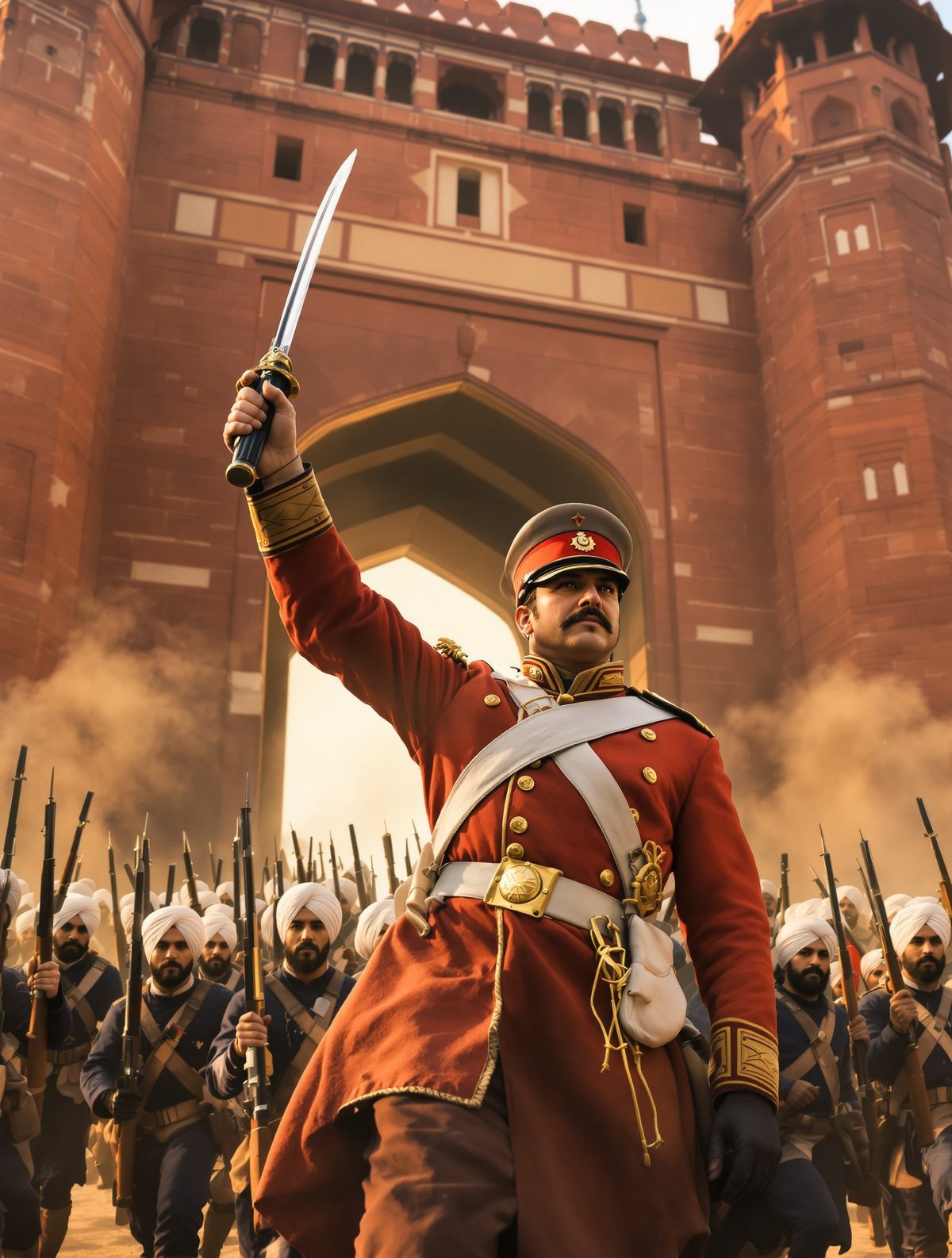
The telegram that arrived at Colonel Henry Havelock's camp on July 11th, 1857, contained just twelve words that would haunt the British Empire for generations: "Cawnpore fallen. Garrison massacred. Women and children butchered. Send immediate relief." As the 62-year-old veteran read those words in the stifling heat of an Indian summer, he looked out at his ragtag force of barely 1,000 men—mostly Scottish Highlanders and Sikh irregulars—and made a decision that defied every principle of military logic. He would march straight into the heart of rebel-controlled territory, through 126 miles of scorching wasteland where 25,000 insurgents waited to destroy them.
What happened next became one of the most extraordinary military adventures in British imperial history—a march so brutal that it killed nearly as many of Havelock's own men as enemy bullets, yet so relentless that it carved a legend into the blood-soaked annals of the Indian Rebellion of 1857.
The Preacher-Warrior's Impossible Odds
Henry Havelock was not your typical colonial officer. Known throughout the army as "the preacher-warrior," this devoutly religious Baptist had spent 34 years in India, fighting in Afghanistan, Burma, and the Punjab. His men called him "Old Testament" behind his back—partly for his habit of reading scripture before battle, partly for his Old Testament approach to justice. At an age when most officers were enjoying retirement in English country houses, Havelock was about to embark on the most grueling campaign of his life.
The numbers were staggering. Intelligence reports suggested that Nana Sahib, the rebel leader who had orchestrated the Cawnpore massacre, commanded at least 25,000 men equipped with British artillery captured from overrun garrisons. Havelock's entire force consisted of 1,065 men: the 64th Foot, a handful of the 84th Foot, the 1st Madras Fusiliers, a battery of Royal Artillery, and 150 irregular cavalry. One thousand men against twenty-five thousand. In military academies, this would be filed under "suicide missions."
But Havelock had one advantage his enemies didn't expect: he understood that sometimes the impossible becomes inevitable when driven by righteous fury. The reports from Cawnpore weren't just military dispatches—they were accounts of an atrocity so horrific it had electrified British India with a thirst for vengeance.
Into the Furnace: When the Earth Became an Oven
On July 12th, 1857, Havelock's column began their march through what soldiers would later describe as "a preview of hell." The temperature soared to 120 degrees Fahrenheit in the shade—when shade could be found. The sun beat down with such ferocity that rifle barrels became too hot to touch, and men's boots began to disintegrate on the molten roads.
The first day's march covered just eight miles. By evening, seventeen men had collapsed from heatstroke. The column's medical officer, Dr. James Sylvester, noted in his journal that the men's tongues had turned black, and several were hallucinating. Yet when Havelock called for volunteers to continue, not a single man stepped backward.
Water became more precious than ammunition. Each man carried a single water bottle that had to last between wells—sometimes a distance of 15 miles through country where every village might hide rebel snipers. The Highlanders, bred in the cool mists of Scotland, suffered worst of all. Their heavy woolen uniforms, designed for European campaigns, became instruments of torture in the Indian heat. Many began discarding equipment piece by piece: first their packs, then their greatcoats, finally everything except weapons and ammunition.
What made the march truly hellish wasn't just the heat—it was the knowledge that every step took them deeper into hostile territory, where 25,000 enemies waited in prepared positions with British guns turned against British soldiers.
First Blood at Fatehpur: The Miracle of Discipline
On July 12th, just hours into their march, Havelock's exhausted column stumbled into their first major engagement at Fatehpur. Nana Sahib had positioned 5,000 men with twelve cannons across the Ganges road—a force five times larger than Havelock's entire army. As the rebels opened fire, British soldiers who could barely stand from heat exhaustion were suddenly required to execute complex battlefield maneuvers under withering artillery fire.
Here, Havelock revealed the tactical brilliance that would make this march legendary. Instead of the conventional frontal assault that rebels expected, he used his tiny force like a scalpel. The 64th Foot fixed bayonets and charged straight up the center while his artillery—just two guns—concentrated fire on the rebel cannons. Simultaneously, his irregular cavalry swept wide to threaten the rebel flanks.
The psychology was devastating. Rebel troops, confident in their overwhelming numbers, suddenly found themselves facing soldiers who attacked when they should have retreated, advanced when they should have withdrawn. After ninety minutes of fighting, 5,000 rebels broke and fled, abandoning their artillery and leaving 300 dead on the field. Havelock had lost exactly eleven men.
But the real miracle wasn't the victory—it was that heat-exhausted soldiers could fight at all. As Sergeant William Forbes-Mitchell of the 93rd Highlanders later wrote: "We were more dead than alive from the sun, but when the pipes began to play and we saw the enemy guns, something in us came alive that was stronger than the heat."
The Crucible of Aong: Where Heroes Are Forged
Three days later, at the village of Aong, Havelock faced an even more formidable challenge. Rebel intelligence had accurately predicted his route, and a massive force of 12,000 men with twenty-eight guns had transformed the village into a fortress. The position was nearly impregnable: rebels occupied stone buildings that commanded every approach, while their artillery was positioned to create devastating crossfire.
Any conventional military wisdom dictated retreat or at least waiting for reinforcements. Havelock had neither time nor reinforcements. With each passing hour, the rebels grew stronger while his men grew weaker. More critically, every delay meant more time for the perpetrators of Cawnpore to escape justice.
The battle of Aong showcased Victorian military engineering at its most brutal and efficient. Havelock's artillery commander, Captain Francis Maude, deployed his guns with mathematical precision to create gaps in the rebel line. The infantry then advanced in coordinated rushes, using disciplined volley fire to suppress rebel positions while engineers cleared obstacles with explosive charges.
The fighting lasted four hours under a sun that, according to military thermometers, reached 122 degrees. Men fought with bayonets while suffering from severe dehydration. The 1st Madras Fusiliers lost thirty percent of their strength, but they held their positions and continued advancing. When the village finally fell, the rebels had lost over 800 men and all their artillery. Havelock's casualties: 37 killed and wounded.
Perhaps most remarkably, captured rebel letters later revealed that Aong was intended to be Havelock's graveyard. Nana Sahib had been so confident of victory that he'd already drafted proclamations announcing the destruction of the British relief column.
The Reckoning at Cawnpore: Justice in the Shadow of Atrocity
When Havelock's battered column finally reached Cawnpore on July 16th—after covering 126 miles in just four days through enemy territory—they discovered scenes that would scar the British imperial conscience forever. The Bibighar, where British women and children had been imprisoned, told its story in bloodstains that covered every wall. Personal effects scattered in the courtyard revealed the human cost of the rebellion: a child's toy soldier, a woman's prayer book, a locket containing a family photograph.
The well where the bodies had been thrown became a shrine to imperial fury. Havelock, the devout Christian who normally showed mercy to defeated enemies, authorized executions that shocked even hardened soldiers. Captured rebels were forced to lick blood from the Bibighar's floor before being hanged. Those who refused were sewn into pig skins—an ultimate insult to Muslim sensibilities—before execution.
Yet even in vengeance, Havelock maintained military discipline. When some of his officers proposed burning Cawnpore in retaliation, he refused, declaring: "We are British soldiers, not barbarians. We will have justice, not savagery." This distinction—between justice and revenge, between military discipline and mob violence—would define how the British Empire remembered both the rebellion and its own response.
The march had cost Havelock nearly 200 men—not to enemy action, but to heat, disease, and exhaustion. Yet his impossible mission had succeeded. A force of 1,000 men had defeated 25,000 rebels, recaptured a major city, and restored British prestige at a moment when the entire empire in India teetered on the edge of collapse.
The Legacy of an Impossible March
Havelock's march to Cawnpore reveals something uncomfortable about how empires maintain themselves: sometimes they survive not through wisdom or justice, but through sheer, bloody-minded determination to do the impossible. In an age when military planners rely on overwhelming technological superiority, there's something both inspiring and terrifying about 1,000 men deciding that numerical odds simply don't matter when the cause is just.
The march also illuminates the psychological foundations of imperial power. Rebellions succeed when subject peoples believe their rulers can be defeated. Havelock's impossible victory—broadcast throughout India by telegraph—sent a different message: that the British Empire, however outnumbered, would march through hell itself to maintain its authority.
Today, as modern armies struggle with asymmetric warfare and insurgencies, Havelock's march offers sobering lessons about the relationship between military power and political will. Technologies change, but the fundamental equation remains: sometimes impossible missions succeed simply because someone decides they're necessary, regardless of cost. In July 1857, in the furnace heat of northern India, 1,000 men proved that the word "impossible" has no meaning when empires decide to march through hell.