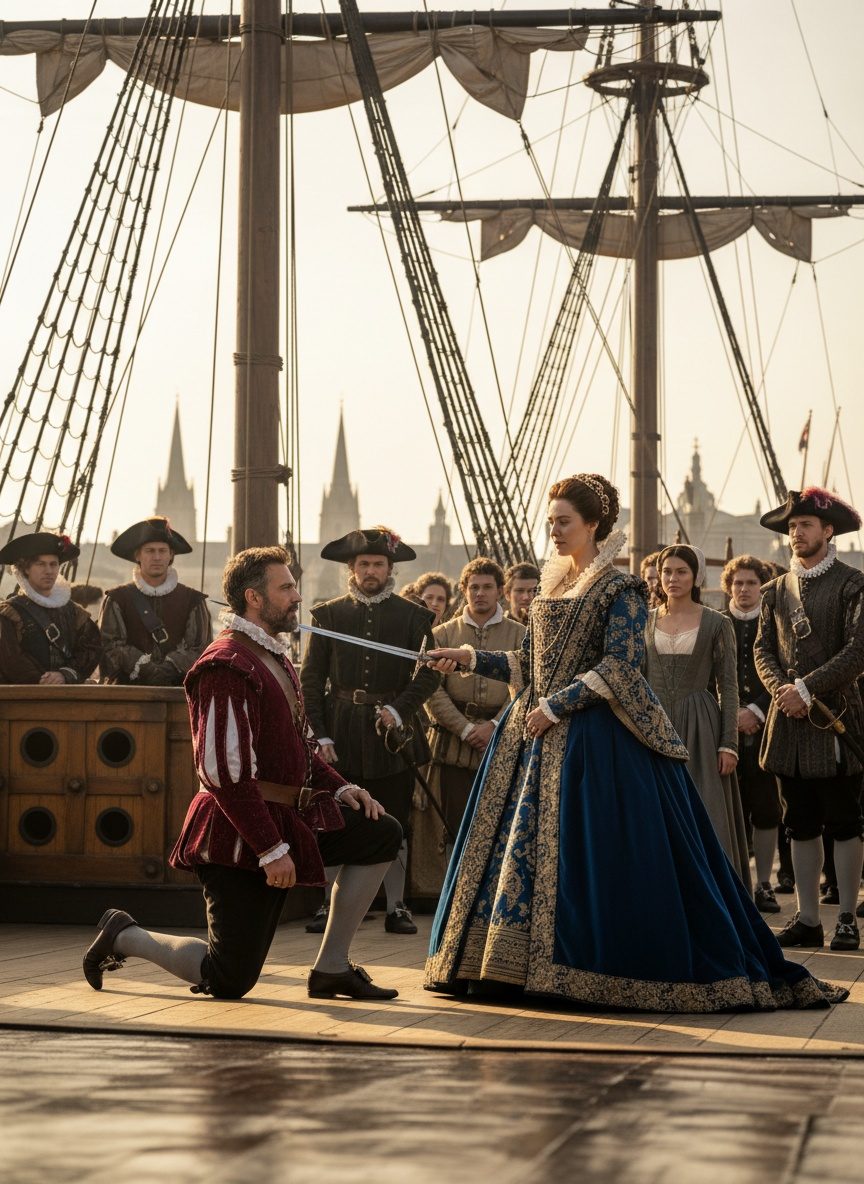
April 1581. The salty breeze carried whispers of destiny across the deck of the Golden Hinde.
Knights of the Sea
On that fateful morning, Sir Francis Drake prepared to kneel before his Queen, Elizabeth I, atop the very ship that bore countless tales of adventure. The Golden Hinde, weathered by the ocean's relentless embrace, was more than just a vessel; it was a symbol of England's burgeoning audacity. With its hull scarred from untold trials, each dent and worn timber testified to the triumphant completion of a formidable circumnavigation of the globe. This grand achievement was a first for the English and second only to the pioneering Portuguese navigator Ferdinand Magellan.
To view the Golden Hinde as merely a ship would be to overlook the soul of the vessel—the daring crew that manned it, the same men who claimed treasure and plunder from Spanish galleons and faraway shores. It was here on this wooden stage that the pirate from Devon, once considered a thorn in the side of powerful Spain, was to be transformed into a chivalrous knight, an emblem of English strength and ambition.
The Queen's Gambit
Queen Elizabeth I, resplendent in her regal attire, stood ready with her sword drawn. Her choice to knight Drake was as strategic as it was ceremonial. This act was an unmistakable declaration: England was no longer a mere spectator on the world stage but a rising contender for global influence and might. The knightly accolade bestowed upon Drake was not just for his prowess as a navigator but for his role in undermining Spanish hegemony, her arch-rival in the dance of empires.
The knighting of Drake, a former privateer, was both bold and controversial. Many at court grumbled, viewing Drake's past raids on Spanish territories as acts of piracy rather than heroism. However, Elizabeth possessed a shrewd understanding of symbolism and the power it wielded in statecraft. With a deft touch of her sword, she transformed England's rogue mariner into a gentleman of prestige.
Amidst this calculated move lay an unspoken message to Spain: Behold the metamorphosis of a once-loathsome pirate into a knight of the realm, sanctioned by the crown, further affirming England's intent to steer its course among the great powers of Europe.
The Voyage Beyond
Francis Drake's journey around the globe was a daring exploit for its time, fraught with peril and yet marvelously successful. The expedition that saw him sail from Plymouth in 1577, circumnavigating the world and returning in 1580, provided tangible proof of his resourcefulness and the resilience of his crew. They maneuvered through treacherous waters, encountered indigenous peoples, and amassed great wealth at the expense of Spanish interests. Such exploits brought accolades but also tales shrouded in myth and intrigue.
Unlike Magellan, who did not survive to complete the journey he started, Drake returned a hero. He brought with him not only treasures and goods from distant lands but also valuable knowledge and experience that would fuel England's aspirations of becoming a global seafaring power. His voyage opened new frontiers and possibilities, stirring the imaginations of those who dreamt of emulating his adventures in search of fortune and fame.
Rising Tides of Empire
Sir Francis Drake's knighthood marked more than just the personal triumph of a tanner's son from Devon; it was a harbinger of the rise of the British Empire. Before Drake's voyage, England had been cautious and tentative in its overseas ventures. His successes emboldened English efforts to explore and assert influence across the seas, laying the groundwork for the country's expansive imperial ambitions.
The Golden Hinde, now transformed into a symbol of national pride, epitomized the spirit of adventure and exploration that would drive England's maritime pursuits for centuries to come. Drake’s knighting also resonated through the ranks of aspiring seafarers as a testament to social mobility, a rarity in the rigid hierarchies of Elizabethan England. It showcased that valor and courage could indeed transcend one's birthright, a notion that would resonate for generations.
In knighting Francis Drake on the deck of his storied ship, Elizabeth I signaled that England would no longer be marginalized by the older hegemonies of Europe. Drake's ascent from privateer to knight underscored the nation's determination to forge its own path through uncharted waters, its commitment to exploration, and its zeal for expansion. As history would show, England's ambition would indeed reshape the world—a ripple begun by one man's extraordinary voyage.