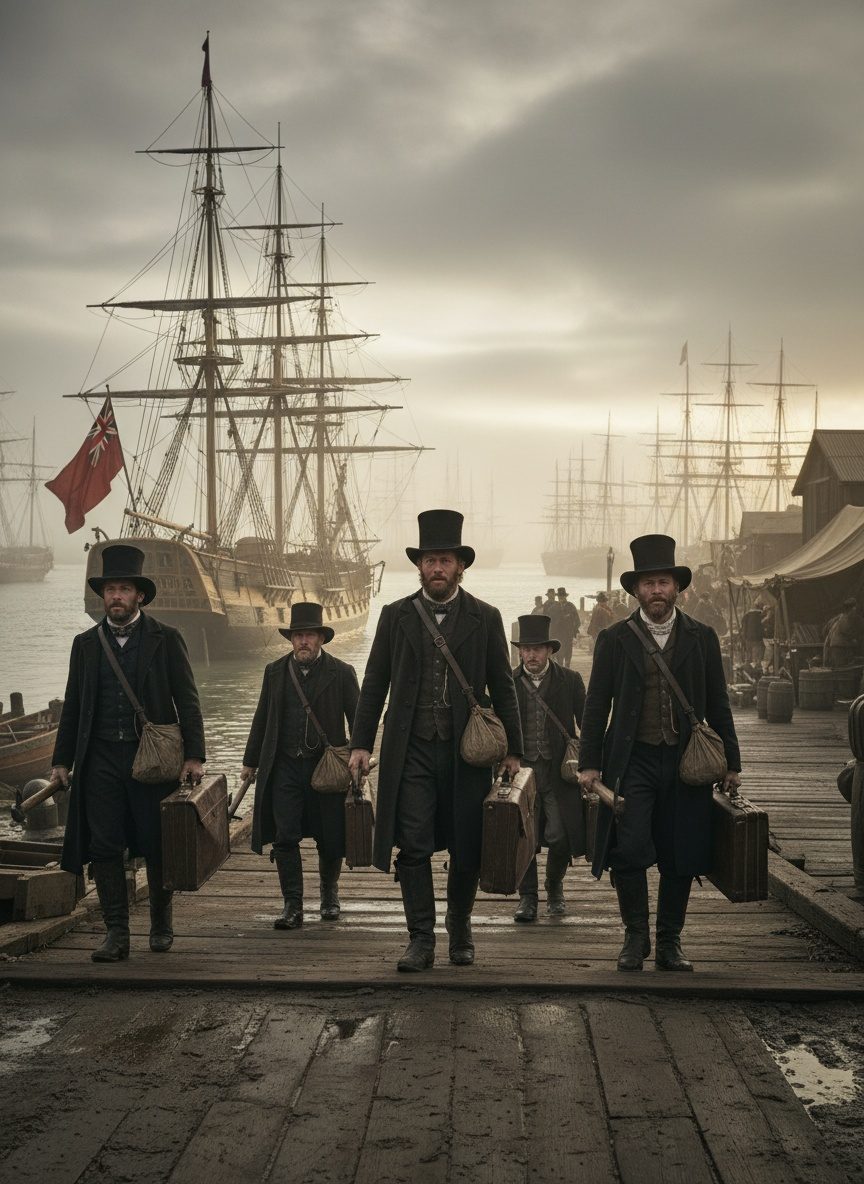
January 24, 1848. A distant rumble across the Sierra Nevada hinted at impending upheaval.
A Spark in the American Wilderness
On that fateful January morning, James Marshall was inspecting the American River when he spied the glimmer of what seemed to be gold. This accidental discovery at Sutter's Mill would soon cascade beyond borders, altering the focus of empires. As word of the find spread, the echo was felt far from California—across the sweeping British Empire.
Within months, rumours of untold wealth had navigated oceans to the bustling ports of Britain’s colonial dominions. From the convict-filled shores of Australia to the strategic coaling stations in Hong Kong, and the multifaceted precincts of India, the allure of seemingly limitless riches triggered a profound migration. British ships began to divert their courses, flooding San Francisco Bay with vessels laden not with goods to trade but with men fervent for fortune.
The magnitude of this diaspora perplexed the Colonial Office. Here was a challenge not anticipated by policymakers: the Empire's own workforce abandoning its posts for foreign soil. Deserters from the Royal Navy, merchants with half-unpacked wares, and even colonial administrators forsook their duties, lured westward by an American discovery. The gold was unreachable to the British Crown, yet it held an irresistible power over its subjects. As one contemporary observer noted, "The riches of the Earth are begotten but once in a generation, and when they appear, not even the Queen's chains may restrain them."
Decks Cleared and Flags Furled
The consequences of Marshall's find wreaked havoc on British colonial operations, particularly in Australia where the effects were most keenly felt. In 1848, the burgeoning colony needed every able hand for its own economic consolidation. But with the California Gold Rush, the sparsely populated continent found itself stripped of men. Sailors jumped ship in Sydney Harbour, midshipmen on the RMS Fortitude slipped overboard at night, and ordinary settlers hurriedly packed their meagre belongings to join the throng making for San Francisco.
Governors from Sydney to Singapore wrote deeply concerned dispatches to London. Reports recorded unruly clusters of men gathering on wharves with little more than grand dreams fueling their voyages. The loss of labour was not just an economic drain but a spiritual shockwave—as if the very idea of British Empire expansion was being pulled backward across the Pacific Ocean.
In Hong Kong, this westward fever saw ships previously chartered for tea and opium trading turn into crudely refitted human transit vessels. Meanwhile, Indian ports experienced a curious amalgamation of desertion and recruitment as wave after wave of British citizens embarked across the Pacific. It was an exodus as much in spirit as flesh; an era where ironclad rigging wasn’t enough to tie down the soaring ambitions of those hoping to return with gold rather than silk or spice.
A Global Appetite for Change
The Gold Rush was more than a fever—it was a seismic shift in the psyche of an empire accustomed to being the arbiter of fortune, not a mere bystander to American enterprise. As the ships sailed, they carried with them not only men but also a collective hunger for self-made prosperity that challenged the very notion of propriety and class so deeply entrenched in Victorian society.
The narrative of those dramatic years holds fascination not for the gold actually mined, but for what these migrations represented: the tightening cables of allegiance slackened by the promise of American opportunity. British journals of the time capture an Empire at a crossroads, with cartographers scrambling to redraw routes occupied not by spice-laden galleons but by fleets driven by gold dreams. The experience of California’s goldfields reshaped lives—not with wealth, but with the knowledge that fortune could reside outside the confines of a structured colony.
Today, as we delve into these pages forgotten by textbooks, we unravel a subplot of the Victorian narrative where raw commercial aspiration met the gravid ambitions of global citizens. The story of British desertion to California is a lens on a moment when lines between boundaries blurred, and allegiances were tempted by the elemental lust for progress. In this history of chance finds and colossal ventures, one can glean the timeless insistence of human nature to uproot and seek something profoundly new. The Gold Rush wasn't merely a touchstone for those who ventured to pan the icy waters of the Sierra Nevada; it was a clarion for generations who followed, that opportunity knows no leash.