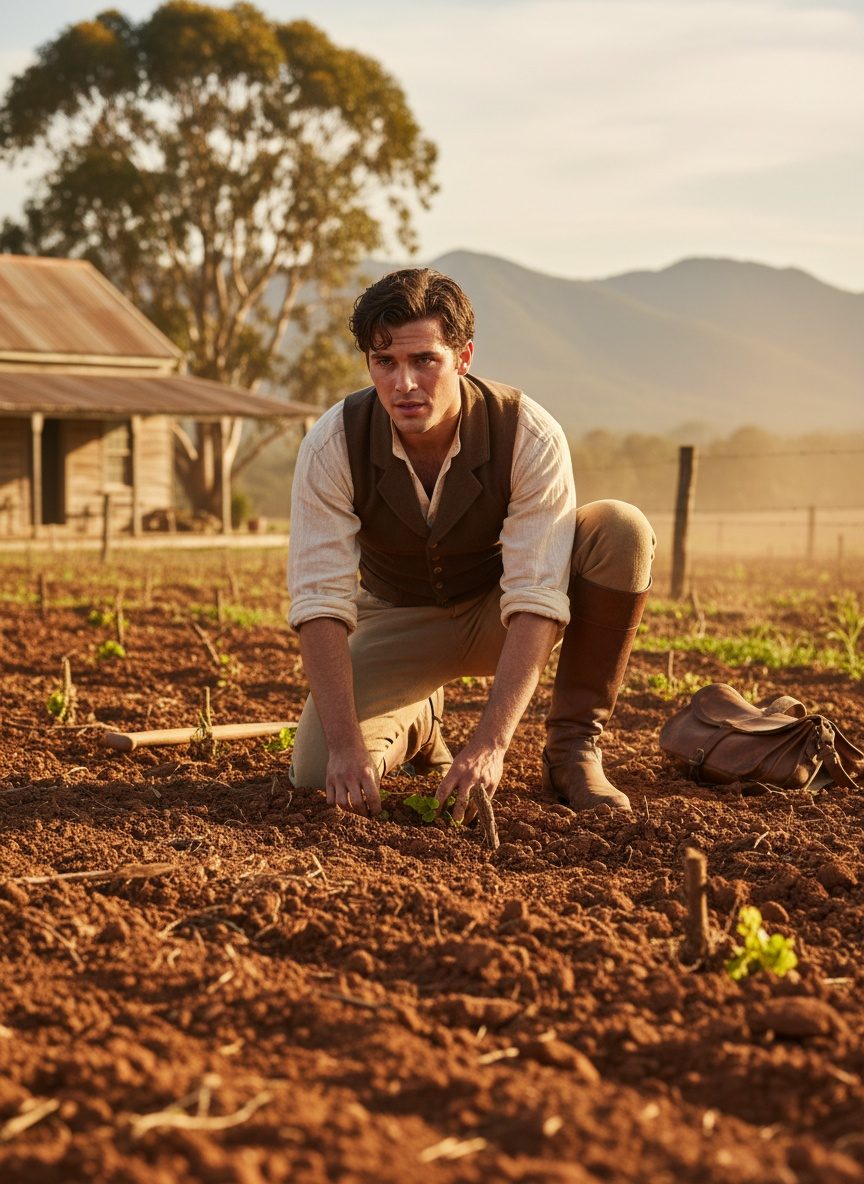
1835. The relentless Australian sun cast its golden hue over the dusty plains of New South Wales, illuminating a solitary figure kneeling in the battlegrounds of the land's untamed wilderness. John Macarthur Junior, his face a picture of determination and quiet resolve, was planting what many at the time might have dismissed as mere green cuttings. Yet these unassuming shoots, pressingly inserted into the red soil, were destined to transform the fledgling colonies of Australia into a viticultural powerhouse.
The Legacy of a Father
To understand John Macarthur Junior's journey, one must first delve into the tumultuous legacy left by his father. John Macarthur Senior, a name once synonymous with controversy, had played a pivotal role in the history of New South Wales as one of the original architects of the Australian wool industry. While his contributions to the colony's agricultural development were undeniable, his tenure was marred by conflicts with colonial governors, mutinies, and a reputation for a rather combative disposition.
By the time John Junior found himself amidst the dust and dreams of New South Wales, he carried with him not only the burden of continuing his father's legacy but also the opportunity to carve out his own path. At this moment on Australian shores, viticulture was merely a pipe dream; far outside the mainstream ambitions of colonial settlers focused on more traditional crops. Yet, like all pioneering spirits, the promise of something different sustained John’s vision.
He arrived equipped with little more than a handful of vine cuttings and a keen desire to see them thrive. These vines, carefully brought from Europe, held the potential to revolutionize agriculture in a land predominantly known for its wool and penal applications. Every vine he planted was a testament to a deeper understanding of the land, and a firm belief in its potential to exceed its conventional uses.
But the path was not without its sacrifices and hardships. The vines needed water, of which there was often little, and protection against the array of pests unfamiliar to their roots. Still, with each season, John worked tirelessly, immersing himself in the science of viticulture, learning from failures, and celebrating moments of success, however modest they might be.
The Fruit of Persistence
Patience became John Macarthur Junior’s closest ally, as he and his vines faced the harsh unpredictability of the Australian climate. There was something mystical in the process—an alchemical transformation fashioned through bolts of sunlight, smatterings of rainfall, and the gentle whispers of the eastern winds. The cycle of growth, hibernation, and regeneration became mesmerizing tales told by the landscape itself.
As the vines matured, so did John’s understanding of their peculiarities. Over the years, he honed traditional European methods with innovative practices adapted to Australian conditions—a seamless convergence of old-world tradition with new-world tenacity. Slowly, the barren fields began to shape themselves into rows of green, filled with promise and forecasted abundance. The familiar stories of hardship were transmuted into joyful narratives of harvest, laden with the musky fragrance of grapes.
Word began to spread slowly at first. Stories exchanged in the candle-lit camps of explorers, between sheep farmers' meandering journeys, or whispered in the marketplaces of newfound settlements. This soil, once thought barren of value, was now found to be fertile, teeming with potential unmatched by existing European imports.
The earliest wines produced by these vines were rudimentary, experimental even. Yet, amid the rusticity lay hints of a robust character—a boldness and depth once hidden away, now emerging like the crimson sunset crashing upon the horizon. New South Wales was, for the first time, tasting its own terroir—a distinctly Australian signature wine.
A Nation’s Toast
The significance of John Macarthur Junior’s endeavor lies in the quiet revolution it sparked. Though he sought no fame or fortune from his venture, his dedication laid the groundwork for what would become a cornerstone of Australia’s national identity and economic prosperity. The simple act of planting those cuttings heralded an era of innovation and international recognition for Australian wines.
From these humble beginnings, an industry blossomed. By the late Victorian era, Australian wines had found their way to Europe, challenging established tastes and convention. They bore qualities shaped by distinctly Australian conditions, offering something entirely unique—something impossible to replicate elsewhere. The records of French vinters speak of their intrigue and often jealousy, and slowly, the world began to recognize the distinct ‘terroir’ of Australian wines.
Today, nestled across the landscapes of the Hunter Valley, Barossa, and Yarra, expanses of vineyards blanket hillsides and plains, telling tales of resilience and fortitude. Each vine is a living legacy of the man whose vision dared to challenge the accepted norms and bore fruit far beyond his imagination. John Macarthur Junior may not have sought glory, but by tending quietly to his vines, he forever altered the course of Australian agriculture.
His is a story of patience and faith—a symbiosis of man and land, shaped not by grand intent but by small, persistent acts of care. It stands as a silent reminder that history is often crafted by those who toil away from its spotlight, urging us to look beyond the thunderous headlines to the whispers of promise laid in the soil beneath our feet.