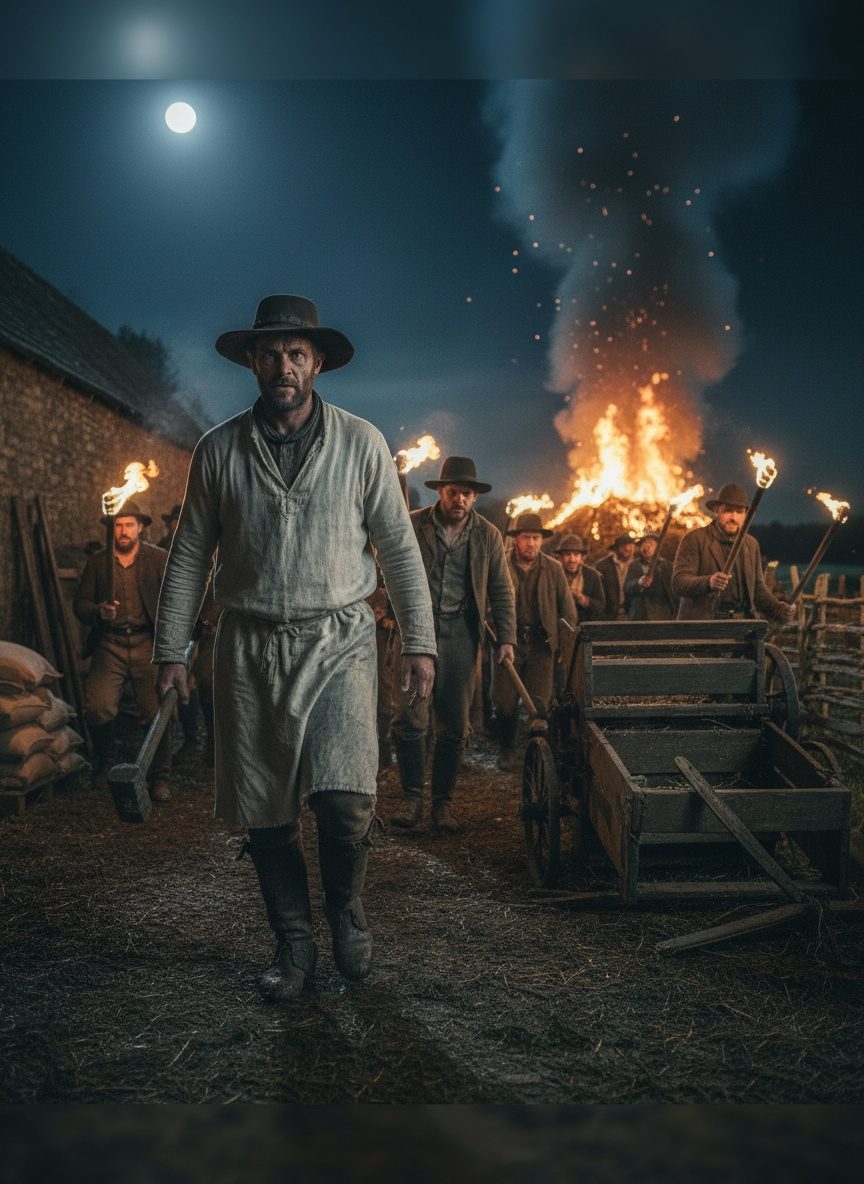
The chill of autumn clung to the air, as if the wind itself carried a whisper of ancient grievances across the bucolic expanse of southern England. Mist settled gently over the fields, shrouding the skeletal remains of crops, their bounty harvested by cold steel and not human hands. In this stark landscape, punctuated by the creak and clatter of relentless machines, an unseen storm brewed just beneath the horizon of rural livelihoods. By November 1830, this storm would erupt—silent no longer—as farm laborers unleashed their pent-up rage upon the threshing machines threatening their survival.
The Seeds of Discontent
For generations, the laborers of England had relied on the rhythm of the seasons, their hands calloused from decades of toil. Yet the onset of industrial progress had seeded upheaval instead of prosperity. The advent of the threshing machine—a marvel of innovation—had multiplied productivity for the wealthy landowners while spelling doom for the men who had once labored those fields by hand. The machine, with its unforgiving efficiency, was eradicating men's jobs faster than a scythe through ripened wheat.
As hunger gnawed at the bellies of farm workers and their families, the bitterness of displacement fermented into desperation. Landowners, eyes wide with avarice, saw machines as the means to greater yields, ignoring the human cost. The laborers, however, saw them as harbingers of their extinction, each machine a physical manifestation of their invisibility in this new industrial age.
The Shadow of Captain Swing
In the early evenings, amidst the golden light that spilled over hedgerows, a figure emerged—not in flesh, but in words etched on parchment. Letters signed by "Captain Swing" began to circulate, striking fear in the hearts of property owners from Kent to Yorkshire. Bearing no physical form or singular purpose, Captain Swing was a specter of rebellion—spurring laborers across the countryside to rise against the injustices wrought upon them.
The letters spoke with an eloquence born of desperation, warning landowners of the consequences should the threshing machines continue to steal livelihoods. Yet no matter how fervently authorities searched, Captain Swing remained elusive—a ghost conjured by the collective will of the oppressed. For where there was no single captain, there could be no arrest, no figure to scapegoat. The anonymity of the author was both the movement’s strength and mystery.
Fire and Fury
As the November nights grew longer, the English countryside was cast into an unholy glow, haystacks ablaze like macabre bonfires set against an indifferent sky. The Swing Riots had begun, their focus the threshing machines that seemed to stand in arrogant defiance of tradition and survival alike. Under the cloak of darkness, groups of farm laborers dismantled and destroyed the symbols of their despair, resorting to arson as a form of exorcism for the specters of hunger and poverty.
Even in their desperation, there was a brutal poetry to their actions. It was not simply spiteful destruction, but a plea to restore the balance of power disrupted by technology. The fires were beacons, signals imploring those in power to comprehend the plight of the disenfranchised. Yet too often, all they reflected was counteraction—swift justice meted out by the authorities, who labeled the rioters as common criminals rather than desperate men pushed to the brink.
The Iron Hand of Justice
The response from landowners and magistrates was draconian. Determined to crush the insurrection, they dispatched military regiments and increased the presence of Yeomanry in rural areas. Mass trials were conducted with unprecedented speed, delivering harsh sentences intended to deter further unrest. Transportations to penal colonies and public hangings served as grim reminders of the price of defiance against entrenched authority and technological progress.
Despite the authoritative crackdown, the ripples of the Swing Riots extended far beyond the justice meted out in crowded courtrooms. They forced a nation to confront the human cost of unchecked industrialization and raised painful questions about the future of agrarian workers in a mechanized world.
The Ghosts of Captain Swing
As the fires died out and the echo of hammering soldiers' boots faded, the spirit of Captain Swing lingered silently in the English soil. The Swing Riots were quelled, yet they left behind an indelible mark—a somber reminder that resistance, while often painful and punished, is sometimes the only voice known to the unheard.
In recalling the Swing Riots, we are reminded of the resilience found in unity, manifesting in the simplest yet most profound of ways. Traces of Captain Swing linger in every struggle against inequality; his ghost a testament that, even without a face or a form, a name can ignite change. The story of the Swing Riots is more than a chronicle of rebellion; it is an enduring question of how society values its humanity amid the march of progress. As we gaze upon the landscape where once-threshing machines stood, we must ask ourselves if the lessons of 1830 have truly taken root—or are they doomed to be forgotten like the mist over the fields?