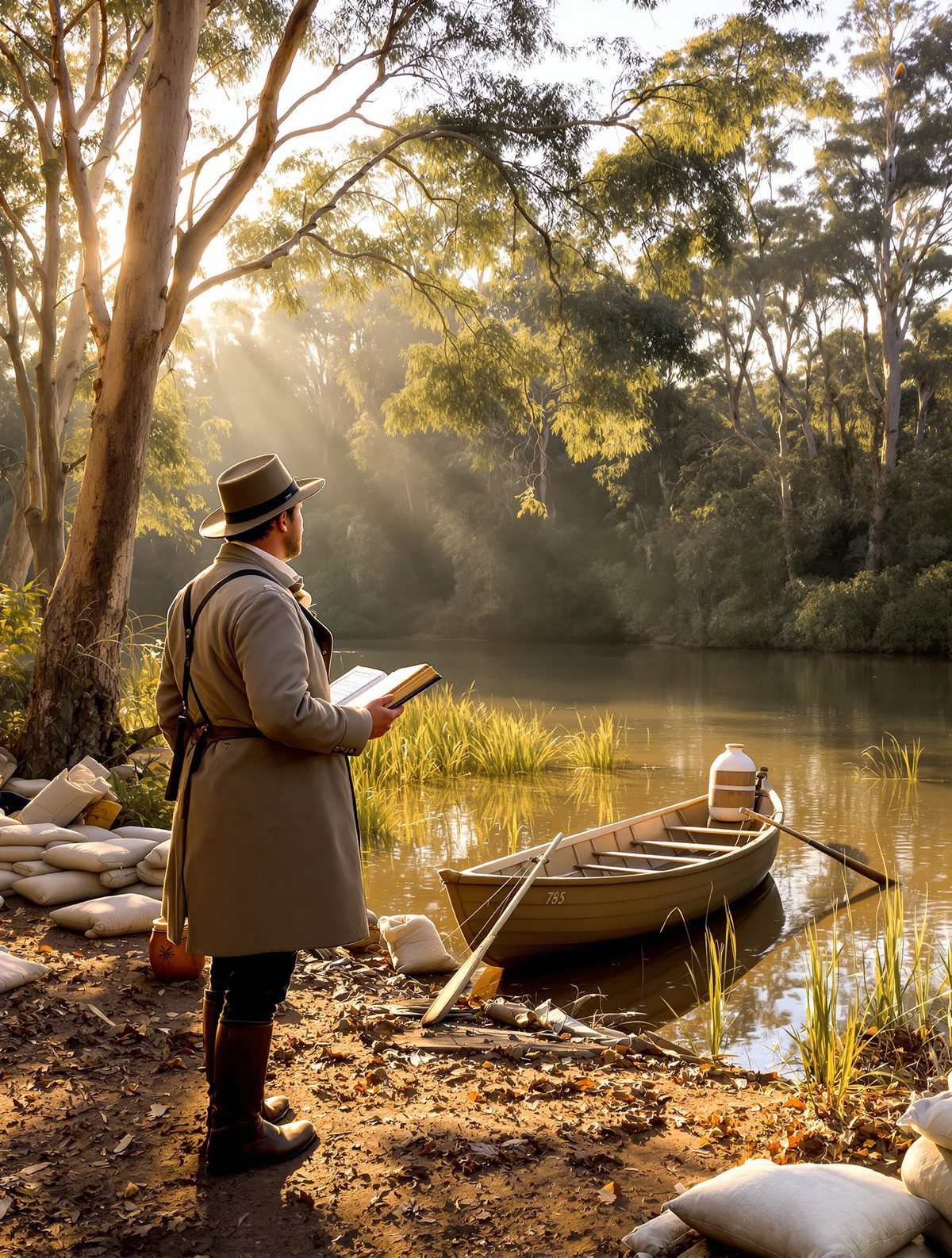
In the early hours of a winter morning in June 1835, a chill danced across the surface of the Yarra River. The land was ancient, known as Naarm by its traditional custodians, the Wurundjeri people of the Kulin Nation. Against this timeless backdrop, a curious scene unfolded: a small band of Europeans had arrived, led by a resilient farmer named John Batman. Laden with flour, mirrors, and blankets, he came to make a deal that would ripple through history. Little did he know, this would be the moment a city was born—the city we now know as Melbourne.
An Ambitious Voyage
John Batman was far from an ordinary farmer. Born in New South Wales in 1801, he ventured to Van Diemen's Land—present-day Tasmania—at a young age, establishing a reputation for himself as a bold and ambitious settler. By the early 1830s, stories floated back of a fertile land across the Bass Strait. Batman was compelled by these tales, and in May of 1835, he set sail from Launceston. Ironically, the same spirit of exploration and conquest driving him would seed the city of Melbourne just one month later.
Batman didn’t arrive empty-handed. His ship, the Rebecca, held a cargo meant to entice and trade with the native people: beads, mirrors, and tools—items of little intrinsic value to him, but potentially enticing to indigenous leaders. He also carried a deed—a type of document familiar to European merchants but foreign to the indigenous concept of land ownership. As he saw the land rich with promise, Batman whispered a thought to himself: This is indeed the place for a village.
Negotiating With Tradition
The understated power of Batman's journey was not purely in the territory claimed, but in his meeting with the Wurundjeri elders, amongst them a leader known as Billibellary. Batman, with a calculated charm, presented his trade goods, promising annual compensation in exchange for vast tracts of land. It was an ostensible deal steeped in misunderstanding, rooted in a concept alien to the Wurundjeri—land ownership.
The deed, famously called the "Batman Treaty," essentially proclaimed Batman's possession of 600,000 acres, including what now encompasses much of the greater Melbourne area. For this massive acquisition, he vowed to pay an annual rent of 'knives, tomahawks, blankets, scissors, looking-glasses, flour, etc.' Batman’s journal entry paints a picture of control: 'I am the greatest landowner in the world.' Yet his grasp was tenuous at best; the land had never belonged to him, nor could it.
The Consequences of Overconfidence
Beneath the layers of handwritten deeds and sterling promises, the repercussions of Batman's dealings were both immediate and long-reaching. His boldness challenged the conventions of the time, threatening the status quo of British colonial administration. Governor Bourke, upon hearing of Batman's "treaty," swiftly intervened. On August 26, 1835, he declared the agreement invalid, stating that only the Crown could allocate land.
This top-down dismissal did little to slow the pace of settlement. The lure of fertile land proved irresistible to many, and Melbourne—named by surveyor Robert Hoddle in honor of then-British Prime Minister William Lamb, 2nd Viscount Melbourne—began to take shape. Its streets were an intricate grid, structured with a vision far from the chaos that lay ahead.
From Swampy Beginnings to Urban Expanse
Upon Batman’s "purchase," the landscape was deceptively swampy, speckled with lagoons and rich in wildlife. But by 1847, overshadowed by relentless settlement, it was decreed a city. The transformation was rapid; the discovery of gold in the 1850s catapulted Melbourne into a bustling metropolis. The opulent architecture of the Victorian era began to rise, a testament to the city’s newfound wealth.
Yet, underlying these transformations was a narrative of displacement and upheaval for the indigenous populations. With the land wrested from them, the Wurundjeri and other clans faced a future of marginalization, a stark contrast to the prosperity burgeoning around them.
Reflecting On Melbourne’s Origins
The foundation of Melbourne conjures mixed emotions—a tale of ambition, misunderstanding, and transformation. Today, as Melbourne thrives as one of Australia’s great cities, it's crucial to remember the complex layers of its birth. The city stands as both a testament to human enterprise and a poignant reminder of past transgressions against its first people.
John Batman’s once-simple statement, This will be the place for a village, echoes with layers of irony and consequence. Yet, in acknowledging these tales—the legends deliberately left out of the textbooks—one can gain a deeper and more nuanced understanding. As we wander the bustling streets today, we must not forget those early days by the Yarra, remembering both the dreams and the costs entwined in its history.