Twilight tinged the South African landscape on January 22, 1879, casting long shadows over the British mission station known as Rorke's Drift. For the 139 soldiers garrisoned there, the day had been uneventful until a lone horseman, breathless and wide-eyed, galloped into view. His news brought a chill deeper than any nightfall — the column at Isandlwana had been annihilated by the Zulu, and now a howling swarm of 4,000 warriors was headed straight for this insignificant patch of earth.
The Gathering Storm
Drifting on the wind, the distant ululations of the Zulu impi were barely discernible at first. As Lieutenant John Chard, a Royal Engineers officer tasked with the station's defense, surveyed the makeshift fortifications, he knew the odds were stacked sky-high against them. The mission hospital, a few ancillary buildings, and a storeroom were all that comprised Rorke's Drift. Yet in this tenuous haven, biscuit tins and mealie bags would soon become legendary instruments in a stark fight for survival.
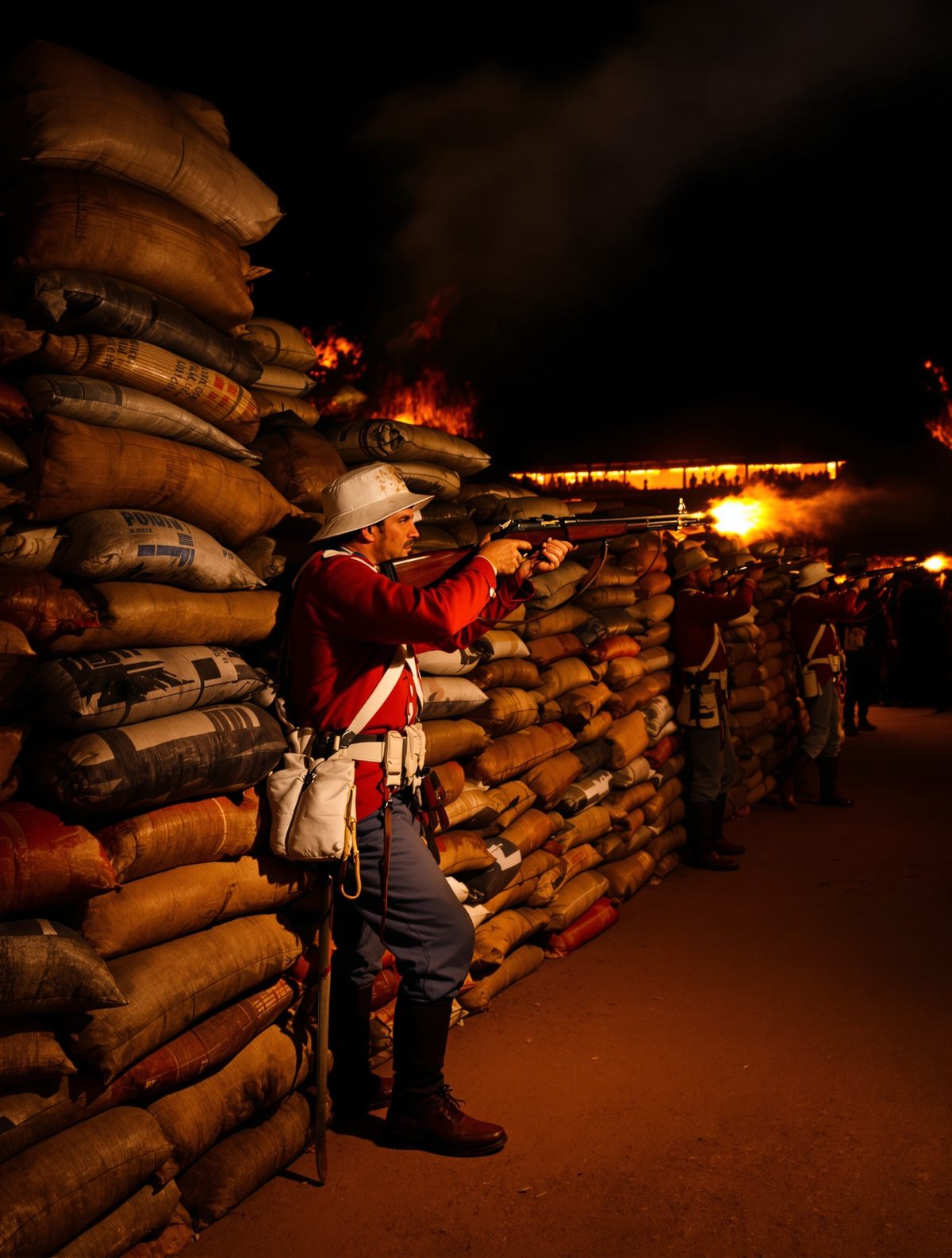
Chard, acting as the unlikely leader, and his fellow officer, Lieutenant Gonville Bromhead of the 24th Regiment of Foot, stood shoulder to shoulder. Together, they improvised a twisting barricade from available supplies, creating a wall reminiscent of a desperate, life-or-death game of Tetris. With Martini-Henry rifles at their disposal, each soldier stood resolute, waiting for the dark mass of battle-hardened Zulus to spill over the horizon.
The Onslaught Begins
As the sky reluctantly surrendered its last gleam of daylight, fires flickered to life around the fortifications. Guided by orange tongues of flame, the Zulu warriors descended with a silent fury that was instantly shattered by war cries loud enough to rattle the bones. The first attack wave struck with the ferocity of a lion's pounce. The defenders didn't flinch. A relentless volley of rifle fire, sharp and precise, met each charge, finding targets under the eerie illumination of burning thatch.
Among them, the name Private Henry Hook would emerge into legend this night. A proverbial hero, Hook's valiant efforts to defend the hospital while evacuating its patients became a gritty tableau of gallantry. Here, amid feverish cries and the stench of gunpowder, he fought fiercely in cramped makeshift corridors, leaving not a single man behind.
Firelight and Fury
Hour after relentless hour passed as men and warriors alike sank elbows-deep into a siege defined by life and death, bisected by the shattered remnants of Rorke's Drift. As ammunition supplies dwindled, Chard's leadership shone magnanimously. He urged his men to conserve bullets, commanding that every shot fired must count.
In one harrowing account, the soldiers repurposed biscuit tins as makeshift defense, an impromptu shield against incoming spears and bullets. Some squeezed into doorframes, others huddled by windows or crouched low behind walls, swapping jammed rifles for bayonets and fists. Meanwhile, the Zulu painted the night with their own brand of indomitable spirit; they were warriors born to the rhythm of battle, ageless in resolve and proud in stance.
Dawn's Bleak Reveal
As dawn stained the horizon a blushing red, its glow illuminated a scene that no mind could ever erase nor fully comprehend. An eerie lull had slipped over the battlefield. The Zulu, having suffered massive losses yet undaunted, withdrew as suddenly as they had appeared. The body-strewn perimeter of Rorke's Drift testified to a desperate victory wrought by Britain's beleaguered forces amidst the harsh echoes of failure at Isandlwana.
Seventeen British soldiers lay dead, 15 wounded, yet the impact of their stand reverberated far beyond the meager walls they had defended. For their extraordinary bravery, no fewer than 11 Victoria Crosses were awarded, making Rorke's Drift the most decorated single engagement in British military history.
Echoes of Courage
But why, after more than a century, does the story of Rorke's Drift still captivate us? Part of it rests in the mathematical improbability of survival—the incomprehensible feat of a minuscule garrison fending off an overwhelming foe. Yet, beneath the brass buttons and rifle cartridges, the story embodies the indomitable human spirit. It is a reminder that courage can ignite in any form — whether sparked by necessity, desperation, or an unyielding devotion to comrades by one's side.
In an era that romanticizes the empire's reach and its tales of conquest, perhaps it is these moments, untouched by grandeur, that truly matter. They are the whispered legends that remain left out of textbooks but dwell forever in the heart's chronicles — timeless and fierce.