
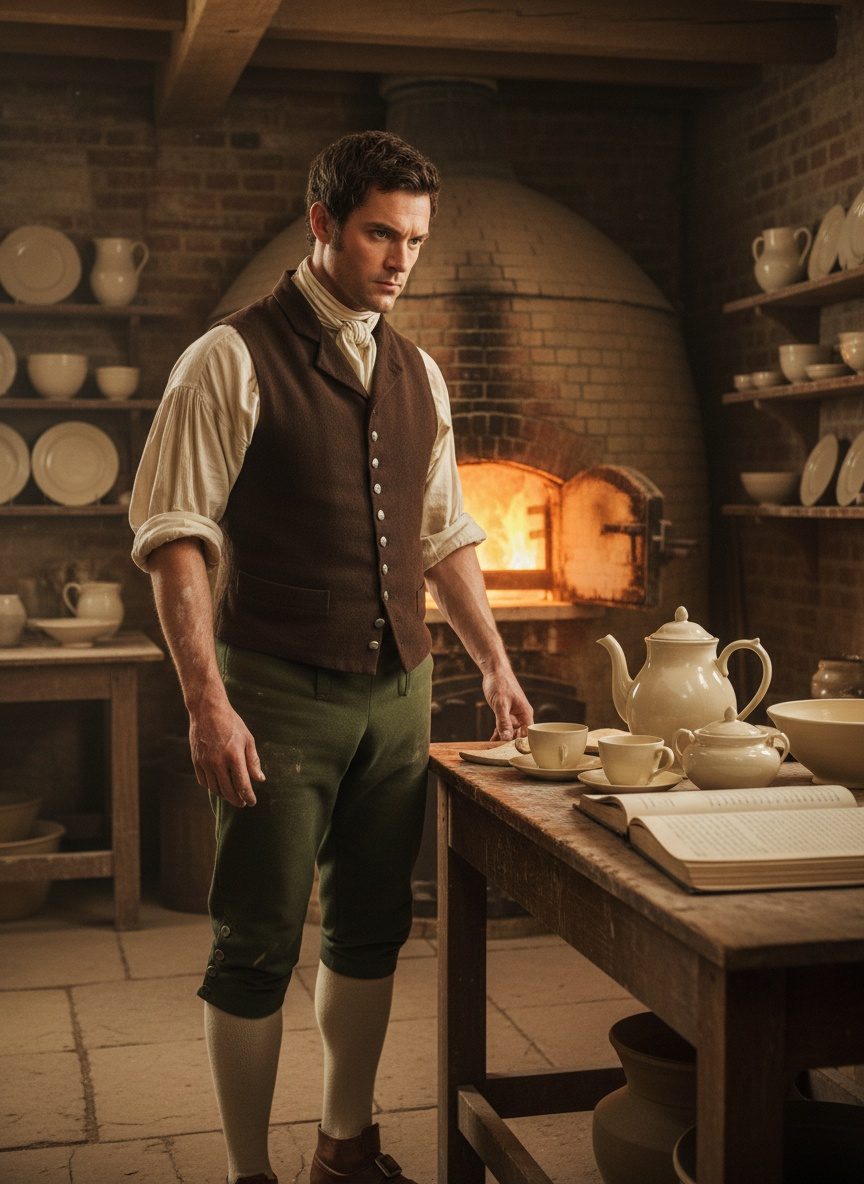
Josiah Wedgwood isn’t a household name. He should be.
Imagine the bustling town of Staffordshire in 1765, a place where the grounding roots of England's Industrial Revolution slowly took hold. Streets bustled with tradesmen, and among them was a potter with dreams as vast as the imagined empyreal heights of his craft. Josiah Wedgwood emerged not from finery but from earth, transforming humble clay into a global emblem of prestige and elegance that transcended his origins.
As a young boy watching over the shoulders of seasoned potters, Josiah honed a keen sensitivity to the materials at hand. His beginnings were unpretentious — a potter's apprentice, he understood the earthy language of clay. Through each trial, every small success and numerous failures, his determination was sculpted. By the time he embarked on the journey that would skyrocket him into the annals of history, Wedgwood’s hands knew the dance of wheel and fire like birds knew the sky.
The Staffordshire potteries were a region bustling with potential yet yearning for innovation. It was a time when the refinement of taste was becoming paramount in the echelons of society, a fertile ground for Wedgwood’s aspirations. His foresight and keen business acumen led him to recognize the burgeoning desire for refined craftsmanship and elegance in everyday objects. Tea, an infallible staple of British identity, required vessels that matched its growing cultural significance. Earthenware of mundane conception simply would not suffice — something more regal was essential.
It was in this setting that Wedgwood, while still largely unknown, took an audacious step that would revolutionize his fortunes and those of the pottery industry. He set his sights on the highest echelons of influence, the royal family. Crafting a tea service that was distinct in its elegance yet demure enough to marry with nobility’s sophisticated tastes, he presented his creamware creation to Queen Charlotte herself.
The anticipation was as palpable as the glaze that enveloped his earthen pieces. Accepting the Queen’s nod of approval, he waited with bated breath. It was a seemingly simple gesture, yet one that resonated far beyond the golden halls of the monarchy. When word came that Her Majesty had indeed granted her favor upon the beautiful tea service, Wedgwood aptly christened it ‘Queensware’. The dominoes began to fall.
This name, infused with regal endorsement, became a passport for Wedgwood, thrusting him into an exclusive market dominated by continental porcelain giants. Queensware's adoption by the crown was not merely a badge of honor; it marked a strategic entry into the drawing rooms and dining tables of Europe’s elite. Like a ripple through still waters, word of its beauty and fine workmanship spread across nations. From St Petersburg to Versailles, the allure of owning a Wedgwood piece became an aspiration of the highest social order.
Yet Wedgwood's genius extended beyond his craftsmanship. His innovative marketing strategies were unprecedented. He was among the first to recognize the power of branding, his strategy was ahead of its time, enveloping his ceramics with an identity as exclusive as the clientele he targeted. Every piece was imbued with a story of royalty's approval, adding layers of desirability beyond its functional role. Wedgwood’s showrooms were modern marvels of sensibility, blending the art of display with the sciences of appeal and purchase, dedicated wholly to creating a customer experience that was revolutionary in its anticipation of desires.
His pathway through the international markets was carved with relentless determination and keen foresight, traits that would see his brand endure through the tumult of economic cycles and changing tastes. While Queensware came to define the era's fashionable tableware, it was Wedgwood’s continued experimentation with materials and technology that stood testament to his innovative prowess. Underpinning all this was his unwavering commitment to perfection — every piece exiting his kiln was subjected to the scrutinous standards that cemented his legacy.
Perhaps another key to Wedgwood’s empire-building lay in his embrace of the burgeoning principles of the Industrial Revolution. Recognizing the efficiencies to be derived from division of labor, he pioneered techniques within his factories that would maximize production, quality, and economy. He was a visionary who knew that to dominate the ceramics world, one must engineer not just products, but entire systems of production. His philosophy was simple yet profound: impeccable craftsmanship married with relentless productivity.
The need to consistently evolve also led Wedgwood to join with some of the era’s brightest minds, bringing about advancements not just in ceramics, but in commerce itself. Partnerships with figures like Thomas Bentley broadened his reach and philosophical base, making the Wedgwood name synonymous with not just luxury but innovation as a driving force. In doing so, Wedgwood was not merely crafting pottery; he was delicately shaping the identity of an age.
Josiah Wedgwood’s rise from artisan to entrepreneur, and finally, to empire builder presents a deeply compelling narrative of innovation and resilience in historical trade and commerce. His legacy serves as a reminder that the boundaries of what can be achieved with skill and audacity are limitless. As we examine the sophisticated ceramics that decorate our lives, it is worth reflecting upon the profound impact of a revolutionary potter from Staffordshire. That, with nothing but earth and imagination, Wedgwood carved out a legacy as enduring as the clay he once shaped.