The cool breeze of an African night whispered across the parade ground in Lusaka, brushing against the faces of those gathered under the star-studded sky. Beneath the floodlights, shadows stretched long over the earth, illuminating an end and a beginning. As the moment drew nearer, the air was heavy with anticipation, laden with the mingled scents of freshly turned soil and evening dew. The weight of history bore down upon this place, and in the stillness just before midnight, the sound of gently fluttering fabric accompanied the somber ceremony about to unfold.
The End of an Era
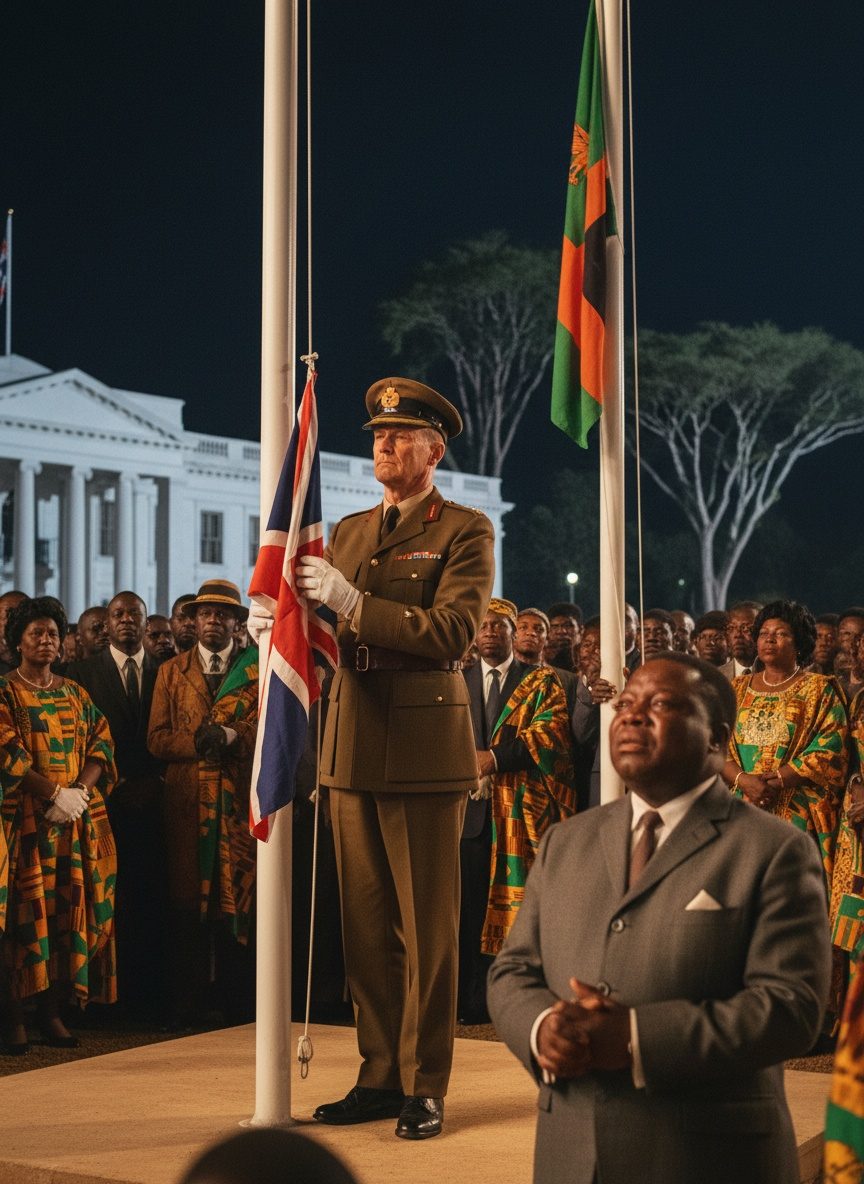
It was 24 October 1964, a date that marked the conclusion of one chapter and the commencement of another. As the clock inched toward midnight, all eyes were on the Union Jack, the iconic symbol of British colonial authority. For decades, it had flown over Northern Rhodesia, a testament to an empire that spanned continents. But here, at this solemn juncture, its historical presence was about to dissolve. The British officer's hands were steady as he carefully untied the ropes tethering the flag to the mast, a deliberate and poignant act that encapsulated the retreat of imperial Britain.
The lowering of the Union Jack was not merely a perfunctory altering of national symbols; it was the culmination of political and cultural shifts that had been simmering for decades. This moment of quiet dignity was a nod to the painstaking negotiation, the fierce debates, and the eventual acceptance of Northern Rhodesia's right to self-determination. For Kenneth Kaunda and his followers, it embodied the triumph of resilience over constraint. Yet, as the fabric slipped down the pole, there was also an acknowledgment of the complexities that came with independence.
Kenneth Kaunda: The Heart of a Leader
Amidst the gathered crowd stood a man whose presence was both a symbol and an anchor—Kenneth Kaunda, soon to be the first president of the newly named Zambia. Known for his unwavering commitment to non-violence and his passion for education, Kaunda was at the heart of the independence movement. His physical appearance—tall, dignified, a light always dancing in his eyes—belied the emotional depth that characterized his leadership.
As the Union Jack descended, Kaunda made no attempt to mask his tears. His weeping was not a spectacle of weakness, but rather an outpouring of relief, joy, and an acknowledgment of the enormous responsibility that lay ahead. These tears were cathartic, washing away years of colonial domination and cleansing the path for Zambia's future. For the people of Zambia, it was a moment of collective resonance—his openness in that moment of vulnerability endeared him even more to those he was to lead.
Dreams and Struggles
The transition from Northern Rhodesia to Zambia was not without its challenges. The path to independence had been fraught with tension and resistance. The negotiations leading to this night had required strategic diplomacy and, at times, delicate compromise. Yet, they also represented a reclaiming of identity and culture that had been eroded under colonial rule.
In the periphery of this celebratory night lingered the specter of economic and political questions unanswered. How would Zambia harness its natural resources for the benefit of its people? Could the new nation forge a unified identity amid diverse ethnicities? The optimism of independence was tempered by the realities of entering a global stage fraught with Cold War politics and regional instability.
The gathering crowd represented a tapestry of hope and determination. Young children watched with wide eyes, imagining a future unmarred by the shadow of colonialism, while the elders, who had lived years in the shadow of the British flag, perhaps pondered the price of freedom.
Midnight and New Beginnings
As midnight came, a new flag was raised, its colors vivid under the Lusaka moonlight. The Zambian flag—green with an emblem of an eagle, three vertical stripes of red, black, and orange—was a beacon of renewed hope. The symbolism carried deep meaning: green for the plentiful natural resources, red for the struggle for freedom, black representing the people, and orange for the mineral wealth.
The applause that erupted was uncontainable, an expression of a collective breath finally exhaled. This was the hour of rebirth, a moment carefully cradled between past grievances and future aspirations. It was not a mere formality but an act of self-assertion, a chance for Zambia to create a narrative of its own choosing.
Forgetting to Remember
The events of 24 October 1964 often slip into the shadows of larger histories of empire and independence. Yet, the night when Kenneth Kaunda stood vulnerable and resolved in Lusaka’s glow offers much more than a singular event in a distant country. It underscores a universal tenet: the struggle for autonomy and identity is a shared human experience.
The legacy of that night lies not only in charts of governance or maps of political boundaries redrawn but in the story of a people reclaiming their voice and heritage. It becomes a reminder that every flag lowered and raised tells a tale of hearts broken, dreams mended, and destinies proposed.
Kenneth Kaunda's tears on that seminal night reflect the rich emotional landscape of human history—a territory as vast and as vital as any nation carved into a globe, indicative of a past remembered not simply for its trials but for the triumphs of the spirit that carry us ever forward.