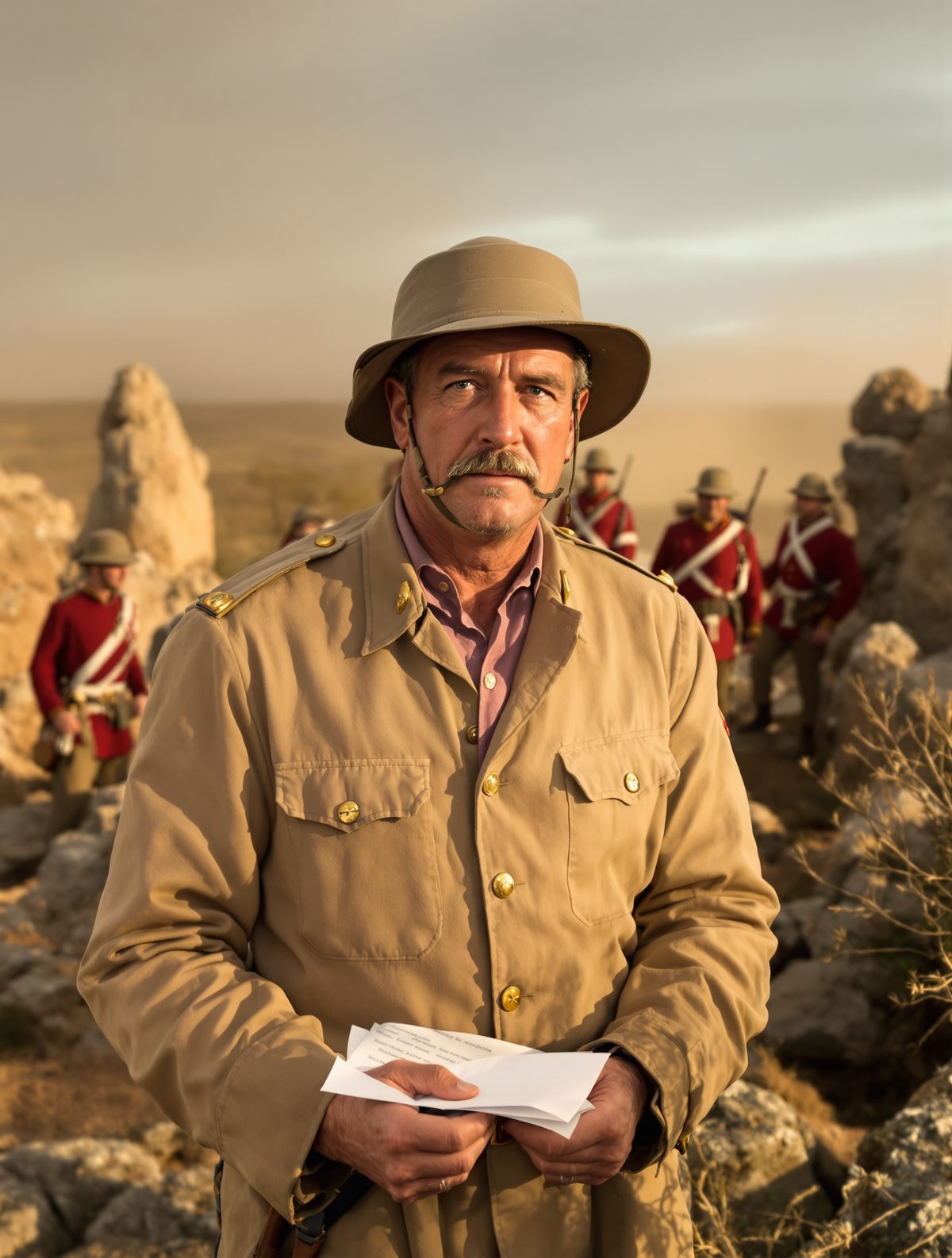
The morning sun cast long shadows across the ancient walls of Kano as Major Frederick Lugard squinted through his field glasses at the most terrifying sight of his military career. Spread across the horizon like a medieval tapestry come to life, 25,000 Fulani horsemen sat motionless on their mounts, their colorful robes fluttering in the harmattan wind. Chain mail glinted beneath flowing turbans, and thousands of spear points caught the early light like deadly stars.
Behind Lugard stood just 2,000 men—mostly West African soldiers from the Royal Niger Company's constabulary. By any reasonable military calculation, they were about to be annihilated. Yet within six hours, this impossible David-and-Goliath encounter would reshape the map of Africa forever, handing Britain an empire larger than Germany in a single morning's work.
This is the story of how Frederick Lugard conquered Northern Nigeria with odds that would make Napoleon weep—and the brutal efficiency of the machine gun age.
The Last Great Caliphate Stands Defiant
By 1903, the Sokoto Caliphate was the last independent Islamic empire in West Africa, stretching across an area roughly the size of France and Germany combined. Founded in 1804 by the brilliant scholar-warrior Usman dan Fodio, it had withstood a century of European encroachment while lesser kingdoms fell like dominoes.
The Caliphate wasn't some primitive backwater—it was a sophisticated Islamic state with universities in Timbuktu, a complex taxation system, and trade networks reaching from the Mediterranean to the Congo Basin. Its capital at Sokoto boasted libraries containing hundreds of thousands of manuscripts, making it one of the great centers of Islamic learning in Africa.
But by 1903, pressure was mounting from all sides. The French were advancing from the west, the Germans from the east, and the British Royal Niger Company was pushing north from Lagos. Sultan Attahiru I knew that if he didn't make a stand soon, his empire would be carved up like a feast-day goat.
He chose to make that stand at Kano, the Caliphate's commercial heart and a city that had been trading gold, slaves, and ivory since before Christopher Columbus was born. If Lugard wanted Northern Nigeria, he'd have to take it from the largest cavalry force assembled in West Africa since the Middle Ages.
The Unlikely Conqueror and His Mechanical Angels of Death
Frederick Lugard was an odd choice to conquer an empire. A moody, often difficult man with a talent for making enemies among his own officers, he'd been bounced around the colonial service like a problematic relative. He'd failed as a soldier in Burma, struggled in East Africa, and had a notorious habit of exceeding his orders—usually in spectacular fashion.
But Lugard possessed two crucial advantages that morning outside Kano: tactical brilliance and four Maxim machine guns.
The Maxim gun was the iPhone of its era—a technology so revolutionary that it instantly obsoleted everything that came before. Invented by American-born Hiram Maxim in 1884, it could fire 600 rounds per minute with devastating accuracy. As one British officer cheerfully noted, "Whatever happens, we have got the Maxim gun, and they have not."
Lugard's force was a motley collection that would have horrified a European general: Nigerian Hausa soldiers who'd switched sides from the Caliphate, Yoruba troops from the south, a handful of British officers, and those four precious Maxim guns operated by specially trained crews. Most of his men had never seen a battle this large, and many were fighting against their own former countrymen.
Yet Lugard had studied the Caliphate's tactics obsessively. He knew they favored massive cavalry charges designed to break enemy formations through sheer momentum and terror. Against medieval weapons, it was devastatingly effective. Against magazine-fed rifles and machine guns, it would be suicide.
The Battle That Lasted One Morning
At precisely 8 AM on February 3, 1903, the Sultan's war drums began their thunderous rhythm. What happened next was less a battle than a technological demonstration of the new century's capacity for industrial-scale killing.
The Fulani cavalry launched their charge exactly as their ancestors had for centuries—a magnificent, terrifying wave of horses and steel designed to break any enemy through psychological shock alone. For a moment, even Lugard's seasoned officers felt their courage waver as thousands of screaming horsemen thundered toward their thin defensive line.
Then the Maxim guns opened fire.
The effect was catastrophic. The leading ranks of cavalry simply disappeared in a hail of .303 bullets, horses and riders crumpling to the earth in windows of death. Behind them, following riders crashed into the sudden wall of bodies, creating a writhing mass of confusion and horror.
What made the massacre even more devastating was Lugard's tactical positioning. He'd arranged his forces in a defensive square with the machine guns at the corners, creating interlocking fields of fire that turned the battlefield into a killing ground. No matter which direction the Fulani charged, they rode straight into mechanical death.
The slaughter was so efficient that some Maxim gun crews later reported their barrels overheated from continuous firing. Within three hours, over 5,000 Fulani warriors lay dead on the field. Lugard's casualties? Fewer than fifty men.
By noon, the Sultan's surviving forces were in full retreat, and the 500-year-old city of Kano opened its gates to avoid further bloodshed. The Sokoto Caliphate, which had stood unconquered since Thomas Jefferson was president, had fallen to a British major with delusions of grandeur and four machine guns.
The Psychological Warfare of Modern Technology
What truly broke the Caliphate wasn't just the military defeat—it was the psychological impact of witnessing medieval warfare meet the industrial age. Survivors described the Maxim guns as "weapons of the djinn," supernatural forces that no earthly army could withstand.
This wasn't entirely wrong. The technological gap between Lugard's force and the Caliphate was roughly equivalent to a modern army facing Bronze Age warriors. The Fulani were brave, skilled, and fighting for their homeland, but courage means nothing against 600 rounds per minute.
Lugard understood this psychological dimension perfectly. After the battle, he made a point of demonstrating his remaining ammunition to Caliphate leaders, making it clear that what they'd witnessed was just a small sample of British firepower. The message was unmistakable: resistance was not just futile, but suicidal.
Within six months, the remaining Caliphate strongholds had surrendered without firing a shot. Sultan Attahiru I fled east toward Mecca but was killed in a final skirmish near the modern border with Cameroon. A political entity that had governed millions of people for over a century simply ceased to exist.
Creating a Colony Larger Than Europe
The strategic implications of Lugard's victory were staggering. In a single morning, Britain had acquired a territory of over 350,000 square miles—larger than France, Germany, and Britain combined. The new colony of Northern Nigeria contained an estimated 10 million people and vast untapped resources including what would later prove to be enormous oil reserves.
Perhaps more importantly, the victory gave Britain control over the headwaters of the Niger River, effectively controlling trade routes that had been vital to West African commerce for over a millennium. It was as if a foreign power had suddenly seized control of the Mississippi River system.
Lugard's conquest also demonstrated the terrifying efficiency of European military technology when applied to African resistance. News of the Kano battle spread across the continent, convincing many remaining independent rulers that accommodation was preferable to annihilation. The "Lugard method"—overwhelming technological superiority applied with surgical precision—became the template for European conquest across Africa.
Yet the victory came with a bitter irony that Lugard himself never fully grasped. In destroying the Sokoto Caliphate, he'd eliminated one of Africa's most sophisticated indigenous political systems. The Caliphate had its flaws—including slavery and religious intolerance—but it was also a functioning African state with its own legal system, educational institutions, and economic networks.
The Machine Gun's Empire and Its Modern Echoes
Standing in the ruins of Kano that February afternoon, watching his men strip weapons from thousands of corpses, Frederick Lugard had no idea he'd just demonstrated the future of warfare. The Battle of Kano was a preview of the industrial slaughter that would consume Europe just eleven years later, when machine guns would mow down British soldiers at the Somme with the same mechanical efficiency they'd shown against Fulani cavalry.
But perhaps the most unsettling lesson of Lugard's conquest isn't about military technology—it's about how quickly overwhelming force can reshape political reality. In six hours, millions of people went from being citizens of an independent African empire to colonial subjects of a European power they'd barely heard of.
Today, as we watch modern military technologies create equally dramatic power imbalances around the world, Lugard's conquest of Northern Nigeria feels disturbingly contemporary. The weapons have changed—drones instead of Maxim guns, precision missiles instead of magazine rifles—but the fundamental dynamic remains the same: technological superiority can still reshape the world's political map in a single morning's work.
The ghost of Frederick Lugard and his four machine guns haunts every modern conflict where technological asymmetry trumps courage, justice, or even basic humanity. Sometimes the legends they left out of the textbooks are the ones we most need to remember.