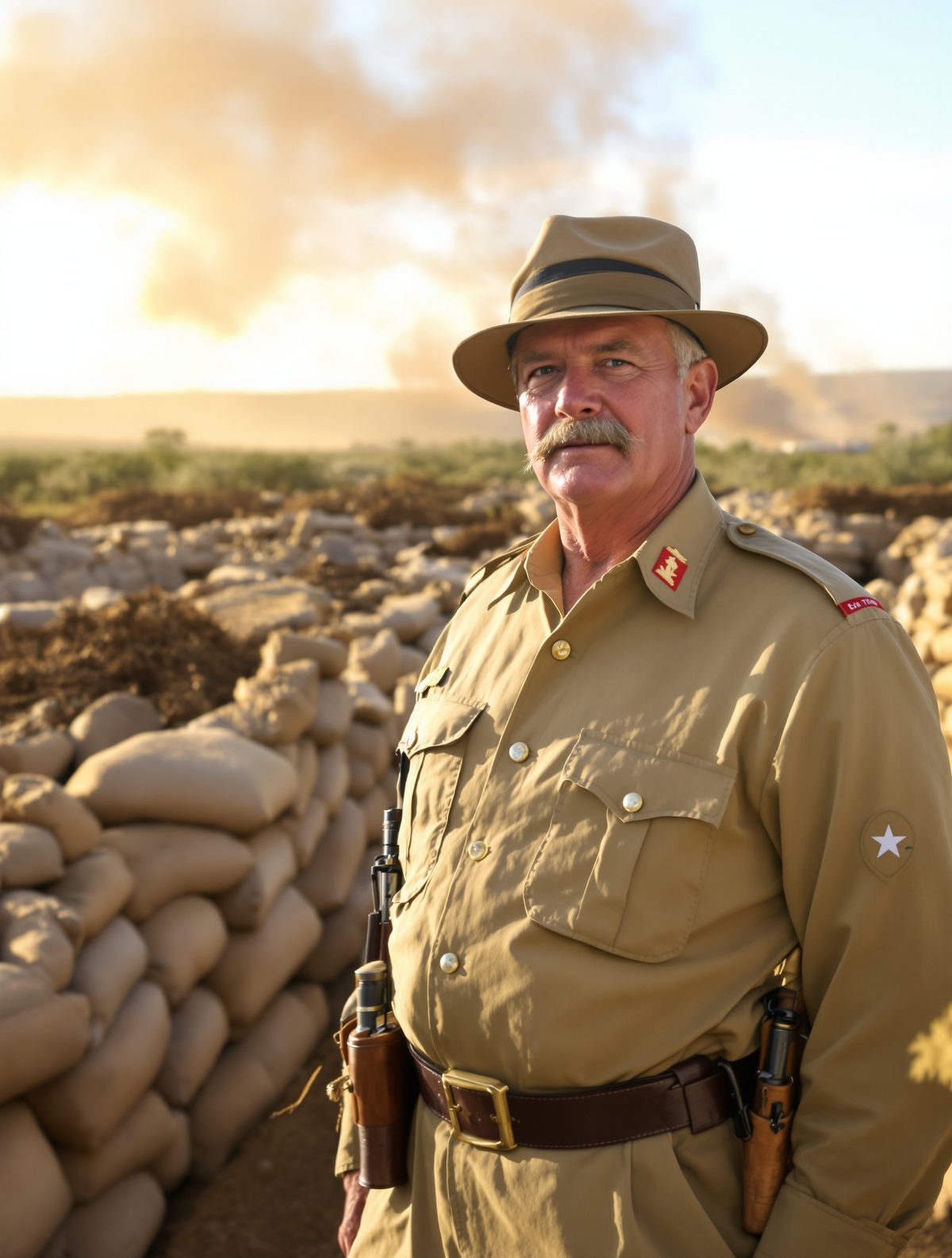
The morning of January 13th, 1842, brought an impossible choice to Major-General Robert Henry Sale. Outside the crumbling walls of Jalalabad fortress, Afghan war drums thundered across the winter landscape. Inside, his 2,000 British and Indian soldiers prepared for what seemed certain annihilation. A messenger had arrived with devastating news: the entire British army retreating from Kabul had been massacred—16,500 souls obliterated in the snowy passes of Afghanistan. Sale's garrison now stood alone, an island of red coats in a sea of vengeful enemies who smelled total victory.
The 59-year-old general climbed the fortress walls and surveyed the gathering storm. Twelve thousand Afghan warriors were converging on his position, their banners snapping in the bitter wind. Any reasonable commander would negotiate surrender. Instead, Sale did something that would echo through the annals of military history: he ordered his men to prepare for a siege that would last five brutal months and ultimately save the British Empire in India.
The Disaster That Started Everything
To understand Sale's incredible stand, we must first grasp the catastrophe that preceded it. The First Anglo-Afghan War had begun in 1839 as a Victorian fever dream of imperial expansion. British officials, paranoid about Russian influence in Afghanistan, decided to install a puppet ruler in Kabul. What followed was a masterclass in colonial overreach.
By late 1841, the British occupation of Afghanistan was crumbling faster than a house of cards in a hurricane. The puppet Shah Shuja was universally despised, British forces were scattered across hostile territory, and the legendary Afghan capacity for guerrilla warfare was bleeding the invaders dry. When the decision came to evacuate, it triggered one of military history's most shocking disasters.
Dr. William Brydon's solitary arrival at Jalalabad on January 13th told the entire horrific story. This army surgeon, bloodied and barely conscious, was the sole British survivor of the 16,500-strong force that had left Kabul just days earlier. The retreat had become a running massacre through the snowbound Khyber Pass—men, women, children, and soldiers torn apart by Afghan jezails and tulwars in a week-long nightmare of pursuit and slaughter.
But here's what the textbooks often miss: Sale's garrison at Jalalabad wasn't supposed to be there at all. Originally ordered to march back to India, Sale had been delayed by Afghan attacks on his supply lines. That delay, which seemed like military misfortune at the time, would prove to be the thread that held the entire British position in South Asia together.
Fighting Bob Takes Command
Robert Henry Sale was not your typical Victorian general. Nicknamed "Fighting Bob" by his men, he had earned his reputation the hard way—through thirty years of frontier warfare where hesitation meant death. Born in 1782, Sale had cut his teeth in the savage campaigns of the Peninsular War, where he learned that audacity often succeeded where caution failed.
What made Sale different was his relationship with his soldiers. In an era when British officers often viewed their men as expendable resources, Sale knew every regiment's history, understood their fears, and shared their hardships. His men called him "the old war-horse" with genuine affection—rare in the rigid hierarchy of Victorian military life.
When news of the Kabul massacre reached Jalalabad, Sale faced immediate mutiny from his Afghan allies, who began deserting en masse. His Indian sepoys wavered, knowing they were now completely cut off from reinforcement. The fortress itself was a crumbling relic, its walls pockmarked by previous sieges and its defenses barely adequate for the storm about to break.
Sale's response was pure theater. He ordered the Union Jack raised to full height, doubled the guard, and issued a proclamation that would become legend: "We shall hold until relieved or die. There is no middle course for soldiers of the Queen." Then he did something remarkable—he shared his rations with the men and moved his quarters to the most exposed section of the fortress. If Jalalabad fell, Fighting Bob would fall with it.
The Iron Ring Closes
By January 20th, 1842, Akbar Khan—son of the deposed Dost Mohammed—had surrounded Jalalabad with an army that dwarfed Sale's force six to one. The Afghan commander was riding high on his stunning victory over the retreating British forces and saw the isolated garrison as the final obstacle to complete Afghan liberation.
Akbar Khan's strategy was methodical and brutal. He positioned artillery to command every approach to the fortress, established pickets to prevent any supply runs, and began systematic bombardment of the walls. His message to Sale was simple: surrender now and live as prisoners, or die slowly as the walls crumbled around them.
But the Afghans had underestimated both the fortress and its defender. Jalalabad might have looked decrepit, but its position was nearly perfect—perched on a slight rise with clear fields of fire in every direction. More importantly, Sale used the opening weeks of the siege to transform his men from a demoralized retreat guard into a hardened defensive force.
Here's a detail that rarely makes it into the histories: Sale instituted what he called "aggressive defense." Rather than cowering behind the walls, he launched regular nighttime raids against Afghan positions. These sorties served multiple purposes—they disrupted enemy preparations, kept his men's fighting spirit alive, and convinced the Afghans that the garrison was far from beaten. One such raid captured an entire Afghan artillery position, guns and all, in a operation so audacious that even Akbar Khan reportedly expressed grudging admiration.
The Longest Winter
As winter deepened, the siege became a test of endurance that pushed both sides to their limits. Inside Jalalabad, Sale's men faced constant bombardment, dwindling supplies, and the psychological pressure of complete isolation. Outside, Akbar Khan's forces struggled with the realities of maintaining a siege in one of the world's harshest climates.
The fortress walls took a pounding that would have broken lesser defenders. Afghan artillery, much of it captured British guns, hammered the ramparts day and night. By March, entire sections of the wall had collapsed, creating gaps that seemed to invite assault. Sale's response was typically innovative—he ordered his men to build secondary defenses behind the breaches, turning each gap into a potential killing ground.
Food became critically short, with the garrison reduced to quarter rations by February. But Sale had learned lessons from his decades of frontier warfare. He organized foraging parties that slipped out under cover of darkness, established hidden supply caches throughout the fortress, and even negotiated secret agreements with local merchants who risked death to smuggle provisions through the Afghan lines.
Perhaps most remarkably, Sale maintained morale through what can only be described as psychological warfare against despair. He instituted daily drills as if preparing for inspection, organized sporting competitions among the men, and even arranged musical performances by the regimental band. The sound of British military music echoing across the Afghan siege lines became a powerful symbol of defiance that unnerved the enemy and inspired the defenders.
The Thunder of Relief
By April 1842, both sides knew the siege was reaching its climax. Akbar Khan, frustrated by his inability to crack the seemingly impregnable garrison, prepared for a final, massive assault. His spies reported that the British walls were nearly in ruins and ammunition was running critically low.
What the Afghan commander didn't know was that General George Pollock was marching from India with a relief force specifically tasked with saving Jalalabad. The British government, stung by the disaster at Kabul and desperate to restore prestige, had authorized a campaign of retribution that would either rescue Sale or avenge him.
On April 7th, the siege reached its most desperate moment. Afghan forces breached the outer defenses and were fighting hand-to-hand in the fortress courtyards. Sale, now wounded from shell fragments but still commanding from the front lines, prepared for a final stand. His men fixed bayonets and gathered around the flagpole, ready to die fighting rather than surrender.
Then, at the moment when all seemed lost, the thunder of British artillery echoed across the Jalalabad plain. Pollock's relief column had arrived at precisely the right moment, catching Akbar Khan's forces strung out in assault formation. Sale, showing the instincts that had made him legendary, immediately ordered his remaining men to sally forth from the fortress. Caught between Sale's desperate charge and Pollock's disciplined advance, the Afghan forces broke and scattered.
The Legend They Never Taught You
Sale's defense of Jalalabad ended on April 16th, 1842, after 155 days of siege. But the significance of those five months extends far beyond military tactics or Victorian adventure stories. In holding that crumbling fortress against impossible odds, Fighting Bob Sale quite literally saved the British Empire in India.
Had Jalalabad fallen, the psychological impact across the subcontinent would have been catastrophic. Every princely state, every potential rebel, every colonial administrator would have seen the British as a defeated power. The Great Game with Russia would have tilted dramatically toward St. Petersburg, and the entire edifice of British control in South Asia might have crumbled decades earlier than it eventually did.
Today, as modern armies grapple with counterinsurgency warfare in many of the same Afghan valleys where Sale fought, his story offers unexpected lessons. His success came not from superior technology or overwhelming force, but from understanding that military victory is often about morale, leadership, and the refusal to accept defeat even when logic suggests it's inevitable.
Perhaps most remarkably, Sale's stand demonstrates how individual character can alter the course of history. One stubborn general's refusal to surrender a "worthless" fortress changed the trajectory of empires and the fate of millions. In our age of global uncertainty, that's a lesson worth remembering: sometimes the most important victories are won not by those who never face defeat, but by those who simply refuse to accept it.