March 15, 1897. The sun beat down mercilessly on the mirrored surface of Lake Victoria, casting blinding reflections that danced on the water.
The Edge of the Known World
As Dr. Albert Cook stepped off the steamer, he was not met with the comforts of civilization. Before him lay Uganda, a rugged landscape dotted with lush greenery and distant hills, where the beating heart of the Bugandan kingdom echoed faintly against the relentless rhythm of nature’s pulse. What greeted him more solemnly, and lurked insidiously beyond the verdant façade, was a rampant enemy — smallpox.
In this era of the Victorian Empire, the Scramble for Africa was fueling ambitions and fears in equal measure. European powers were carving up the continent with imprecise zeal, driven by avarice cloaked as the “moral mission” of empire. Yet, amidst the political machinations, pandemics like smallpox struck with indifferent cruelty at colonizers and indigenous peoples alike. For the Bugandan people, this particular smallpox outbreak was devastating, threatening to decimate entire communities.
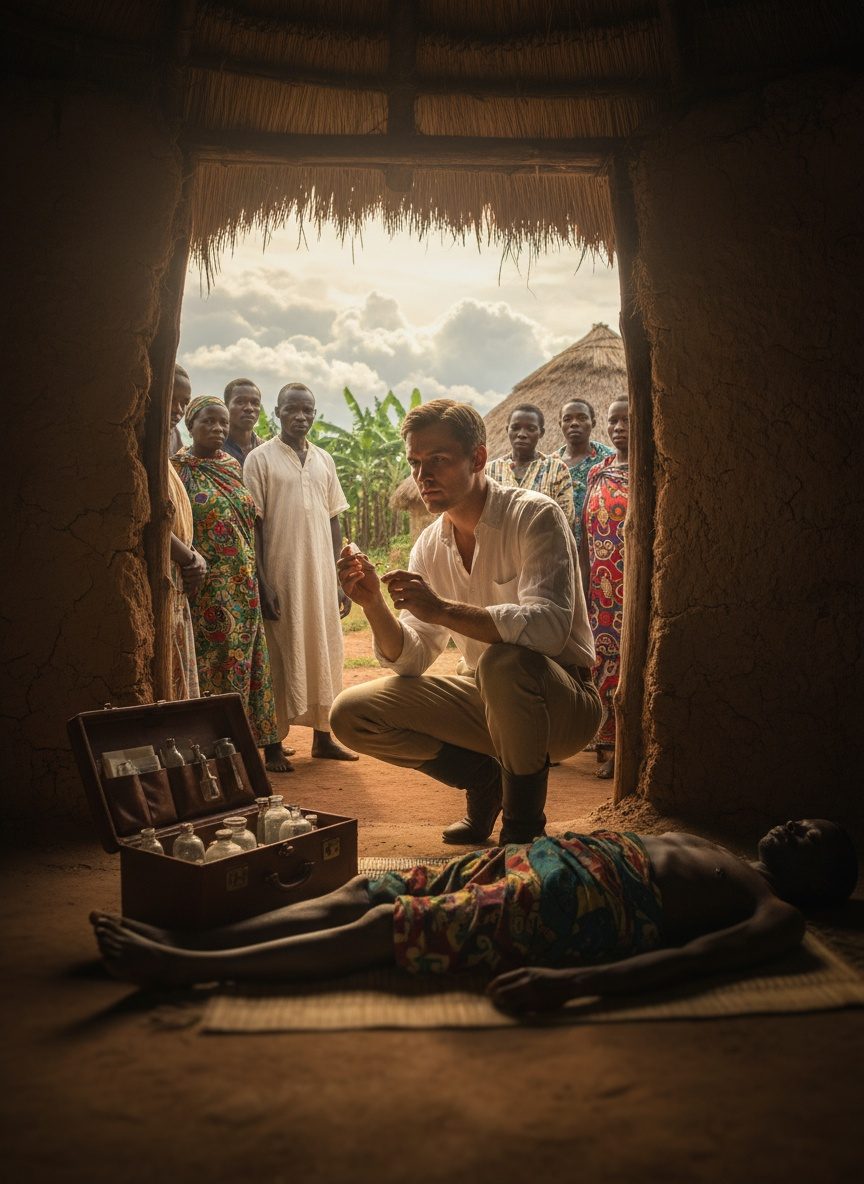
Cook, bearing the weight of his medical bag and the courage of his convictions, was a solitary figure moving through the land. He carried no weapons nor military escort — a stark contrast to other colonial endeavors swathed in displays of power. His was a different mission, born of urgency and humanity. Unlike the soldiers on imperial expeditions, he wielded science and sheer nerve.
Word traveled quickly through the towns and villages: a foreign doctor had arrived to offer salvation through vaccination. It was a radical notion for many, a strange counter to the traditional healers’ chants and herbs. Trust was hard-earned but necessary if Cook was to succeed. He set about the arduous task of educating the local chiefs and community elders, striving against skepticism as fierce as the illness itself. His determination was infectious, spreading almost as fast as the pandemic he sought to quell.
The Silent Battle
Amidst feverish cries and congested huts, Dr. Cook moved with purpose, his every step a calculated maneuver in the battlefield of disease. This was Uganda’s worst epidemic, and thousands had already been lost. To the afflicted, he brought reprieve; to the uninfected, he offered hope. Nation by nation, village by village, he administered vaccinations tirelessly, each pierced skin marking a small victory in the colossal war against smallpox.
There, in the heart of Africa, Cook operated without the aid of modern infrastructures. He made do with rudimentary tools and the indispensable courage of those few who joined him in this relentless campaign. It was a frontier romance turned tragic reality — the stuff of legends and nightmares intermingled, as he wove through disease-stricken territories without succumbing to despair.
Cook faced more than mere disease. He battled logistical nightmares and the looming specter of distrust that often accompanied foreign endeavors. An outbreak of suspicion occasionally arose among the communities he endeavored to save; yet, he approached each interaction with patient diligence. By listening as much as he prescribed, and respecting as much as he advised, he slowly bridged the cross-cultural chasm.
His journey was marked not only by isolation but introspection. Cook recorded his experiences meticulously, his journals becoming a testament to perseverance amidst peril. He understood that medicine was as much about hearts and minds as it was about bodies, an epiphany mirrored in the faces of those who eventually sat trustingly before him, sleeves rolled up, ready to receive his life-giving serum.
Changing the Face of Medicine
In the aftermath of the smallpox storm, as the epidemic gradually dwindled under Cook’s steadfast care, something profound began to shift. Albert Cook’s approach was not merely about combating one disease; it heralded an era where public health took on a new dimension within colonial territories. His work laid the groundwork for a medical ethos in East Africa, where empathy and education would become key components of healthcare, entwined irrevocably with treatment.
By circumventing traditional power displays in colonized lands, Cook had unintentionally illustrated a different path — one where imperial imposition could morph into collaborative care. The seeds he planted would grow, eventually leading to more structured medical facilities and training opportunities for locals. These establishments symbolized the cross-pollination of Western science with indigenous knowledge, a hybrid that promised resilience against future outbreaks.
Dr. Albert Cook’s solo crusade against smallpox did more than save thousands; it forged a shared narrative of survival and adaptation. His journey through Uganda’s disease-ridden expanses was a testament to the capacity of medicine to transcend boundaries, drawing humanity together in its shared vulnerability and unyielding hope. In the boundless struggle against the shadows of illness, Cook’s story stands not merely as a historical footnote but as a reminder of what one voice, driven by compassion, can achieve amidst silence and despair.