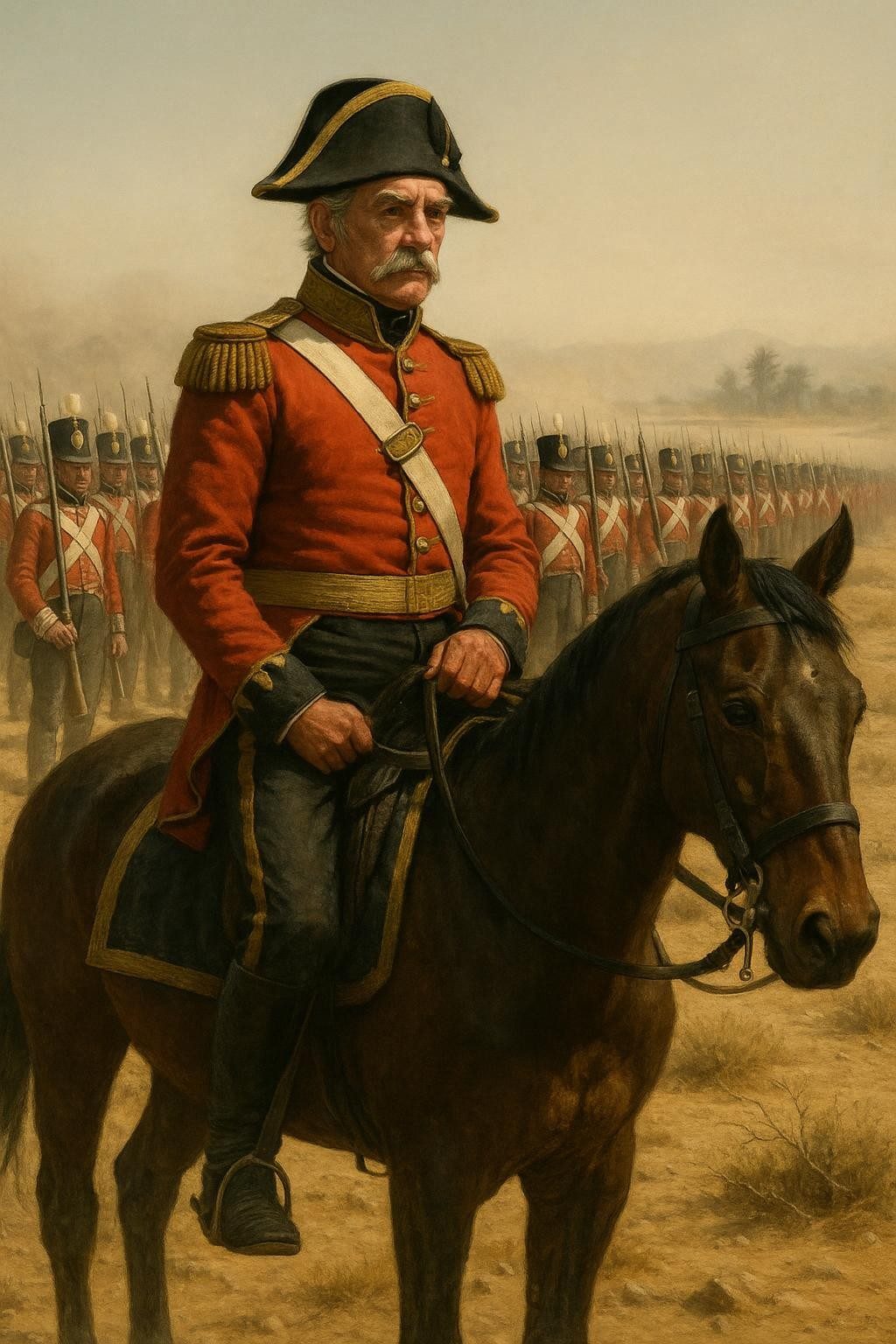
The Baluchi army seemed unstoppable with its formidable 35,000-strong force. Yet by evening, a smaller British contingent of just 2,800 men had altered the fate of Hyderabad forever.
February of 1843 was a month that would carve new paths in the landscape of colonial India with a tale that defied the arithmetic of war. Major-General Charles Napier's strategic ingenuity was about to unfold in a theater bursting with disadvantage. It was a time when British hegemonic ambition was threaded delicately through the needle's eye of the Asian hinterlands. Napier, tasked with commanding his outnumbered troops in the arid Sindhi terrain, was to adopt a daring gamble based more on wit than brute force.
The stage was set against a backdrop of increasing tensions. The British East India Company sought to cement their grasp over Sind, a prospect that promised both economic and strategic boons but one not yet sanctioned by London. The Baluchi Confedracy, allied under the Amirs, stood as both obstacle and opportunity. The geographic tapestry was woven with vast expanses of desert, offering few comforts and fewer options. Here, the art of war was stripped to its essentials — a test of tactical prowess pitted against overwhelming odds.
Upon receiving his orders, Napier refused to play by the rules of conventional warfare. The disparity in manpower — a daunting twelve to one — was enough to suggest a more judicious commander might reconsider. Yet Napier's resolve was steeled by his conviction in the element of surprise and misdirection; his troops were well-drilled and their discipline unyielding. His dedication to 'acting rather than reacting' had bred a regiment of soldiers sharp enough to cleave decisively through uncertainty. It was with these very tools that he planned to craft legend out of logistics.
As dawn arrived on February 17th, the Battle of Miani loomed. The British forces, dappled in the shadowy hues of morning, epitomized a blend of red-coated resolve and stoic determination. They mounted an audacious offensive against the crescent ranks of Baluchi warriors, the clamor of which echoed through valleys and crested over dunes. Strategically, Napier had capitalized on the terrain, splitting the Baluchi line with an assault that drew them into miscalculating the actual strength that lay within the British ranks.
A lesser-known maneuver — though crucial — was Napier's use of compensatory tactics to play on his enemy's assumptions. He created impressions of a larger force through bluff and bluster, clever positioning, and by maximizing artillery fire impact. The Baluchi, their initial charge brimming with confidence, found themselves enveloped rather than entrapping. As cannon fire thundered and muskets crackled, their ranks began unraveling. Napier's cavalry, despite being drastically outnumbered, executed feints that further sowed disorder into the heart of the Baluchi lines.
Underneath the scorching sun, the battlefield became a tableau of contradictions and confusion. On one side, disciplined formations moved with precise choreography, their cohesion a testament to the martial dedication installed by British drillmasters. On the other, war cries resounded in an attempt to renew vigor amongst scattered formations. The cries, however, were steadily drowned by the rising din of British advances reclaiming territory — inch by inch, foot by brutal foot.
As the sun began its descent, the tables had turned with an irrevocable finality. What began as a confrontation destined to be a footnote in a larger imperial conquest had become a crescendo of British ascendancy. Napier, privy to each ebb and swell of the combat tide, dispatched his men not like a bludgeon but a scalpel, dissecting the heart of an army seemingly impervious from afar. Dust, mingled with sweat and smoke, settled over a battlefield now owned by unexpected victors.
With the Sind firmly within British grasp, questions emerged from as far afield as the halls of power in London. The decision to conquer Sind had not been mandated when Napier moved; his actions had rewritten imperial directives on the fly. In the aftermath, the annexation appeared as a fait accompli that could not be ignored; destiny, it seemed, had been dictated by deeds rather than deliberations.
This episode in 1843 demonstrates not merely the might of colonial ambition but the prowess of individual agency within the imperial apparatus. As history unfolded, the outcome resonated through corridors of power and beyond, profoundly reshaping perceptions of British presence in the subcontinent. It was significant not just for the territory gained but for the strategy it dared to employ and the risks it audaciously endorsed.
What remains fascinating is the indelible mark it left on fidelity to duty and impact over intention. In a world wrought with conflicts defined by the vast over the individual, Napier's triumph underscores the seismic potential lying dormant behind calculated courage and keen intellect. This incredible tale, cast from the looming shadows of dust and heat, reminds us that even the most towering of odds can sometimes bow before the will of a single inspired individual. Such stories, left out of most textbooks, continue to echo long after the sounds of battle have faded into history's tapestry. The shadows of Miani stretch far, hinting at the reality that history is not merely etched by armies, but by the choices of those who lead them, as they turn the seemingly impossible into unyielding inevitability.