
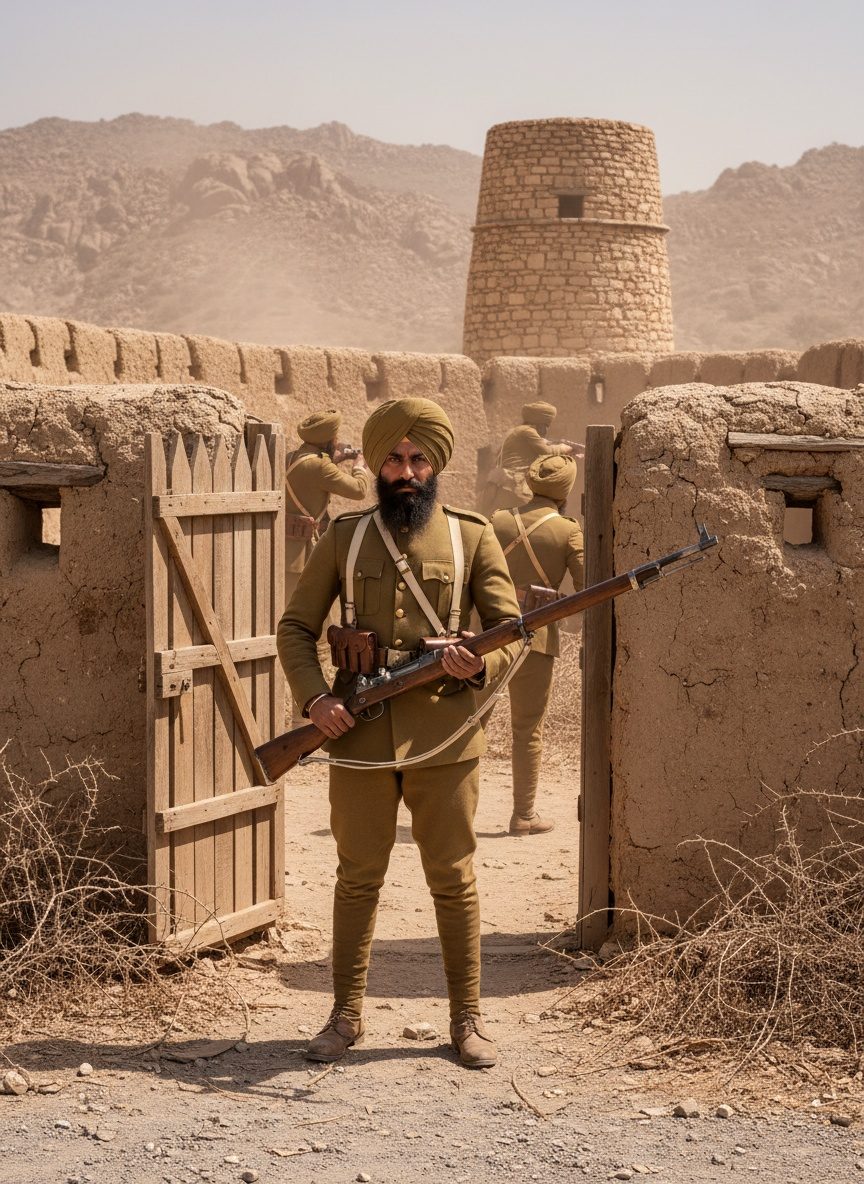
September 12, 1897. The sun rose slowly over the North-West Frontier, casting long shadows over the rugged peaks.
The Forbidden Apex
Nestled in the lawless lands between British India and Afghanistan, the North-West Frontier was the scene of frequent clashes, where empires grappled with fierce tribal warriors for dominance. The importance of maintaining communication along this corridor was paramount, and this duty fell to a band of soldiers stationed at the Saragarhi signal post. This was a remote outpost, a speck on the vast landscape, manned by a mere 21 soldiers of the 36th Sikh Regiment under the command of Havildar Ishar Singh.
To many, Saragarhi seemed an insignificant dot in the shadow of its imposing neighbors, the key forts of Lockhart and Gulistan. Yet, its position was vital, enabling essential communication between the forts through heliographic signals. On this seemingly ordinary day, the soldiers woke to an ominous sight; the surrounding hills were alive with Afridi and Orakzai tribesmen, their numbers swelling to 10,000 strong. Like an incoming storm ready to break, the air thickened with the tension of what was about to unfold.
The Onset of Conflict
The previous night had been a restless one, filled with the distant thrumming of war drums echoing through the steep valleys. As dawn broke, the reality of their predicament washed over Ishar Singh and his men. Their tiny contingent was all that stood against a force dauntingly vast and fiercely resolute. The tribesmen had not come for parley or posturing; they advanced with singular purpose — to overrun, to conquer.
Orders were clear and resolute from their leader. Havildar Ishar Singh rallied his men with a rousing speech, the echoes of which still reverberate through the annals of military history. This was not just another skirmish or an avenue for medals; this was a stand for dignity and duty. The choice to hold their ground at all costs resonated deeply, the ethos of the Khalsa burning bright in their hearts. "We shall not shame ourselves," Ishar Singh intoned, his voice unwavering. The decision was made — no surrender, no retreat.
A Wall of Determination
As the tribesmen gathered, tribal war cries filling the air like harbingers of chaos, the Sikh soldiers took positions along Saragarhi’s stone walls. They were armed with their Lee-Enfield rifles, woefully outnumbered but fortified by unyielding courage. Every man knew that the outcome was bleak, yet their resolve was as steadfast as the very rocks they defended.
The Afridi and Orakzai forces, emboldened by numbers, charged in waves, hoping to crush the resistance with overwhelming might. But what met them at each charge was the vicious bite of disciplined defense. A relentless barrage of rifle fire rang out from the Sikhs, turning each advance into a retreat. The ground before Saragarhi was soon littered with the fallen.
Throughout the forenoon and into the afternoon, the intrepid defenders kept holding the hordes at bay. Their communications had succeeded in raising awareness of the desperate situation at neighboring posts, yet the distance and rugged terrain made immediate relief impossible. The valiant soldiers fought on, animated by solitary valor against the pressing tide.
The Final Standoff
As the sun began its descent, the outpost’s defenses started to crack, the simple fortifications leaving scant protection against such an onslaught. Yet the men, though weary and wounded, fought on with a fire stoked by heritage and honor. Havildar Ishar Singh, tireless in the fray, was everywhere at once, his presence a continuous source of inspiration.
As the line began to falter and the Afridi surged over compromised walls, he ordered his men into the inner reaches of the post, determined to make their last breaths count. Each defender, his ammunition nearly expended, prepared for hand-to-hand combat, where they wielded their rifles, not as firearms, but as clubs; their kirpans flashed like flickers of steel in the waning daylight.
The battle waged fiercely until every Sikh lay still, yet their sacrifice reverberated through the history of military valor. News of the stand at Saragarhi ignited imaginations and evoked admiration across the British Empire, a tale of courage that defied the finality of numbers. It became a defining moment, a narrative of indomitable spirit set against overwhelming odds.
It is a poignant reminder of human resilience and the extraordinary lengths small bands of individuals can go to defend their principles. The Battle of Saragarhi inspired soldiers and civilians alike, teaching lessons in duty, sacrifice, and honor that echo even in today's world. As each man received posthumous honors, the timeless legacy of Saragarhi was sealed into the pantheon of history — a testimony to bravery that needs no embellishment, only remembrance. This tale, though born from fields of conflict, speaks to universal truths about courage and the human spirit's capacity to stand unbowed before its own ending.