
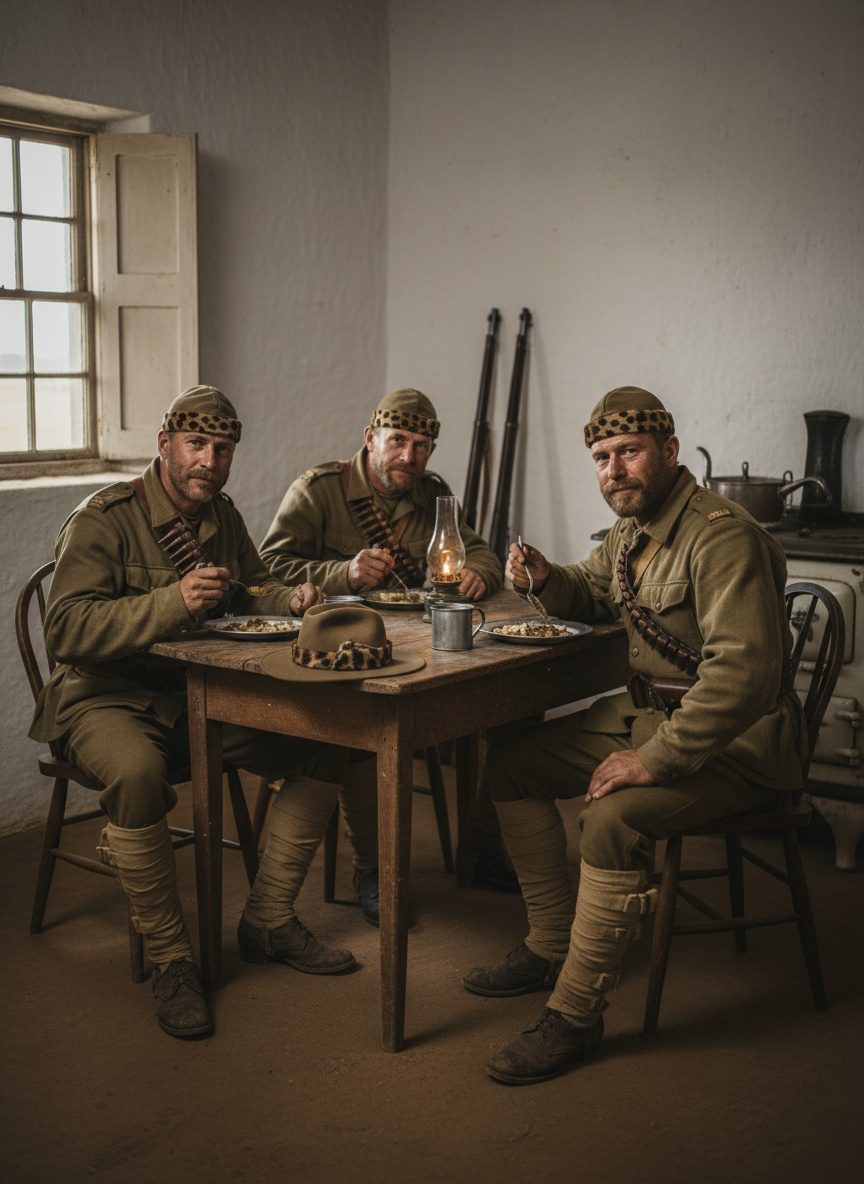
The dusty wind swept across the South African veldt, rattling the dry leaves of the scorched trees and scattering errant debris across the barren landscape. A silent, oppressive heat sat heavy on the abandoned farmhouse, its whitewashed walls smeared with red dust. The sun, a relentless orb, hung high in the cobalt sky, casting elongated shadows through the skeletal window frames. Inside, the silence was thick and tangible, broken only by the faint sound of footsteps and the subtle rustle of fabric. This desolate place, once a home filled with life and laughter, now stood as a stage for those well-acquainted with the art of invisibility—Rimington's Tigers, a band of guides and scouts who were as much myth as they were men.
The Boer War, spanning from 1899 to 1902, was a brutal conflict that tore through the South African landscape, leaving in its wake a patchwork of empty dwellings and ghostly echoes of life once vibrant. The stakes were high, with the British Empire seeking to consolidate its power and the Boer republics striving to defend their autonomy. Among the myriad forces maneuvering through this turbulent scene were Rimington's Guides, a unique detachment led by Major Michael Rimington. Dubbed "Rimington's Tigers" for their audacious exploits and distinctive leopard-skin headbands, these men were a breed apart—part scout, part shadow, and wholly mysterious.
To be part of this select group meant more than just proficiency in arms or fortitude under fire. It required an intimate understanding of the veldt, an ability to read its subtle signs, to discern the stories concealed within its landscape. These guides spoke Afrikaans, the language of their adversaries, with the fluency of natives. Their task was to melt into the countryside as whispers on the wind, moving stealthily through enemy territory to gather intelligence and strike with precision before vanishing once more into the ether. Their actions, invisible yet impactful, often turned the tide of skirmishes in favor of the British forces.
When such men took respite, it was often within the confines of an empty farmhouse—bereft of its inhabitants, stripped to the bones by the exodus of war. The kitchens, once fragrant with the aroma of Boer cooking, now hosted silent vigils where the Tigers would gather to share brief meals. Inside, the air was stilled, thick with the dust of unturned years. The only evidence of human presence lay in the hastily gathered rations—the metallic clink of tins being opened, the low murmur of cautious conversation intermingling with the distant cries of the veldt.
These moments of reprieve were fleeting glances of normalcy amidst the chaos of warfare. The empty hearths offered a sobering reminder of lives disrupted, but for Rimington's Tigers, they served as rare oases of calm, opportunities to rest and refuel both body and spirit. There was a certain eerie peace within these vacated spaces, a sanctuary formed from the absence of life where soldiers could reclaim a sliver of silence, if only for a brief interlude.
The distinctive leopard-skin headbands that crowned each man were more than mere adornment; they were symbols of their prowess and agility, marks of identity that distinguished them from other units. The headbands, striking against the backdrop of their khaki uniforms, whispered of a ferocity and cunning that made these men akin to the great cats themselves—silent hunters of the open plains. To the Boers, these bands signaled the presence of an elite force, a foe to be respected and feared in equal measure. For the men who wore them, the leopard-skin was a bond among brothers, a reminder of their dual mission to challenge and to endure.
Life as a Rimington's Guide was one of constant movement, where every shadow held potential threat, and every sound might signal danger. Yet it was also a life of extraordinary freedom, untethered by the regimented constraints that governed more conventional military units. They roamed the South African terrain with an unparalleled autonomy, bound not by traditional hierarchy but by mutual respect and shared purpose. This free spirit allowed them to engage in guerrilla tactics, moving swiftly and striking decisively, always one step ahead of the enemy.
Although they were shadow soldiers, virtually invisible in the grand tapestry of war, Rimington's Tigers played a pivotal role in the broader strategy of British operations. Their intelligence-gathering missions often provided crucial insights that helped shape military decisions, tiptoeing along the lines of risk to harvest rewards that mere numbers could not quantify. The information these guides offered was invaluable, a whispered truth carried back from the mouth of uncertainty.
Yet, as with any legend born of war, questions linger about the true nature of their legacy. Did they walk the thin line between hero and harbinger, liberators, or occupiers in the eyes of those whose lands they traversed? The stories left out of textbooks speak to the complexities of human conflict, where honor and infamy commingle, and heroes pass through houses not their own, leaving only faint traces in the dust.
The tale of Rimington's Tigers brings us to a contemplative pause in the evolving story of military history. Here, in the echo of deserted homesteads and the fleeting touch of a leopard-skin headband, lies a poignant truth. It reminds us of the human cost of war and the indomitable spirit of those who move within its shadows. The history of Rimington's Guides might not feature prominently in history's grand narratives, yet it speaks volumes about the paths less trodden—stories of adaptability, resourcefulness, and the quiet endurance of those who lived the legend, those tales whispered still among the veldt’s vastness.