Stuttgart, 1907. The world turned its eyes to a woman waving a flag. They weren't prepared for what it represented.
An Unyielding Spirit in Exile
In the early days of the 20th century, Bhikaji Cama stood as a beacon of defiance against the all-powerful British Empire. Born in Bombay, she was no stranger to the imperial grasp that sought to bind her homeland, India, into submission. Yet, it was in her voluntary exile that Cama found both her voice and her stage. Fleeing to Europe after contracting the plague during her humanitarian work in 1896, Cama continued to channel her fervor for an independent India from abroad, cementing her reputation as an unyielding spirit.
Life in exile did not deter her. Reaching the shores of Europe allowed Cama to network with radical thinkers and revolutionaries who were as motivated to dismantle colonial infrastructure as she was. From her base in Paris, she published articles and distributed revolutionary literature, relentlessly critiquing British imperialism. Her aim was to translate her determination into action, which she did so audaciously in 1907 in Stuttgart, Germany, at the International Socialist Congress.
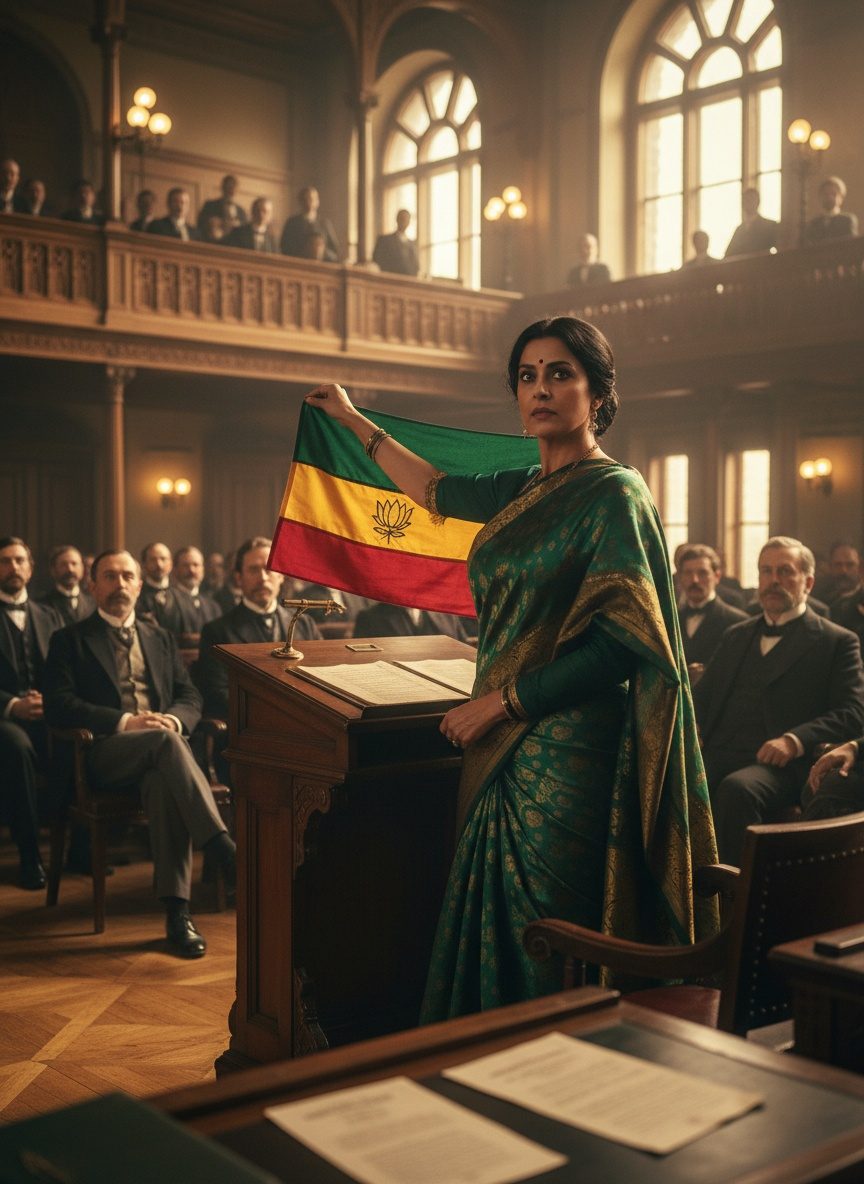
At this international gathering, Cama did what no Indian had done before. She mounted the podium and unfurled a hand-stitched flag that marked the dawn of a new narrative. It was not just a cloth of colors; it was India's claim to sovereignty. Meticulously crafted, the flag bore hues of green, saffron, and red, emblazoned with symbols of cultural and political significance that represented the united front of an oppressed nation thirsting for freedom. From an impassioned address, Cama called for the "awakening of a people," declaring a message that would resonate well beyond the walls of the Congress.
The Colors of Revolt
In the panorama of world revolutions, flags have always carried colossal symbolic weight. Cama's flag held green to symbolize Islam and Hinduism, saffron for strength and courage, and a red band for the freedom struggle. Alongside these colors, the crescent and the sun signified progress and the energy of a rejuvenated people. The moment it was unveiled, it was as if a new dawn had arisen on an old empire. The British mandate was clear: seek to silence her, paint her as a radical, a troublemaker, unworthy of serious attention.
But the British Empire, in all its reach and might, found the task more challenging than anticipated. The visual and the act of unfurling that flag transcended borders, igniting discourse. For many delegates, it was a stark revelation—India, under the thumb of colonial rule for too long, sought to assert its identity and autonomy. In a gathering meant to address socialist agendas, Cama reshaped the narrative to include the fight against imperial dominance. It steered the global conversation toward India's struggle for self-rule, enshrining her bold gesture in history.
Despite attempts to quash her call for freedom, news of her act spread like wildfire. Resistance movements worldwide took note, inspired by her courage and the sheer tenacity she displayed. It was a moment that showcased the power of symbols wielded by women like Cama, challenging patriarchal colonial narratives that perceived women as passive subjects. Instead, she carved a pedestal from which India could voice its protests, equipped with a flag of its own.
A Legacy Sewn with Threads of Courage
The legacy of Bhikaji Cama’s stand at Stuttgart persists as a testament to undeterred resistance. More than simply an act of defiance, it was a rallying cry for change and a blueprint for future activism. The flag she unfurled at that Congress was like a seed—as decades passed, it flourished into a profound symbol of India's persistent stride toward independence, culminating in 1947 when India finally broke free from British rule.
Bhikaji Cama’s courageous act reminded the world that empires, no matter how invincible they may seem, were not immutable. Every protest, every symbol, every flag can inspire a movement capable of challenging the status quo. The realization that took hold among those thirty nations in Stuttgart reverberated back to India, where freedom fighters took heart from her actions and absorbed her message into their everyday struggles.
Today, as India stands tall on the world stage, Bhikaji Cama’s passion and bravery live on. In an era where voices still strive against subjugation, her contribution transcends time—a vivid narrative of a flag unfurled and a world forever stirred. The lesson is unerring: change begins when one person decides to stand, even in a sea of apathy or against the tide of tyranny. Cama was not just a participant in history; she authored her chapter with threads of courage, inked in the vibrant colors of a once-colonized country's destiny.