November 26, 1903. A lone figure cut through the tangled vines of the Congo forest.
An Empire of Silence and Suffering
At the dawn of the 20th century, the Congo Free State was a place shrouded in veil and mystery, a vast region carved into personal dominion by King Leopold II of Belgium. Leopold’s agents ruled over this immense territory — twice the size of their homeland — with savage efficiency. Their tools of governance were fear and brutality, leaving a scarred landscape of frightened villages and silenced communities.
News of the atrocities whispered through the corridors of Europe, but few dared to confront the reality. The Congo, for many, was a distant horror, a sensational story never fully acknowledged or believed. Yet below the surface lay a repository of unspoken suffering, where the wealth extracted in ivory and rubber came at a catastrophic human cost. It was into this charged atmosphere that Roger Casement walked, ready to lay bare the unspeakable truths.
The Consul and His Notebook
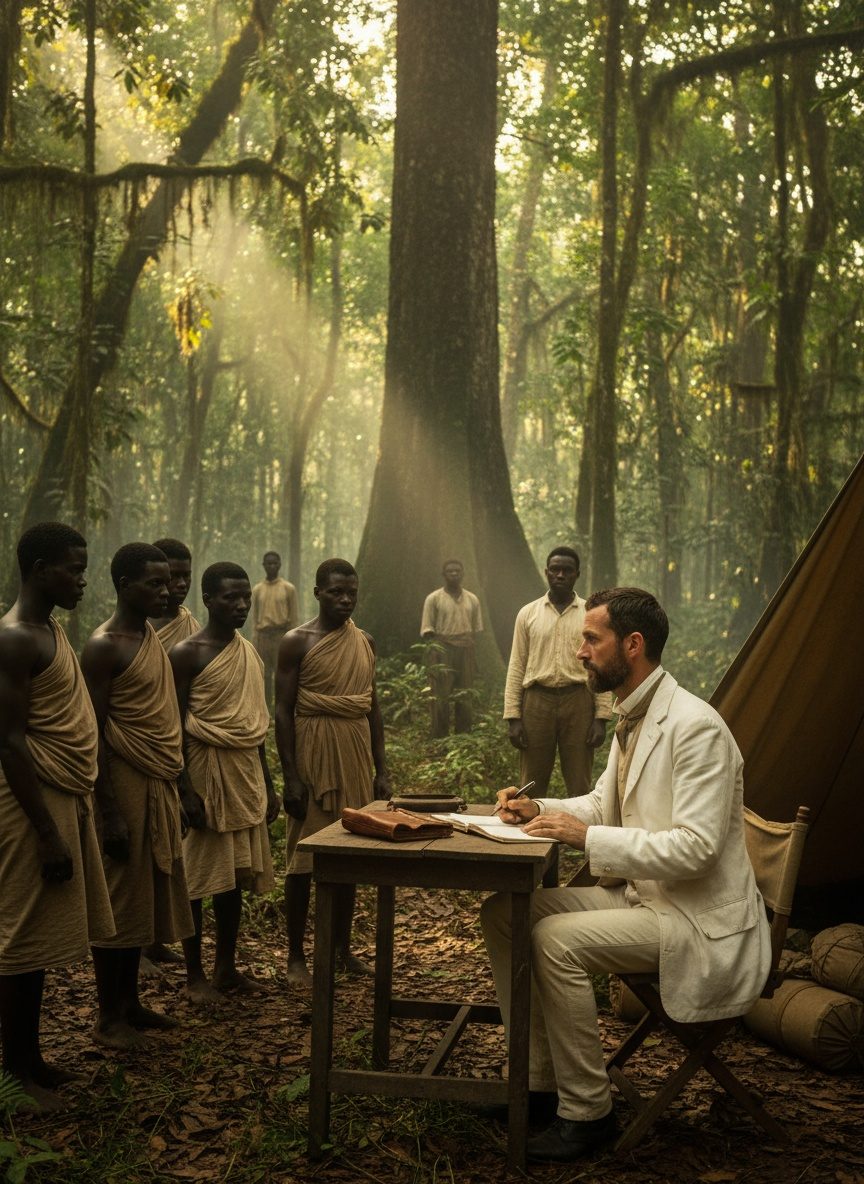
Roger Casement was not an ordinary British consul. His heart was as precise as his mind was sharp; sensitive to injustice and relentless in pursuit of truth. Appointed to investigate the growing rumors of abuse in King Leopold’s Congo, Casement journeyed alone with the unassuming presence of a man carrying only essentials: a trusty notebook, a pencil, and a moral compass pointing unwaveringly towards justice.
Tasked by the British government, Casement's entry into the Congo was no diplomatic mission but rather an exercise in raw observation and human empathy. As he moved from one ghostly village to the next, he asked questions, listened to broken voices, and recorded everything he saw. His notebook became a living document of misery — every name, every scar, every missing hand carefully inscribed like edicts against oppression.
Names and Scars in Ink
The testimonies Casement collected were heartbreaking in their simplicity. Villagers spoke of the 'forced labor' — a euphemism for enslavement — that tore families apart and ravaged villages for the wealth of Europe. Children stood barefoot in front of the consul, their innocence stolen by the daily horror of life under Leopold's rule. The severed hands became a grim symbol of the greed-fueled sanctions imposed by colonial overseers, ruthless agents keen to extract quotas at any cost.
Casement's entry into the Congo was an act of profound listening, of bearing witness. His notebook documented every detail, from the systematic starvation of laborers on rubber plantations to the brutal collective punishments meted out on entire communities. In his writings, the abstract numbers gained faces, stories, heartbeats. The depth of suffering he cataloged transcended statistics, transforming into a roaring plea from the whispered silences.
Stirring Europe's Conscience
Upon his return, Casement's report did not merely recount the inhumanity — it sent shockwaves through the corridors of power. The scales began to tip; what had been possible to ignore became impossible to dismiss. Casement’s meticulous notes shattered the illusion of Leopold's grand mission civilisatrice, exposing it as a facade for naked exploitation.
The report did not quietly settle into dusty archives. It was a lightning strike that ignited the consciousness of Europe, sparking outrage among those who read its pages. Public figures and private citizens alike took up the cause, rallying for reform in the Congo. Emboldened by Casement's findings, voices demanding change grew louder, piercing through Leopold's carefully curated narrative.
The Echoes of a Silent Crusade
The impact of Casement’s solitary journey into the Congo reverberated far beyond the borders of Leopold’s private empire. The atrocities documented disrupted the complacency of Empire-european civilization, compelling it to face its ethical and moral dilemmas — its complicity in the cruelty carried out in the name of progress.
Eventually, under international pressure, King Leopold II was forced to relinquish his stranglehold on the Congo. The transformation was neither swift nor complete, but it planted the seeds of change. Roger Casement's vigilance ensured that the voices of the Congolese were finally audible on the global stage. His painstaking documentation bore testament to the power of truth, serving as a reminder of what one determined soul can achieve.
Today, Casement’s Congo report stands as a beacon for those who choose to speak in defense of the voiceless. As we look back on this history, it is worth remembering that sometimes, courage begins with just a notebook and an unwillingness to turn a blind eye. His story reminds us of the extraordinary change one person can inspire by simply refusing to remain silent.