Few recall the voyage of HMS Blossom. Those who do understand its significance.
The Call of the Arctic
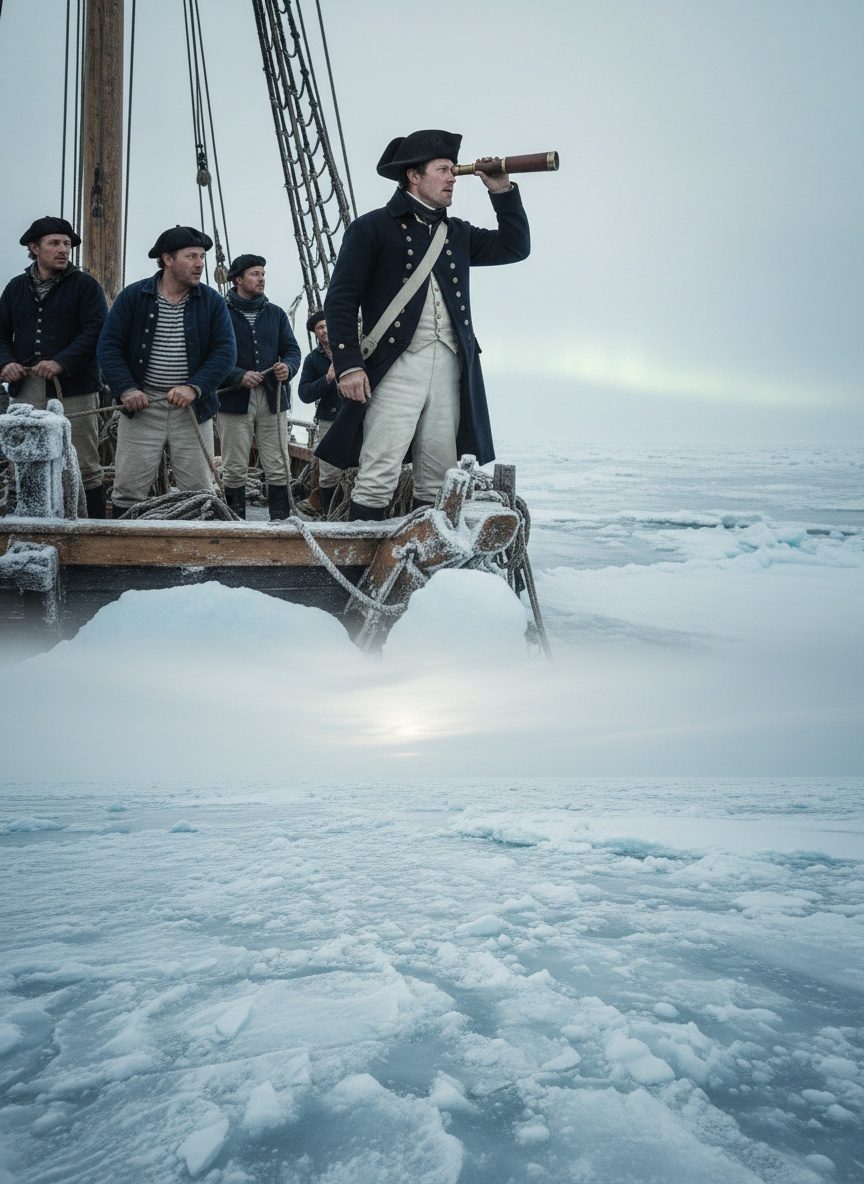
The early 19th century was an era of daring expeditions, where vast stretches of the map remained blank, filled only by the imaginations of the intrepid explorers who set out to chart them. In 1826, the Arctic beckoned once again, as the British Empire sought the elusive Northwest Passage. The HMS Blossom, under the command of Captain Frederick William Beechey, was tasked with an ambitious mission: to navigate to the far reaches of the Alaskan coast and rendezvous with John Franklin's overland expedition emerging from the east. It was a mission fraught with uncertainty, yet rich with the promise of discovery.
The Blossom was a sturdy vessel, well-suited for the harsh conditions of the Arctic. Yet, even with the best preparations, the Arctic was unforgiving. This treacherous environment demanded vigilance and resilience from the crew, from the biting cold winds that swept the decks to the ice floes that lurked beneath the waves. It was a realm where Nature reigned supreme, dictating the limits of human endeavor.
Pushing the Boundaries
As HMS Blossom pressed further north along the Arctic's icy confines, the world as known to Europeans began to blur and reshape. Captain Beechey and his men were carving new paths through the ice-choked waters, venturing into territories that no European had previously documented. With every nautical mile they advanced, they peeled back layers of the earth's geographical mysteries.
Using the rudimentary tools of the time—sextants, compasses, and lead lines—Beechey meticulously charted over 150 miles of uncharted coastline along Alaska’s Arctic fringe. His diligence in mapping these areas provided invaluable insights into regions that had hitherto appeared only as gaping voids on nautical charts. The main aim of connecting with Franklin's expedition never materialized, but the knowledge Blossom gained of these cold, distant shores left an indelible mark on the understanding of Arctic geography.
A Journey Marked by Absence
As the weeks turned into months, the crew of HMS Blossom faced a stark truth—Franklin would not come. The anticipation of meeting another band of explorers gave way to the bleak reality of their solitary quest. But in this solitude, the crew found purpose, adapting to the demands of survival amidst isolation.
The absence of Franklin’s expedition highlighted the unpredictable nature of exploration in such extreme environments. Communication across the expansive and harsh Arctic terrain was as elusive as the Northwest Passage itself. While Beechey’s mission to connect with Franklin failed, the encounter they yearned for underscored the difficulties explorers faced, disconnected not only from the world of civilization but also from each other.
Enduring Legacy
The summer of 1826 saw HMS Blossom retreat southward, ice compelling it to seek safety in warmer waters. Yet, the maps and records it left behind were treasures that inspired generations of explorers who followed. The charts Beechey crafted filled voids in the imperial vision of the world, contributing to a body of knowledge that would eventually aid others in their quests to conquer the Arctic's mysteries.
Today, as we reflect on the Blossom’s voyage, we are reminded of the courage and resilience required to face the unknown. In an age where the Arctic is rapidly changing, Beechey's charts not only depict the physical geography but serve as historical artifacts, marking a critical point in time before the onset of modernity altered these landscapes forever. This story matters because it pushes us to remember the relentless human urge to explore, understand, and map the world, however inhospitable it might be.