Most think the British Raj rarely met defiance. Manipur proved them wrong.
The Gathering Storm
In the March of 1891, nestled in the lush valleys of Northeast India, the princely state of Manipur found itself at a turbulent crossroads with the British Empire. Despite its relative obscurity in the vast canvas of the Raj, Manipur's resistance would etch its name into history with an audacious stand. Like many princely states, Manipur was entangled in the web of British influence, yet it harbored a fierce independence that simmered beneath the surface.
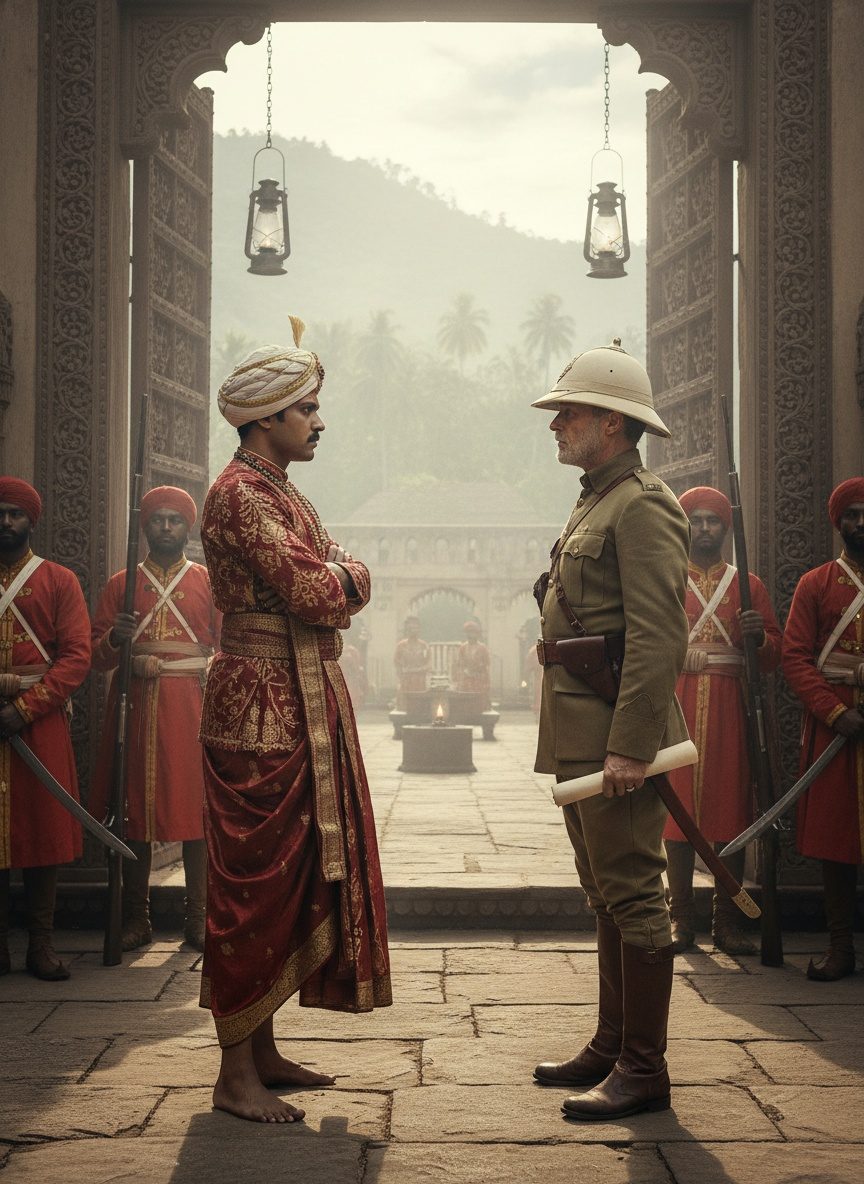
The tension between Manipur and the British was palpable, rooted in a complex mix of regional politics, familial rivalry, and colonial ambition. It was in this charged atmosphere that the British Resident, a representative of imperial authority, marched into the royal palace expecting a swift submission. His mandate was clear: to demand the surrender of the rebellious prince, Tikendrajit Singh. Yet what awaited him was not the compliance he anticipated but an unyielding defiance.
As the British entourage reached the imposing gates of the palace, Tikendrajit, known for his resolute patriotism and tactical shrewdness, stood firmly against the tide. The palace guards, loyal to their prince, closed the gates with a defiant clang that echoed the sentiment of a proud but small kingdom unwilling to bow to imperial dominion. The audacity of such an act was unimaginable to many within the empire, accustomed to seeing their directives enforced with little resistance.
This moment was more than just a personal defiance; it was a spark against the vast tinderbox of colonial subjugation. For Manipur, it was a stand for sovereignty, a vocal stand against the erosion of their traditions and independence. Witnesses to the event would later recount the tension in the air, the palpable electricity as two worlds collided: one of colonial power and another of resilient tradition.
Stand-Off in the Palace
The refusal to buckle to British demands soon escalated into a standoff that was charged with far-reaching implications. The British, led by Chief Commissioner James Quinton, found their expectations turned on their heads. Confident in their approach, they had underestimated the resolve of Manipur’s leadership, led primarily by Tikendrajit Singh and his ally, Bhawani Singh, who emerged as key figures in this historic drama.
Behind closed gates, the Manipur court was not merely reactive but strategic. Tikendrajit and Bhawani Singh were well aware of the military disparities between their forces and the British might. However, what the British saw as hubris, the Manipuris knew as necessity. They leveraged their knowledge of the rugged terrain and the support of their people, turning the anticipated surrender into a palpable resistance.
Meanwhile, British forces outside the gates were both puzzled and perturbed by the unexpected pushback. The Raj had faced many forms of dissent in its tenure across India, but rarely had a small kingdom stood so openly defiant, risking inevitable military reprisals. The maneuvering within the palace became a game of chess with stakes that transcended into symbols of broader native resistance across the subcontinent.
In the tense days that followed, the British officers anticipated a resolution in their favor. After all, time and again, their imperial doctrine had quashed dissenters under the weight of its logistical and technological advantage. Yet, what they faced in Manipur was an incipient movement that prioritized dignity over compliance, even when the latter seemed the only pragmatic choice.
The Aftermath: Echoes of Resistance
As history unfolded, the British response to Manipur's defiance would play out with a dreaded inevitability. A military expedition was launched, overwhelming the Manipuri forces. The aftermath was as the residents had feared: a royal court toppled, brothers against brothers, and the execution of Tikendrajit as a grim reminder of the Empire's retribution. Bhawani Singh and others faced judgment that underscored the might of colonial rule, but the seeds of resistance had been sown.
The impact of Manipur’s defiance transcended its borders. It was a testament to the enduring spirit of resistance even in the face of insurmountable odds. Across India, the audacity of Manipur ignited imaginations and fortified the resolve of those seeking freedom from colonial rule. The story of Bhawani Singh and Tikendrajit Singh, within the winding corridors of that palace, would become chapters not just in the annals of Manipur but in the broader narrative of India's struggle for independence.
For the British Raj, it was a sobering reminder that imperial control was neither absolute nor invulnerable. Complacency was replaced by wariness, as the echoes of Manipur reverberated through the consciousness of an empire that now understood the limits of its power. As the sun began to set on the Victorian Empire, every act of resistance, no matter how small, became part of the herald of a new dawn.
Thus, the defiance at Manipur remains more than a historic anomaly; it is a story about courage and conviction, a story that transcends time to remind us that in the chronicles of power, the most profound chapters are written not by the dominions of might, but by the voices that refuse to be silenced.