Most believe World War I was fought primarily on the Western Front trenches. Yet, a crucial and untold battlefield lay beneath the waves of the North Sea.
The Unseen Menace
In early 1917, the Atlantic shipping lanes were a perilous route for any vessel daring to supply the war-torn British Isles. German U-boats prowled with silent menace, their torpedo trails a harbinger of doom. The situation reached a dire crescendo when, each month, these elusive predators sank over 300 Allied ships, threatening to cut off Britain's lifeline. The seas had become a vast, unyielding snare, with helpless merchants falling prey to the Kaiser’s wolf pack.
Constrained by this aquatic siege, Britain’s response had to be nothing short of revolutionary. Enter the audacious concept of the North Sea Mine Barrage. With a leap of imagination that matched the horrific scope of the problem, the British Admiralty, in concert with their American counterparts, envisaged a maritime shield — an explosive necklace stretching from the craggy coasts of Scotland to the icy fjords of Norway. A proposal that was at once both breath-taking and overwhelmingly hazardous.
A Herculean Undertaking
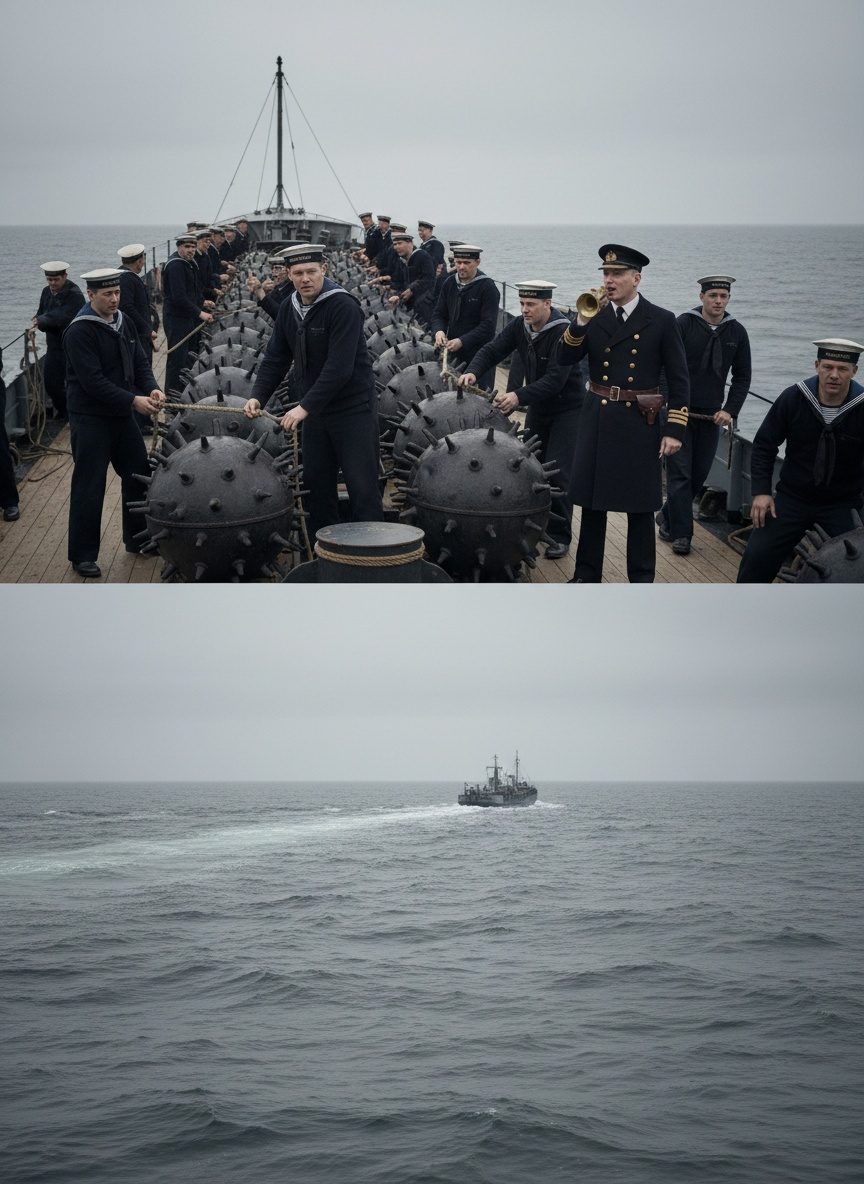
The project to mine the North Sea was no mere tactical tweak but a colossal engineering feat. It demanded the coordination of resources on a scale hitherto unseen. In this watery expanse, where nature's unpredictability ruled and the harsh winds howled, ships draped with miles of deadly ordnance were to forge an impenetrable barrier. These were no mere barnacle-clad mines; they were the apex of wartime ingenuity.
Spanning 230 miles, this colossal minefield required meticulous planning and ruthless efficiency. The sheer logistics were staggering: 70,000 mines, each armed with a promise of fiery destruction, had to be strategically placed in a grid-like pattern, constituted an unseen barricade against the U-boats' marauding forays. Yet the construction of the North Sea Mine Barrage was not solely about engineering challenges. The risk of explosion made each deployment a test of nerve and skill for the naval personnel aboard those mine-layer vessels, where a single spark could spell catastrophe.
The Battle Beneath the Waves
Yet while the laying of mines was a spectacular achievement, it was just the prelude to a subterranean duel. As the mighty assembly of steel and explosives settled beneath the frothy waves, it began a cloaked, deadly contest with the German U-boats. For commanders in the Kaiser’s ranks, the minefield transformed their hunting grounds into treacherous traps. No longer could they navigate their shadowy realm with free rein; instead, each dive carried the risk of a fateful, final detonation.
Despite its intention as an impenetrable line, the mine barrage was far from infallible. Nature and chance conspired against complete coverage; gaps in the formation allowed some U-boats to slip through, a stark testament to the chaotic and unpredictable nature of maritime warfare. Nonetheless, this ambitious wall of mines served as a deterrent, altering German tactics by forcing U-boats into more well-defended convoy routes and diminishing their devastating effectiveness.
The Ripple Effect
The North Sea Mine Barrage, though not as foolproof as its architects dreamed, delivered a significant blow to the German war machine. It ushered in an epoch where naval warfare strategy gravitated as much to undersea weaponry as it did to mighty warships. The fear of underwater mines spurred innovations in both naval engineering and oceanic technologies — legacies that rippled quietly yet profoundly through the waters of subsequent conflicts.
While the names of great battles and their generals are etched into the annals of history, the North Sea Mine Barrage remains a lesser-known player that helped shape the course of the First World War. Its unsung story of bold engineering and daring logistics reminds us how ingenuity, even when deployed in the service of war, can redefine the landscape of human conflict. The very notion of constructing such a monumental and hidden armament stands as a striking tribute to the spirit of survival and adaptation in the face of overwhelming adversities.