
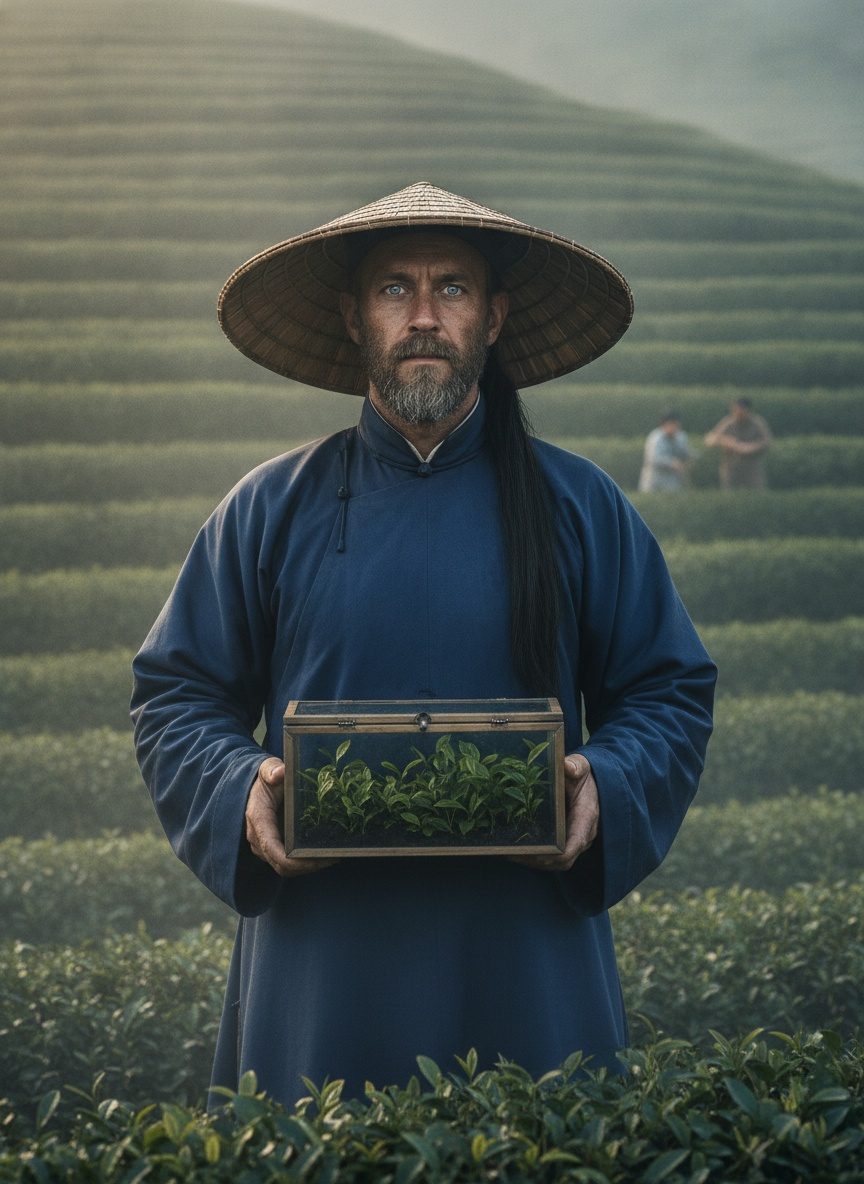
He was a botanist, not a spy. Yet Robert Fortune’s mission would change the world more profoundly than most acts of espionage. For in 1848, Fortune embarked on a daring expedition into the heart of China—the land of tightly guarded tea secrets—that would reshape the dynamics of global commerce, carve a new page in the history of tea, and alter Britain's imperial economic landscape.
The scene is the fervent heart of the Victorian Era, a time when Britain's imperial ambitions were steered by its appetite for tea, a daily ritual grown indispensable in British life. The trouble was, every sip savoured was at the mercy of China's steadfast control of tea production and its consequential monopoly. Britain faced a looming trade deficit, forcibly rectified until then by the opium trade—a solution fraught with ethical and political peril. Enter Robert Fortune, a Scottish botanist whose expertise in horticulture had already taken him to the enigmatic lands of China, a place where foreigners ventured at their own peril.
Armed with little more than fluency in botany, an indomitable spirit, and incredible ingenuity, Fortune adopted the guise of a Chinese merchant. Donning traditional attire, complete with a silk gown and a false pigtail, he navigated the labyrinthine world of Mandarin customs, pushing into regions where the presence of outsiders was forbidden under threat of death. The perilous nature of his mission was evident—a single misstep could unravel not just Fortune’s life, but Britain's plan to break free from China’s economic stranglehold.
The crucial part of Fortune’s journey lay in his acquisition of knowledge, knowledge deeply embedded within the secluded tea gardens of China’s interior provinces. These were places where ancient methods of tea cultivation and processing had been perfected over centuries, knowledge meticulously guarded with vigilant secrecy. It was here, amid the emerald rows of tea plants basking in the monsoonal mist, that Fortune witnessed the art and science of tea making. His notebook became a reservoir of details—innovations in oxidation, plucking techniques, observable plant varieties—all critical data that the British Empire desperately needed.
One might imagine a solitary man crouched in the lush foliage, his inquisitive eyes darting as his hand scribes notes in the clandestine glow of twilight. Fortune’s observations weren't just observational; they were transformative. They contained the blueprint for reconstructing China’s ubiquitous beverage halfway across the world in the fertile terrains of the British-controlled Indian subcontinent.
The journey back was fraught with challenges. Maintaining the health of thousands of seedlings during transit across oceans presented botanical hurdles never before attempted. Yet Fortune’s understanding of plant physiology enabled these plants to survive the arduous journey. Back in colonial India, these seeds and saplings, coupled with clandestinely obtained instructions on tea cultivation, led to the establishment of flourishing tea estates. It was a horticultural coup that led to the genesis of India's tea industry, today known worldwide for its distinct flavours and varieties.
The impact of Fortune’s expedition echoes throughout history not just in altered commercial pathways, but in the emergence of India as a global tea powerhouse, which ultimately liberated Britain from dependency on Chinese tea. The audacity and determination encapsulated in this journey revealed the complex interplay of botany, imperial ambition, and economic strategy—a triad that resonates with astonishing clarity even in contemporary discussions on trade and globalization.
However, this is more than just a tale of commercial subterfuge and horticultural triumph. It’s a narrative that invites reflections on cultural exchanges, the ethics of espionage, and the power structures that govern global trade. Robert Fortune's daring sojourn stands as a testament to a timeless truth—one man's curiosity and resilience can indeed reshape empires, highlighting once again how the unseen threads of history often weave the fabric of our everyday lives. Behind every cup of tea consumed today lies not only the shared heritage of nations but also the shadows of secrets once so tightly held.