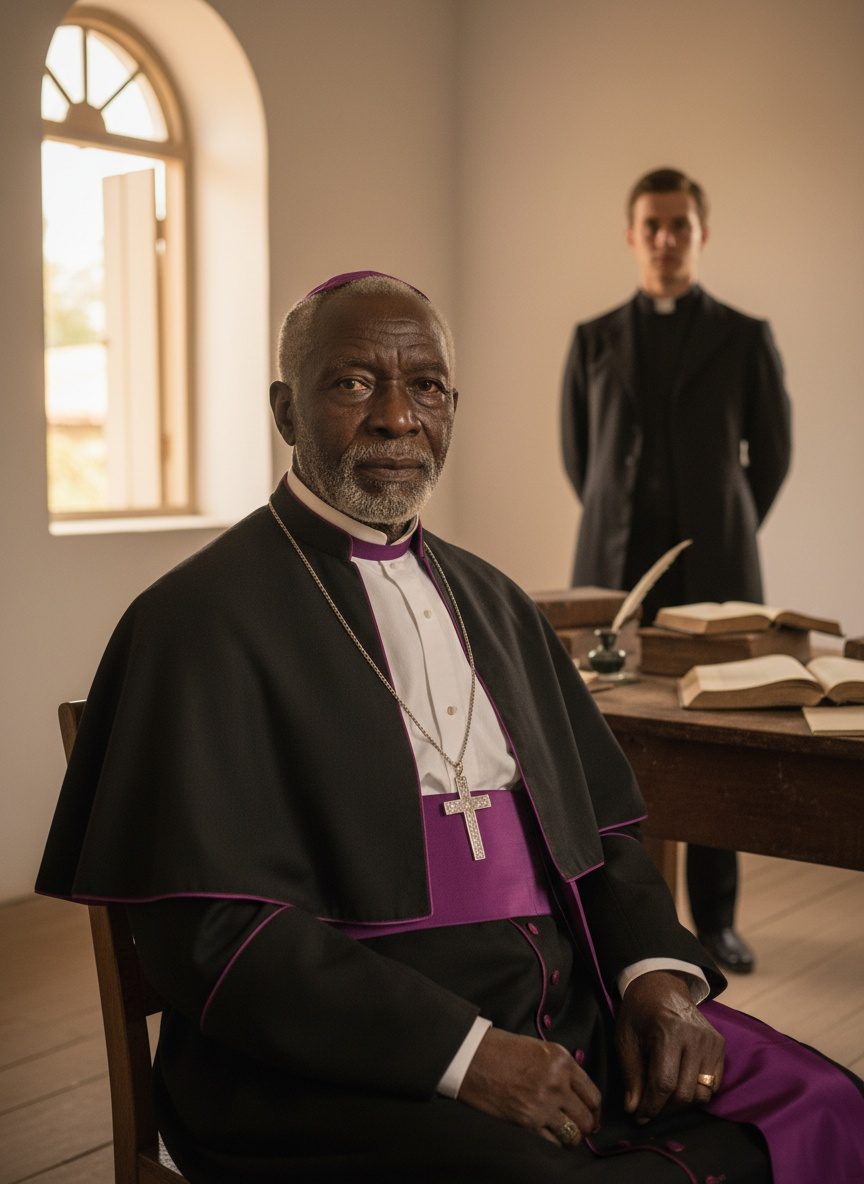
The room felt charged with tension as Samuel Ajayi Crowther stood before his accusers, the worn beads of his rosary clicking softly between his fingers. Shadows flickered across the wooden walls, cast by a single oil lamp that had been carelessly lit — as if the missionaries had been too distracted by their mission to dispel him to consider the ambiance. Crowther, now eighty-three years old, and still every bit the statue of serene authority struggled for calm as he met the stern eyes of the young men who sought to erase his life's work. This confrontation had been a long time coming.
The Making of a Bishop
To truly appreciate the magnitude of this moment, one must retrace the arduous path that led Crowther here. Torn from his village in Yorubaland as a young boy, Crowther was sold into slavery aboard a Portuguese ship. Fortune favored him when the Royal Navy, enforcers of Britain's abolitionist laws, intercepted the vessel. Rescued from the clutches of a life bound in chains, he found himself on the shores of Sierra Leone, where he was given his first taste of freedom and education. It was in Freetown, under the shelter of a mission school, that Samuel was baptized, taking on the name Crowther from one of his benefactors.
His intellect was a force to be reckoned with, a beacon that drew the attention of missionary societies. Crowther's linguistic talents flourished as he mastered English and several African dialects, skills he wielded with precision in his biblical translations. These translations would grant many African natives access to the Scriptures in their own tongues for the first time. His ordination in 1843 as the first African Anglican bishop was a ceremonial apex of achievement — a symbol of the potential for African leadership within the Christian faith.
The Unraveling of Trust
Yet, the glory of Crowther's accomplishments could not shield him from the creeping shadows of colonial scrutiny. By the late 19th century, the Scramble for Africa was well underway, painting the continent in hues defined by distant capitals. With increasing frequency, younger missionaries arrived on Africa’s shores, echoing the imperial drumbeat — and growing increasingly wary of Crowther's autonomy. They saw his African identity and independence not as strengths but as obstacles to complete colonial dominion. These missionaries bore a distinct paternalism, convinced of their civilizing mission and doubting the legitimacy of African leadership.
Crowther’s decision to establish an inclusive church that blended African traditions with Christian rites was radical. For the British missionaries determined to maintain control, his hybrid ministry looked like insubordination. Each year, their calls for his removal grew louder, alleging that Crowther's leadership had become ineffective, even corrupt. With each claim, the problems they concocted bore the unmistakable stench of racial prejudice and cultural superiority.
A Defiant Stand
The meeting room on this charged day in 1890 was the battleground for Crowther's soul and legacy. His accusers, young and self-assured, sat with papers strewn before them — a testament to their perceived organized superiority. Yet, Crowther was not a man easily intimidated. He took the moment in stride, almost ceremonially steadying himself against a carved wooden lectern, his bishop's mitre casting a gentle shadow across the table. As he began to speak, his voice bore the sonority of an elder statesman, honed by decades of sermons and introspective prayer.
“I am the son of the soil and the shepherd of my people,” Crowther declared, his unwavering gaze sweeping across the room. He spoke with the authority of lived experience, recounting the innumerable journeys through dense African jungles and along treacherous rivers to spread the Gospel. With every sentence, he underlined the connection between ministry and cultural identity, advocating for an African church led by Africans, a church that understood Africa's complex societal tapestry.
Unyielding in his conviction, Crowther reminded his audience that his mission had always been God's work — laboring for the souls of his brethren, not for foreign powers seeking to mold Africa in their image. His words stood like a stone wall against the tide of imperialism, a profound retort that resonated with the legacy of the soil beneath his feet.
The Shadows of Colonialism
The aftermath of the confrontation left a bitter taste in the mouths of his detractors. Despite Crowther's defense, their minds were made up, guided by biases that had taken root in unfamiliar ground. The campaign of disparagement that followed saw him gradually undermined, his leadership destabilized until it crumbled. The institutions he had built and nurtured withered as the colonial apparatus seized upon the weaknesses it perceived and exploited them with tactical precision.
Years of dedicated work laid to waste by the relentless churn of colonial machinery — yet Crowther's spirit was undampened. He would continue to serve his remaining days devotedly, a custodian of faith unwavering in the face of adversity. His steadfast resolve remained a testament to the deep roots he planted in the African soil, defying the invaders who sought to uproot it.
The Resonance of Legacy
In contemplating Samuel Ajayi Crowther's story, one glimpses a microcosm of the broader struggles of Africa during the Victorian era. It is a tale rich with the complexities of identity, leadership, and the ever-persistent struggle for genuine independence in the face of overwhelming external force. Crowther's refusal to abandon his people, even when faced with orchestrated repudiation, echoes through the annals of history.
Though the pages of standard history textbooks may overlook Crowther's valiant stand, his story offers invaluable lessons for future generations. It challenges us to examine the dynamics of power, authority, and legitimacy, to appreciate the value of indigenous leadership, and to question narratives designed to undermine it. In the towering figure of Samuel Ajayi Crowther, Africans found a champion of their own making, one whose legacy reminds us that true faith and conviction can weather the fiercest storms.