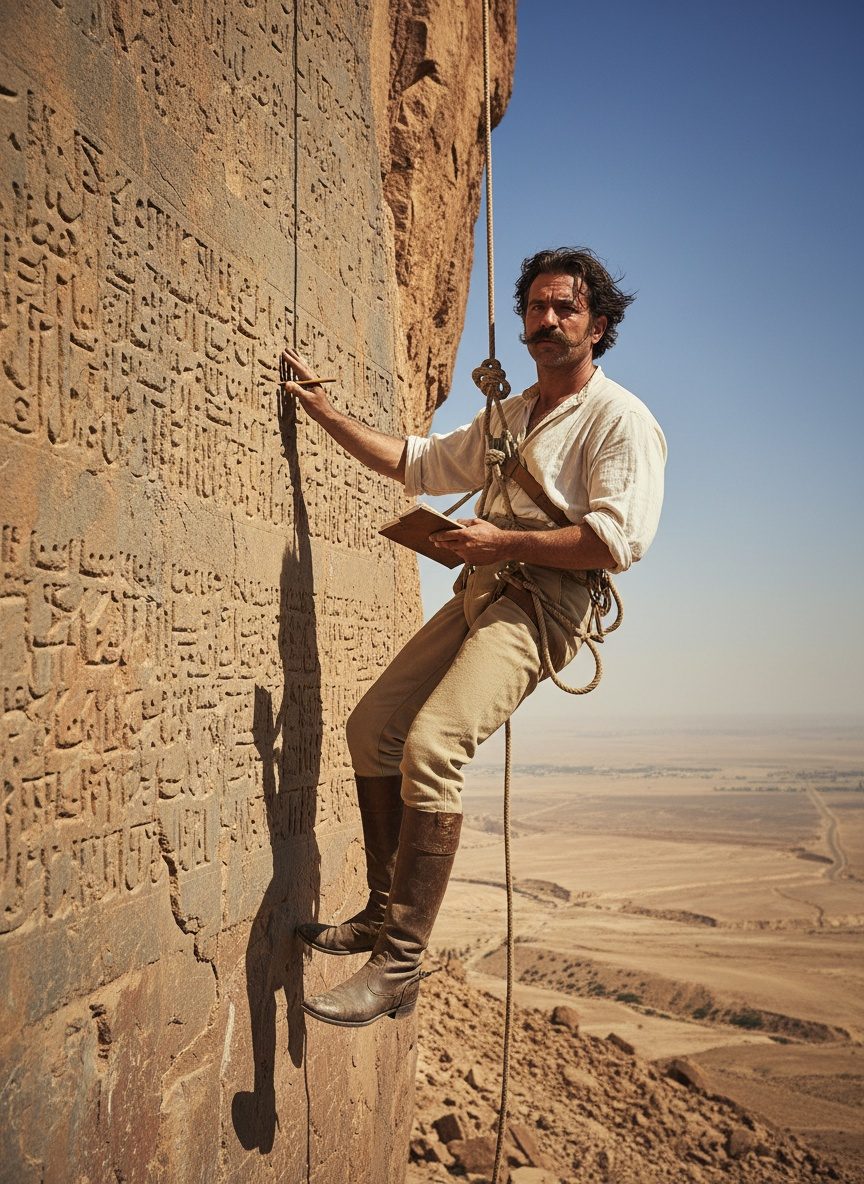
Picture this: A lone figure dangles precariously from the side of a sheer limestone cliff high above the Persian landscape. The searing sun beats down, and the wind threatens his balance. Yet, suspended hundreds of feet in the air, Sir Henry Rawlinson methodically copies an ancient script etched into the rock face, unfazed by the heights or the inherent risk. This Victorian-era British soldier wasn't just risking his life for an adventure — he was on the brink of unearthing a forgotten world from beneath centuries of mystery.
The Unlikely Scholar
It's 1847, and Sir Henry Rawlinson, a British army officer with a keen sense for languages, has found himself in a daring position. Born in 1810 in Chadlington, Oxfordshire, Rawlinson was destined for more than just a typical military career. His early assignments in British India sparked an insatiable curiosity for languages that defied contemporary scholarly constraints. The winds of empire carried him to Persia (modern-day Iran), and there, the resplendent petroglyphs at Behistun sparked a challenge he would spend years unraveling.
Rawlinson was not just an adventurous spirit; he possessed a rare determination and innate linguistic skill. The young officer had taught himself Persian, no easy feat by any measure. But his true ambition lay in the rows of enigmatic symbols climbing the cliffs of Behistun — the cuneiform inscriptions of Darius the Great, which obscured the history of an entire ancient civilization.
The Inscriptions Above
The Behistun Inscription, carved around 520 BCE by order of Darius I, features three languages: Old Persian, Elamite, and Babylonian. Similar to the Rosetta Stone's unlocking of Egyptian hieroglyphs, this multilingual text promised to reveal the forgotten stories of ancient Mesopotamia. Its significance was not lost on Rawlinson, who realized this was humanity’s best chance to decode the Mesopotamian civilization's complex past.
Spanning 15 meters in height and etched into a cliff three hundred feet off the ground, the inscriptions were a daring endeavor of both ancients and modern treasure seekers. Without modern climbing equipment, Rawlinson braved the hazardous ascent, often lowering himself with little more than rope and determination, to painstakingly copy the characters line by line. His task was onerous, and with the threat of losing life and limb ever present, few could have persevered as he did.
A Linguistic Puzzle
Rawlinson's dazzling headway in deciphering cuneiform came from applying the principles of comparative philology. This was no mere parlor game; it was a test of academic mettle, requiring immense linguistic insight and a sharp analytical mind. Despite the high stakes — and higher cliffs — his labor distilled patterns and linguistic elements from Old Persian texts.
By 1838, after years of effort, Rawlinson had completed his first significant breakthrough: translating the Old Persian section of the inscription. Notably, recent research has acknowledged that his work not only shaped the field but also sharpened the precision in modern-day linguistics. His translations were a critical link to the extensive histories of mighty kings of eras past — the origin story of the Achaemenid Empire, under the hand of a ruler who laid down his conquests in stone.
Mysteries Unveiled
The inscriptions revealed more than the intentions of Darius the Great; they unlocked a gateway to a sprawling history. With Rawlinson's work serving as a lighthouse, scholars worldwide flocked to decode the Babylonian and Elamite sections, thereby completing a puzzle that changed historical perspectives. Stories of wars, kings, and cultural exchanges that had been faint echoes were now roaring narratives alive with detail.
The dissemination of Mesopotamian history reshaped Western views of history’s linearity — civilizations weren’t born in Greece, as many textbooks suggested, but flourished under Babylonian skies long before. These profound insights collectively reshaped contemporary perspectives on governance, literature, and even religion, acknowledging Mesopotamia as a historical epicenter of innovation and storytelling.
The Enduring Legacy
Rawlinson’s tenacity and intellect are celebrated not just as acts of individual brilliance but as contributions that fortified the bridge to our ancient past. His achievement became a springboard from which many dimensions of ancient Near Eastern history were launched, from understanding the Epic of Gilgamesh to recognizing administrative marvels of Babylonian law.
In our modern-day world, shaped so indelibly by history and the rapid globalization in Rawlinson’s time, his quest resonates with a reminder: the stories the stones tell are guardians of forgotten knowledge, always waiting for the daring to learn their language. As we unravel histories, what lessons will shape our future narratives?
In unraveling a language thought long-dead, Rawlinson epitomized the Victorian spirit of discovery — tenacious, risk-bearing, and transformative. His work underlined a lesson as relevant now as it was then: the past is never truly lost if we dare to seek it out.