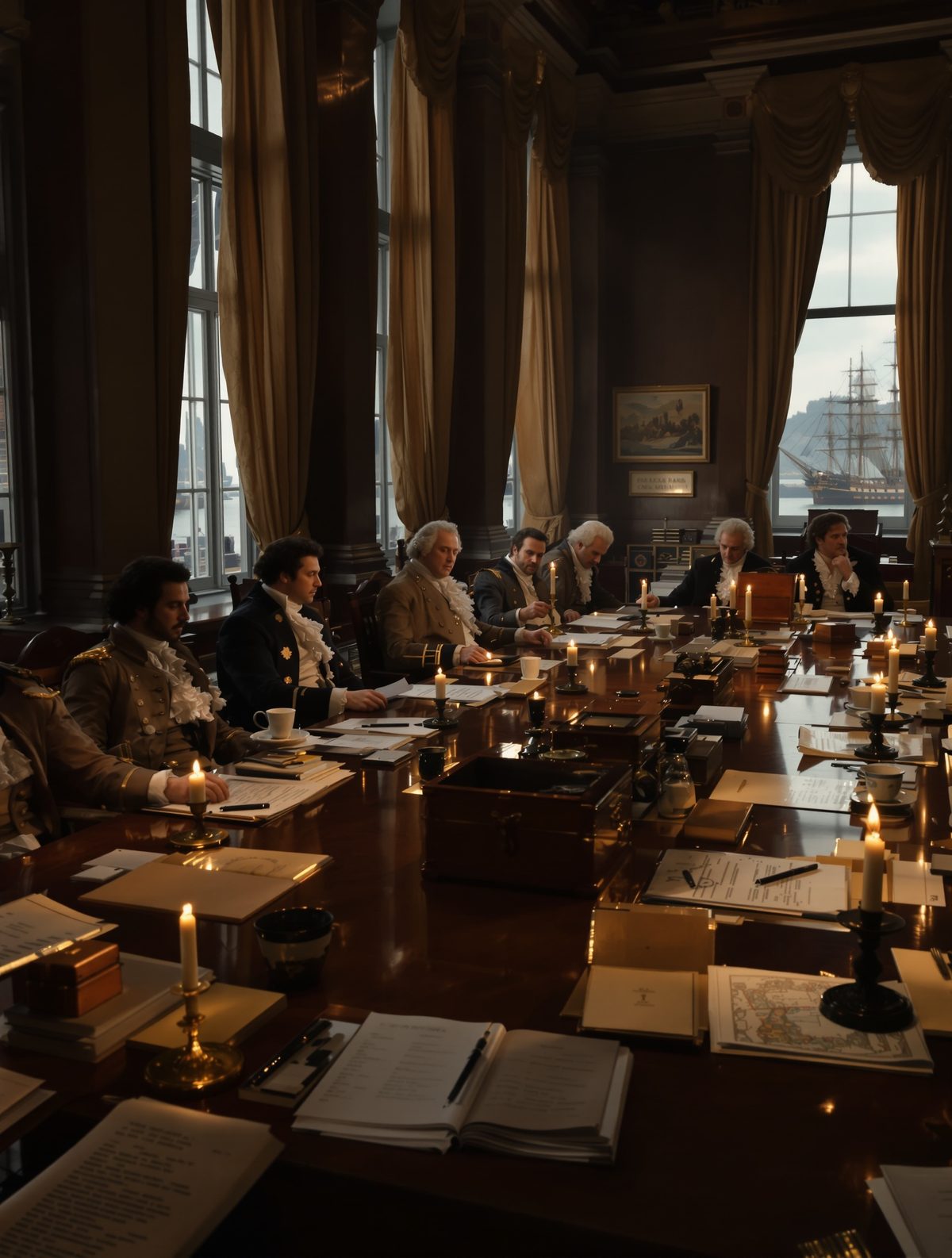
Picture this: A middle-aged English diplomat, sweat beading on his brow despite the December air, approaches the most magnificent court on Earth. Behind him trail servants carrying bolts of rough English wool—laughably modest gifts for an emperor who could buy and sell entire kingdoms. Ahead lies the Diwan-i-Khas, the Hall of Private Audience, where Emperor Jahangir holds court over an empire stretching from Afghanistan to the Bay of Bengal. It's December 1615, and Sir Thomas Roe is about to attempt the most audacious diplomatic gambit in English history.
What happened next would reshape the world. With no army at his back and no fleet in the harbor, Roe was about to secure the foothold that would eventually transform a small island nation into the ruler of the subcontinent. But first, he had to survive a court where one wrong word could mean exile—or worse.
The David and Goliath Mismatch
The numbers were staggering. Emperor Jahangir commanded the loyalty of over 100 million subjects—more people than lived in all of Western Europe combined. His annual revenue exceeded £100 million, making him perhaps the wealthiest ruler in human history. The Mughal military boasted 4 million soldiers, including 40,000 war elephants and artillery that would make European generals weep with envy.
Against this colossus stood England: a damp island of 4 million souls, still recovering from decades of religious turmoil. The newly-formed East India Company had been hemorrhaging money since its founding in 1600, losing ships to storms and investors to bankruptcy. Their previous attempts to establish trade in India had been disasters—the Portuguese controlled the western ports, and Dutch merchants dominated the eastern routes.
But King James I had one secret weapon: Sir Thomas Roe, a man who understood that in diplomacy, perception often mattered more than reality. Roe had studied the intelligence reports flowing back from India. He knew that Jahangir was fascinated by European curiosities, that the emperor collected art obsessively, and most importantly, that he was locked in a complex power struggle with his own nobility.
Entering the Lion's Den
When Roe's dusty caravan finally reached Ajmer in December 1615, he found himself confronting a court that defied European imagination. The emperor's temporary capital sprawled across the desert like a mobile city, housing over 500,000 people. Silk pavilions stretched to the horizon, their walls studded with rubies and emeralds. The imperial kitchen staff alone numbered 3,000, while the royal mint worked overtime producing coins for an economy larger than Spain's.
Roe's English woolens—the finest his country could produce—suddenly looked pathetic beside the Chinese silks and Persian carpets casually draped around the imperial tents. Other ambassadors arrived bearing chests of gold and exotic animals. The Portuguese Viceroy's representative had brought a mechanical organ that played sacred music. What could a wool merchant's son from Hertfordshire possibly offer the world's most powerful monarch?
The answer lay not in what Roe brought, but in how he presented himself. While other envoys prostrated themselves before the emperor, Roe performed only a respectful bow—the same courtesy he would show his own king. When courtiers gasped at his audacity, Roe calmly explained that he represented a sovereign monarch, not a vassal seeking favors. It was a calculated risk that could have ended his mission before it began.
The Art of Strategic Patience
Instead of rushing to negotiate, Roe settled in for what he knew would be a marathon, not a sprint. For three years—three years!—he lived as a guest at the Mughal court, studying its rhythms, learning its languages, and most crucially, understanding its politics. He discovered that Jahangir, for all his wealth and power, was surrounded by nobles who viewed any new trading partners as potential threats to their own commercial monopolies.
Roe's masterstroke was realizing that direct competition with established merchants would fail. Instead, he positioned the English as partners in the emperor's broader strategic goals. When Jahangir complained about Portuguese interference with Muslim pilgrims traveling to Mecca, Roe suggested that English ships could provide safe passage. When the emperor grew frustrated with Dutch merchants' rigid negotiating style, Roe emphasized English flexibility and willingness to adapt to local customs.
But Roe's greatest insight was understanding Jahangir's psychology. The emperor was an aesthete who prized beautiful objects above military conquest. Roe began commissioning portraits of the emperor from the court's finest artists, then casually mentioned that such masterpieces would be treasured in European royal collections. Suddenly, the emperor saw the English ambassador not as a supplicant, but as a gateway to international prestige.
The Breakthrough Moment
The turning point came in early 1618, when a Portuguese fleet attacked English ships in the Arabian Sea. Other European representatives expected Roe to demand immediate military retaliation—the typical European solution to maritime disputes. Instead, Roe proposed something revolutionary: a formal agreement that would prevent such conflicts by clearly defining English trading rights and responsibilities.
This wasn't just clever—it was genius. By framing the agreement as a way to maintain peace rather than gain advantage, Roe made it politically safe for Jahangir to support English interests. The emperor could present himself to his nobles not as favoring foreign merchants, but as a wise ruler preventing costly naval wars that might disrupt the empire's prosperity.
On February 6, 1619, Jahangir issued the firman—the imperial decree—that granted the East India Company the right to establish trading posts throughout the Mughal Empire. The document was elegant in its simplicity: English merchants could trade freely, establish warehouses, and enjoy imperial protection, in exchange for annual tribute and promises to respect local laws and customs.
The Wool That Conquered an Empire
Here's the detail that would astonish Roe's contemporaries: the "worthless" English wool that had seemed so pathetic beside Chinese silk proved to be the treaty's secret ingredient. Roe had discovered that Mughal weavers prized English wool's unique texture for creating certain luxury fabrics. By securing a monopoly on wool imports, the English gained access to India's most sophisticated textile markets—the same industry that would later make fortunes for Manchester mills.
But Roe's true diplomatic masterstroke was what he didn't ask for: territorial concessions. While Portuguese and Dutch representatives demanded fortified bases and extraterritorial rights, Roe sought only commercial privileges. This made the English appear less threatening to Mughal sovereignty, while actually providing more flexibility for future expansion.
When Roe finally departed India in February 1619, his mission appeared modest by contemporary standards. He had secured no military bases, conquered no territories, and brought home no treasure fleets. London investors grumbled that four years of diplomatic expenses had produced only a few sheets of paper covered with Persian calligraphy.
The Foundation of an Empire
Those investors couldn't have been more wrong. Roe's treaty became the legal foundation for every subsequent English expansion in India. When the Mughal Empire began fragmenting in the early 1700s, English merchants could point to their 1619 trading rights as justification for assuming administrative control over increasingly chaotic territories. The East India Company's later claims to collect taxes, maintain order, and govern populations all traced back to precedents established in Roe's carefully worded agreement.
By 1850, the political entity that had grown from Roe's diplomatic patience controlled a subcontinent of 300 million people and generated wealth that financed Britain's transformation into the world's first industrial superpower. The "factory" system that Roe negotiated—small trading posts that gradually expanded their authority—became the template for European colonialism across Asia and Africa.
Perhaps most remarkably, Roe's emphasis on working within existing political structures, rather than against them, created a model of indirect rule that would characterize British imperial administration for centuries. The colonial officers who later governed vast territories with tiny bureaucracies were unconsciously following principles that Roe had pioneered in Jahangir's court.
Today, as diplomats navigate complex international negotiations, Roe's legacy offers both inspiration and warning. His patient, culturally-sensitive approach achieved remarkable success through understanding rather than force. Yet the empire that grew from his diplomatic seeds would eventually collapse under the weight of its own contradictions, proving that even the most brilliant short-term solutions can create unforeseen long-term consequences. In our globally connected world, where soft power often matters more than military might, Sir Thomas Roe's three-year masterclass in strategic patience remains surprisingly relevant—a reminder that sometimes the most profound changes begin with a simple conversation between strangers.